
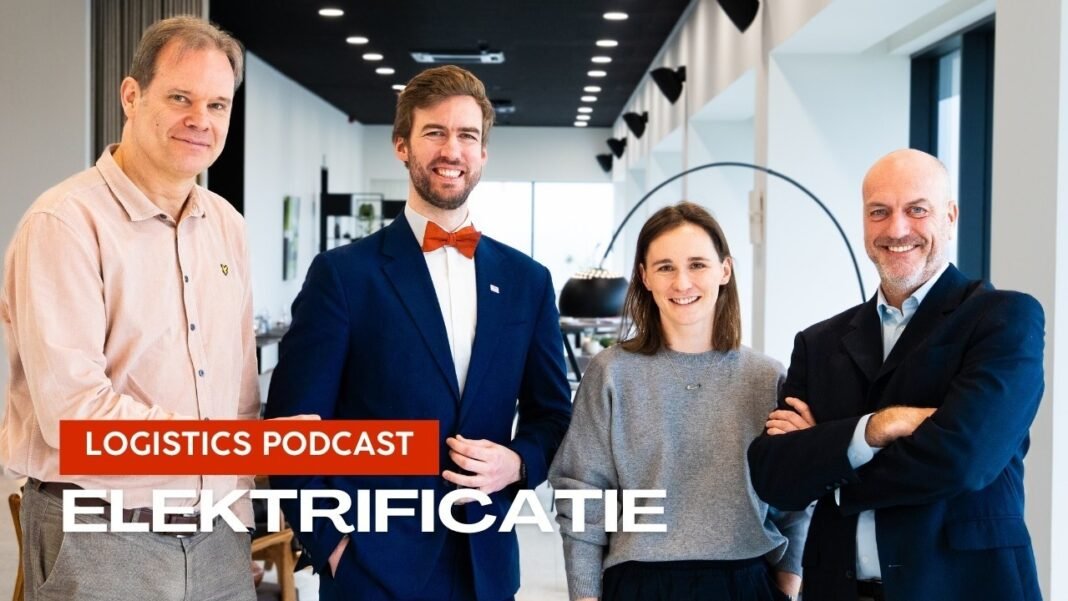

Electrification is central to logistics today. What started years ago with solar panels on warehouse roofs and a few electric vans is rapidly evolving into a complex energy system that unites transport, buildings, storage and grid capacity. With Sofie Gorlé (Arcade Group), Mattijs Plettinx (WDP) and Dirk Van Buggenhout (Montea) we discuss how companies best prepare for these challenges.
Logistics Management: Electrification in logistics, is it a must today or still a choice?
S. Gorlé (Arcade Group): It’s definitely a must, but it’s hard to find the right time. We are at a tipping point. Don’t wait until it’s too late. The investments you make today will also last a long time. They must sit correctly.
LM: How does Montea advise its customers on electrification?
D. Van Buggenhout (Montea): Logistics traditionally has relatively low electrical consumption, but a lot of potential for solar energy. Both Montea and WDP have already used this very well. Today, many sites consume less than the sun generates. At the same time, the electrification of transport is coming. You have to look at this together: how do you become an electricity hub in addition to a logistics hub in the future? From a sustainability perspective, we believe it is important to first use energy as efficiently as possible and to reduce it where possible. We want to keep the generated solar energy local.
LM: Is that also the case at WDP?
M. Plettinx (WDP): Absolutely. It is mainly a matter of timing. We start now, otherwise it will be too late. This is a beautiful moment because all the pieces of the puzzle come together. We used to install solar panels and consumption was low. Today, electrification of vehicles and more automation are added. It all clicks together now. This is the time to put the puzzle together properly, both at site level and across the entire portfolio.
LM: Who is driving that electrification story? The tenants or you as the landlord?
M. Plettinx: Some customers say very clearly what they want, but many do not yet know where to start. Installing solar panels is simple, but once you go further, you really have to work together with your customers.
D. Van Buggenhout: For us, the initiative currently lies relatively little with customers. There are forerunners, with electric vans for example, but when it comes to the combination of building, heavy transport, renewable energy and storage that is a different story. We certainly want to invest now, because things can happen very quickly if the switch to electrification of trucks comes about. We also saw that speed in electric passenger cars.
Scarcity in grid capacity
LM: How can companies prepare for that?
S. Gorlé: Your electrical infrastructure must be prepared for the necessary power. Network capacity is an important and complex factor, because it is scarce and expensive. Reserving capacity that you don’t need seems unwise to me. Energy must also be predicted and consumed immediately, any deviation between production and consumption has an impact.
LM: Should an energy audit be done first?
S. Gorlé: In a way, yes. Every site and every customer is different. You must optimize the dimensioning of connections, batteries and charging infrastructure, because that determines profitability.
D. Van Buggenhout: We enter into discussions with customers, grid operators and partners to see what is possible in the short and long term. Investing without a vision of the future makes little sense. It must be done in a coordinated manner with all stakeholders.
M. Plettinx: At WDP, audits certainly do their job, but we are increasingly moving towards live monitoring. The market is changing so quickly that continuous measurements are necessary. As a developer, you also invest for today’s customer, while the situation may be different tomorrow. That is why we are taking steps now, even though we do not know everything perfectly.
LM: How flexible is the energy infrastructure if another tenant comes later?
S. Gorlé: Flexibility is indeed crucial. The preconditions are somewhat fixed, but you must ensure today that local electrification works if there is a need for local charging later.
D. Van Buggenhout: Just as you do not design a building for a single tenant, the energy infrastructure must also be modular. If there are transformer rooms, we make them large enough so that an additional transformer can be added if necessary. And if there are charging facilities, we provide the necessary waiting pipes for any additional cables afterwards.
M. Plettinx: There is no ideal business case for building in that flexibility. It is mainly about modularity to make that growth possible. With WDP we also build for a certain type of customers. Sometimes we know, depending on region or industry, what they can be used for. We are trying to add that layer of electrification, so that it gives more options.
LM: What about slow charging versus fast charging?
S. Gorlé: Today, slow charging is the most economically profitable. Network capacity and rates make fast charging difficult. That feels a bit counterintuitive, but it is reality. You should keep the option of fast charging open in the future.
D. Van Buggenhout: You don’t install a fast charger at every house for electric company cars. On our sites we mainly focus on slow charging, with possibly some fast chargers.
M. Plettinx: If you look at the ‘total cost of ownership’, that approach sometimes clashes with the customer’s reality. Some customers require fast charging to remain operational. You then have to make that decision together.
D. Van Buggenhout: With trucks we are talking about megawatt capacities, which the grid is not currently equipped for. Energy storage therefore becomes necessary to absorb peaks.
Race for capacity
LM: Are there sectors where electrification is accelerating?
D. Van Buggenhout: Parcel deliverers and urban distribution, for example, are leading the way. They have no choice. Cities are almost closed to vans with combustion engines. Other sectors are still hesitating, especially in heavy transport, due to the high cost of e-trucks. But the transition is coming there too.
M. Plettinx: Electrification is also faster with new buildings. This is a lot more difficult for older buildings. In such warehouses, greater sustainability is a much greater challenge.
LM: Is grid congestion already a brake today?
S. Gorlé: Yes. We are in a race for energy capacity: everyone is requesting an increase without really knowing what they need. That creates scarcity. The procedures for a permanent connection are also taking longer and longer.
D. Van Buggenhout: Sometimes an energy connection even takes longer than a permit. We are almost starting to do this before we can even submit a permit application.
M. Plettinx: In contrast to the Netherlands, where grid congestion is really acute, the problem in Belgium today seems to me to be more virtual than physical. In Belgium it is unevenly distributed, which creates uncertainty. This means that everyone requests as much capacity as possible. We therefore proactively discuss our plans with grid operators. We want to be part of the solution, not part of the problem.
LM: The energy story is becoming increasingly complex: peaks, price differences for electricity during the day and night, etc. Do companies need guidance?
S. Gorlé: Definitely. Logistics has an advantage in this regard, precisely because there is often local energy production via solar panels. This offers opportunities to organize energy smartly. But it remains complex. You have to be able to predict and coordinate everything, because every fifteen minutes there is a moment of energy supply.
D. Van Buggenhout: We really want to relieve our customers of this. We handle everything that has to do with energy – contracts, predictions and management, storage – as much as possible. So that the customer can focus on his core business.
M. Plettinx: Ultimately, energy for customers should be green and simple. That’s the end goal. While reality is more complex than ever, today there are solutions to automate and hide that complexity, through predictions and smart management.
This podcast was recorded at La Vue, de B2B event location on the top floor of the company building of ‘Kris De Leeneer (KDL) | logistics, different’ in Lokeren.
More info: https://deleeneer.be/lavue/
The participants
- Sofie Gorlé is Head of Energy and co-shareholder at research/engineering firm Arcade Groupwhich her father started.
- Mattijs Plettinx is Global Head of Energy & Sustainability bee WDP, investor in and developer of logistics real estate.
- Dirk Van Buggenhout is Chief Sustainability Officer at Monteainvestor in and developer of logistics real estate.

