
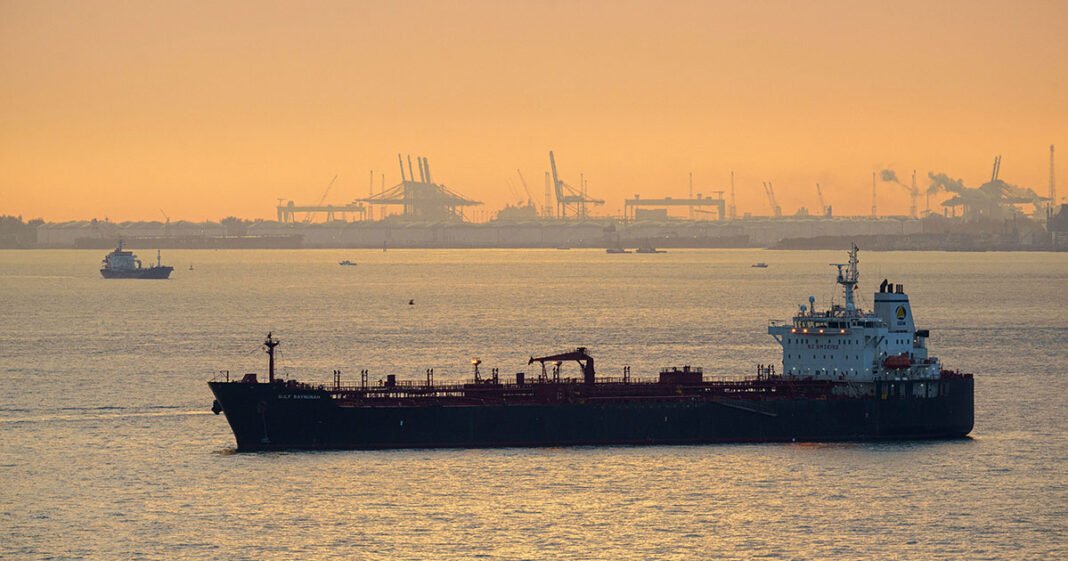

An oil tanker off the shore of Singapore on March 17. (Ore Huiying/Bloomberg)
April 1, 2026 4:35 PM, EDT
Soaring fuel prices from the Iran war are forcing oil traders into longer, stranger journeys, sending cargoes on routes that would normally make little economic sense.
Consider the STI Solace, a 250-meter-long tanker now motoring past West Africa carrying diesel, according to a person familiar with the matter. After loading off the U.K. in the latter half of March, it’s about a third of the way through a trip of more than 12,000 miles to Australia, tracking data from Energy Aspects and Signal Ocean shows.
RELATED: Oil Prices Fall on Renewed Hopes of End to Iran War
What makes the shipment particularly eye-catching is the direction of travel: Europe generally pulls in diesel rather than exporting it. But while Europe’s diesel benchmark has soared since the war began, prices in Asia have jumped even more, meaning it can still make sense to send a cargo thousands of miles across the globe.
“Everything about this market is wild,” said Philip Jones-Lux, a senior oil analyst at energy analytics firm Sparta Commodities. “Europe is still short of diesel, but the situation in Asia is so much more acute that prices there are pulling barrels halfway around the world.”
RELATED: How Should Reefer Fleets Tackle the Diesel Double Whammy?
War in the Middle East is roiling global oil supply chains, depriving the market of millions of barrels of crude and refined fuels such as diesel. Disruptions stem from both the closure of the Strait of Hormuz and reduced refinery processing rates in some areas. The International Energy Agency has called it the biggest supply shock on record.
The result is a global tug-of-war for fuel, with traders scrambling to secure supplies. March flows are already beginning to reflect how quickly the market is adjusting after the conflict’s late-February onset. The longer the Strait of Hormuz remains closed, the more intense the competition is likely to become. Traders have warned that Europe is at risk of diesel shortages in the coming weeks.
Australia has been hit particularly hard. Panic buying, especially in rural areas, has driven up demand and left some service stations out of fuel. The government has urged conservation, blaming the shortages on hoarding rather than underlying supply disruptions.
Yet the STI Solace isn’t the only vessel headed to that part of the world. Multiple tankers — including the Largo Eagle, CL Zhaoge and Hansa Sealancer — recently loaded refined products on the U.S. Gulf Coast, transited the Panama Canal and are now motoring toward Australia, according to Vortexa and ship-tracking data compiled by Bloomberg News. Several more vessels from the U.S. West Coast are either en route or preparing to sail.
The ships are hauling a mix of refined fuels, including gasoline and diesel. If all of them continue on to Australia, March will have seen by far the largest exports on this route since at least 2015, Vortexa data shows.
A journey from the east coast of the U.K. to Sydney normally takes just under 40 days, according to Signal Ocean data.
Parts of Asia are also drawing unusually longhaul shipments as prices there surge far above other regions.
The Clearocean Marauder is sailing from the U.S. West Coast to Singapore with diesel, a route that hasn’t been used for such cargoes since late 2024, according to Kpler data.
Another vessel, the Metro Mistral, is heading to Pakistan after loading gasoline in Europe, according to Vortexa. Assuming the cargo arrives, European March exports of the fuel to Pakistan will have hit their highest for any month since 2023, the data shows.
Those vessels come on top of a host of ships that changed course in the Atlantic — veering away from Europe and toward Africa — part of a wider reorientation of the global oil market as fallout from the Iran war continues.
“Lack of exports via the Strait of Hormuz and run cuts in Asia are keeping diesel prices in the region relatively stronger versus those in Europe, pulling cargoes away from them,” said Natalia Losada, an analyst at Energy Aspects.
Written by Jack Wittels, Serene Cheong and Alex Longley

