
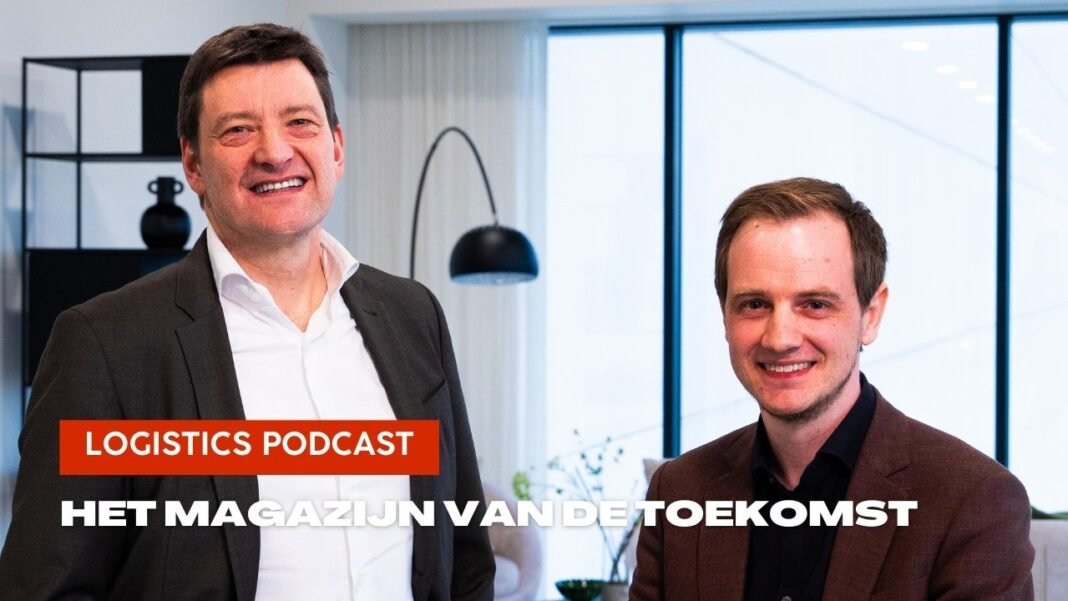

The warehouse of the future will be higher, more compact, more energy efficient and – above all – automated. This is evident from an animated podcast conversation with Roel Vanmaele (Eutraco) and Karel Boone (Movu Robotics). “Artificial intelligence in warehouse software will significantly increase the productivity of automation.”
Logistics Management: Today’s warehouses must be able to store as much as possible, run as quickly as possible, use as little energy as possible and be built as sustainably as possible. How realistic is that?
Roel Vanmaele (Eutraco): Indeed, these challenges sometimes contradict each other. Capacity is not always conducive to productivity. The larger the warehouse, the longer the distances, horizontally and vertically. And the higher the occupancy rate, the lower the productivity. It comes down to finding a balance between productivity and footprint.
Warehouses are also becoming increasingly higher: previously 6 meters, then 9 and 12 meters. And today you must have at least 13.7 meters. As you go higher, automation is a necessity. In the Krommebeekpark in Roeselare we combine a fully automated pallet warehouse with 39,000 pallet places and 9,000 conventional places. The automated part goes towards a height of 28 meters, which keeps your footprint small and still allows you to store a lot. We also generate as much of our own energy as possible and work with ‘energy storage systems’ to store it. We also charge smartly with an energy management system.
L.M.: This approach is especially effective new construction projects? Or can it also be done in existing warehouses?
Karel Boone (Movu Robotics): We also help customers in brownfield projects. There is not much room left for new construction, certainly not in Flanders. And you can also automate in low-rise buildings and on an existing floor. It often remains a hybrid solution: partly automated, partly conventional, so that you retain flexibility and can also store the pallets that do not fit in the machine.
L.M.: Does that seem more complicated to me in a brownfield than in new construction?
K. Boone: They are different challenges. For example, you may have an existing floor that is not perfect and that you need to take into account to get your rack and installation to fit. But that is not ‘more difficult’ than constructing a high-rise building, just different. What is sometimes more difficult: achieving the same ROI, because you can often fit fewer pallet spaces on the same square meters than in a high-rise building. Another challenge: integration with ongoing operations. If you are doing an automation project in an existing warehouse, the operation usually needs to continue running. This requires extra attention to safety and limiting disruption.
Nutrition versus chemistry
L.M.: In which sectors is a lot of automation taking place?
R. Vanmaele: Food lends itself well to automation, especially if the shipper produces nearby. Then production and packaging usually take place very automatically. This produces beautiful, uniform pallets within the dimensions, which is easier to automate. Chemistry is more difficult. You have more risk considerations there, especially in a fully automated high ‘dark store’ warehouse. In addition, pallets are more outsized, with different dimensions, and there are usually many ‘value added services’: sagging, repacking, etc.
K. Boone: Movu also mainly started with food, including in the frozen sector in Flanders. This is extra interesting because dense storage is even more important there: every cooled cubic meter costs money. The closer you store, the more you save in footprint and energy costs.
L.M.: The user of a warehouse today will often no longer be the same in 5 or 10 years. Does that make automation more difficult?
K. Boone: You have to think about that from the start. We work with many 3PL customers who deploy ‘multi customer’ installations. The most important thing is that you keep your parameters generic enough: pallet dimensions, weights, heights… If you work with different height classes (1.8 m, 2.1 m, 2.4 m) and a pallet weight around 1 to 1.2 tons, and you are not too strict on details such as the ’tilt position’, then you can serve many customers.
R. Vanmaele: Beats. You can build generic automated warehouses and you do not always have to go for ‘full automation’. Today there are flexible, semi-automatic and easily accessible automation projects. We also consciously look for customers in a clearly defined target group.
L.M.: Does automation also help to consume less energy?
K. Boone:With almost every automation project, the question arises: what is the energy consumption, what does peak consumption look like, and what is the advantage compared to traditional ‘fixed automation’, such as cranes? One: we already have a strong advantage over the conventional approach, purely through physics. We use a shuttle of approximately 350 kg to move a pallet of up to 1.5 tons: that is energy efficient! Two: because it is battery powered, you can smooth out peaks. You can have shuttles charged at cheaper times. Combined with density, especially when frozen, you can easily save a factor of four to five compared to traditional solutions.
L.M.: Regarding maximum storage capacity and automation: how do you ensure that operational flexibility remains sufficient?
K. Boone:In our case it is often about filling level versus flexibility. We work with multi-deep storage: channels with pallets in a row. This is ideal for larger ‘batches’ of the same goods, but it means you cannot simply get a pallet ‘in the middle’. If you push such a warehouse to 100% full, there is little flexibility left. That is why intelligent design is important: variation in channel depths based on order profiles, batch sizes and call-off behavior. The advantage of shuttles is that they can perform different tasks at night than during the day. They can ‘defrag’ the warehouse overnight by regrouping half-full channels into full channels. This way you create flexibility in the system again. And we also advise not to place 100% of your volume in an automatic warehouse. For example, keep 10% in a conventional part, so that you can also handle exceptional pallets (‘uglies’).
R. Vanmaele:As a logistics service provider, you calculate your warehouse costs in such a way that you are profitable around 80% occupancy rate. From 90% onwards you often start to give away profits in storage in lost productivity. So you want to stay between 80 and 90%. That’s a challenge. We have had periods when everything was full, but today there is a lot of available space again. It is not easy to maintain that bandwidth.
Conflicting seasons
L.M.: Are you looking for new customers when occupancy becomes too low?
R. Vanmaele:You specialize in a target group to have market knowledge, but you don’t just want customers with the same seasonal peak. That’s why you look for customers with conflicting ‘seasons’. Scale and a ‘multi customer’ approach help to absorb fluctuations: if things go poorly for one customer, hopefully things will go better for another.
K. Boone:We believe in scalable automation. If your filling level is not constant, seasonal or because you still have to build up, you want a solution that grows with you. Hence our shuttle solution: you start with what you need today and scale up by adding shuttles as your volume grows. You can temporarily use shuttles during peaks. And you can reduce it again when it is calmer.
L.M.: What will really make warehouses more sustainable, energy efficient and also space-optimal in the future?
R. Vanmaele:We must focus on more horizontal cooperation: bringing together shippers, as well as major recipients, such as retailers, to better coordinate our activities. The logistics service provider can be a facilitator in this, because he works with both the shipper and the recipient.
K. Boone: The job in the warehouse is changing fundamentally. Routine tasks disappear: the operator becomes more of an ‘advanced machine operator’. You will soon manage a smart installation with thousands of pallets, various software layers and hardware components. That requires ‘reskilling’ and training. AI in warehouse software will also achieve much more productivity from automation and make automation possible in more complex situations. An example: today we often check pallet quality once before the pallet enters the installation. But shuttles ‘see’ pallets all the time, dozens of times a day. You can monitor pallet quality continuously instead of just once. Many of these AI building blocks together make a warehouse smarter, more profitable and more logical to use.
The participants
- Roel Vanmaele is Chief Commercial Officer at Eutraco, which will celebrate its 60th anniversary next year. Of the 650,000 m² of warehousing, 600,000 m² is located in Flanders and 50,000 m² in Calais
- Charles Boone is Commercial Director North-West Europe at Movu Roboticsthe automation arm of the Stow Group, the largest rack manufacturer in Europe.

