
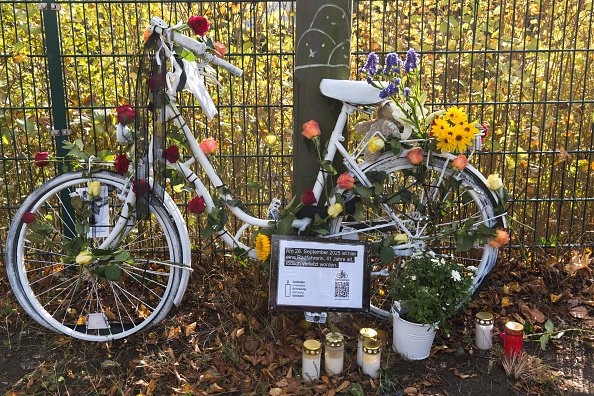

Almost 2,000 cyclists across Europe never returned home after setting out for a ride in 2024 – most of them killed in crashes involving motor vehicles, often cars.
Protected bike lines and stricter speed limits where cars and bikes share the road are essential to reduce this death toll, the European Transport Safety Council (ETSC) concludes in an analysis of the data published on Tuesday.
“You cannot ask people to cycle and then fail to protect them from fast-moving traffic,” said Jenny Carson, one of the co-authors of the Brussels-based road safety organisation’s study.
Brussels has been actively promoting the use of bikes as a sustainable and healthy form of transport since at least 2023, when the European Commission published the European Declaration on Cycling.
Killer cars
Cars are involved in 44% of cycling fatalities. In 28% of cases, cyclists died without hitting another vehicle, but clashes with lorries, vans, motorcycles and buses collectively account for 21% of cyclist deaths. Other bicycles are involved in 3% of cases.
The overall death toll on Europe’s roads is gradually declining, but the ETSC’s study indicates that cycling fatalities have fallen at a much slower rate than those of other road users between 2014 and 2024.
While the number of cyclists killed in 2024 – 1,926 – was down by 8% over the decade, the number of car and other motor vehicle drivers who died in traffic accidents fell by 19%, while pedestrian fatalities were 31% lower.
The report’s authors said this translated into an annual 2% reduction in deaths among motor vehicle users, while for cyclists the figure was only around 0.5%. “Achieving the EU target of halving road deaths by 2030 would require an annual reduction of 6.5%, far higher than current trends,” they concluded.
But while every road death is a tragedy in its own right, the slow reduction in cyclist deaths could also be influenced by a likely sharp increase in the number of Europeans cycling more regularly – a variable which the study fails to provide for across all countries.
Deaths up
In France, for example, cyclist deaths have increased by an average of 4.7% per year between 2014 and 2024, but just in the years between 2019 and 2023 alone bicycle use increased by 37%, especially in towns and cities.
The ETSC noted that cyclists’ deaths are on the rise in some of the countries where cycling is most widespread – such as Germany, Belgium and the Netherlands.
There are ways to reduce the danger, of course – simply wearing a helmet could slash fatal head injuries by 72%, the report said.
In praise of slow
The ETSC’s call for the speed limit in urban centres to be reduced to 30 km/h – an idea that has been widely tested across Europe – appears to be supported by the data.
A survey by Eurocities, which represents over 200 large cities including Paris, Berlin and Rome, found that a large majority of those that adopted a 30 km/h limit were seeing positive results in terms of reduced injury and death on the roads.
Moreover, nine out of 10 of the of the 38 cities survived, reported “at least one positive impact on urban life.”
Eurocities also highlighted encouraging data on the political cost of reducing road speed limits: although often vehemently opposed when first put forward, public acceptance typically increases as citizens get used to a new normal.
“Once people experience the benefits of safer, calmer streets, support grows quickly and resistance fades,” the deputy mayor of the Italian city of Bologna, Michele Campaniello, said in a statement.
“While there were initial challenges and scepticism, the results are clear: safer roads, calmer traffic and a better urban environment for everyone,” he said.
(rh, aw)

