
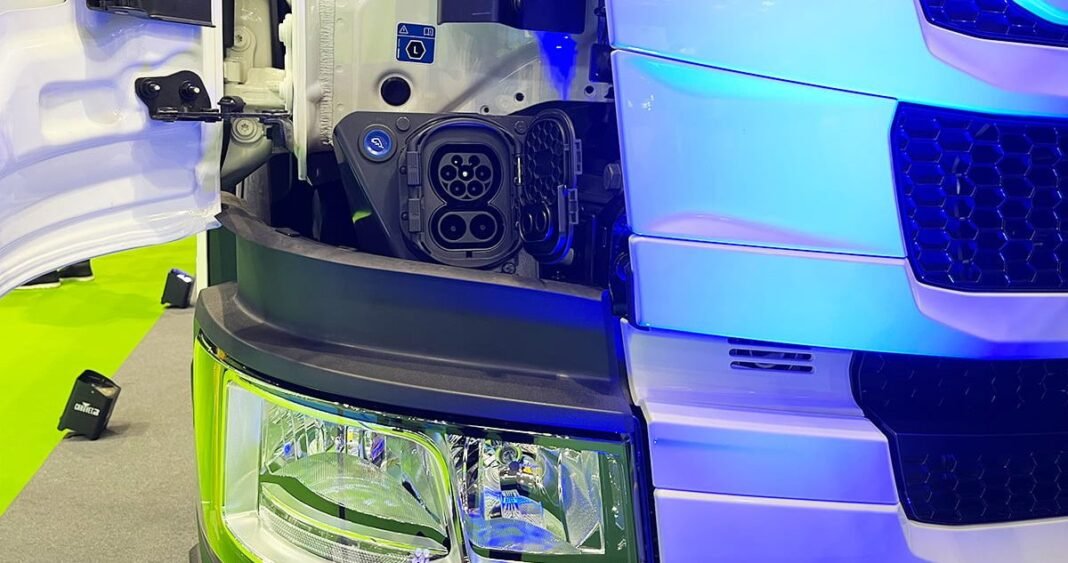

The UK government is being urged to ensure HGV operators can access every available technology to reduce carbon emissions, as industry leaders warn that a narrow approach risks slowing progress and increasing costs.
Speaking at the Commercial Vehicle Show 2026 in Birmingham, Mike Hawes, Chief Executive of the Society of Motor Manufacturers and Traders (SMMT) called for a balanced, technology-neutral strategy to support the decarbonisation of road freight. The event brought together major manufacturers and fleet operators to showcase the latest innovations and discuss the future of sustainable transport in the UK.
New figures from SMMT highlight the scale of the challenge. Zero emission vehicle (ZEV) uptake in the HGV sector has fallen sharply, accounting for just 0.9% of new registrations in 2026, down from 1.4% in 2025. The decline underlines the early-stage nature of the transition and the urgency of accelerating adoption to meet the UK’s target of a fully zero emission HGV market by 2040.
Despite this slowdown, manufacturers have already brought more than 40 zero emission HGV models to market, ahead of natural demand. These vehicles span over 70 different use cases, reflecting the complexity of the sector, which includes everything from bulk tankers and refuse trucks to construction vehicles, agricultural machinery and emergency service fleets. This diversity presents a far greater challenge than the comparatively uniform passenger car market.
HGVs play a critical role in the UK economy, responsible for moving more than 80% of all freight, including food, medicines, retail goods and construction materials. However, the path to decarbonisation is hindered by several significant barriers. These include the high upfront cost of zero emission vehicles, the need for extensive depot infrastructure upgrades and rising energy prices, which affect operational costs.
Infrastructure remains one of the most pressing concerns. Grid connection delays for large-scale projects can stretch to 15 years, while there are currently only around 10 public charging stations suitable for zero emission HGVs across the UK. Such limitations present a major obstacle to widespread adoption.
According to the SMMT, mandating a rapid shift to ZEV-only sales without addressing these challenges could destabilise the market. It warns that such an approach risks increasing costs for businesses, slowing fleet renewal and ultimately delaying emissions reductions.
Instead, the organisation is advocating for a more flexible pathway. Building on existing CO2 regulations—which are already expected to deliver a 30% reduction in HGV emissions by 2030—the SMMT proposes a strengthened target of 64% by 2035, followed by a full transition to zero emission vehicles by 2040. This phased approach would allow operators to adopt a mix of technologies, reducing emissions more quickly while maintaining commercial viability.
Crucially, the SMMT stresses that long-term policy support will be essential. Schemes such as the Plug-in Truck Grant and the Depot Charging Scheme must be extended and expanded to cover all HGV segments. In parallel, the government is being urged to develop a comprehensive national infrastructure strategy, including faster planning approvals for depot upgrades and accelerated rollout of public charging networks.
Without these measures, the industry warns that limiting operators to zero emission vehicles alone could drive up costs across the supply chain, with knock-on effects for businesses and consumers alike.
Mike Hawes, Chief Executive of the SMMT, said: “The HGV industry is fully committed to decarbonisation, having already delivered zero emission models years ahead of natural demand. But while the goal of net zero by 2050 remains, we need a pathway that is realistic, affordable and delivers CO2 savings now. Government regulation must recognise the complexities of this critical market, which are far greater than the car or van sectors, and with so much of our economy dependent on freight, the priority must be to cut carbon in ways that accelerate fleet renewal without driving up costs.”
As the UK pushes towards its net zero ambitions, the message from industry is clear: achieving a cleaner freight sector will require not only innovation, but also pragmatic policy, infrastructure investment and a willingness to embrace multiple technological solutions.

