
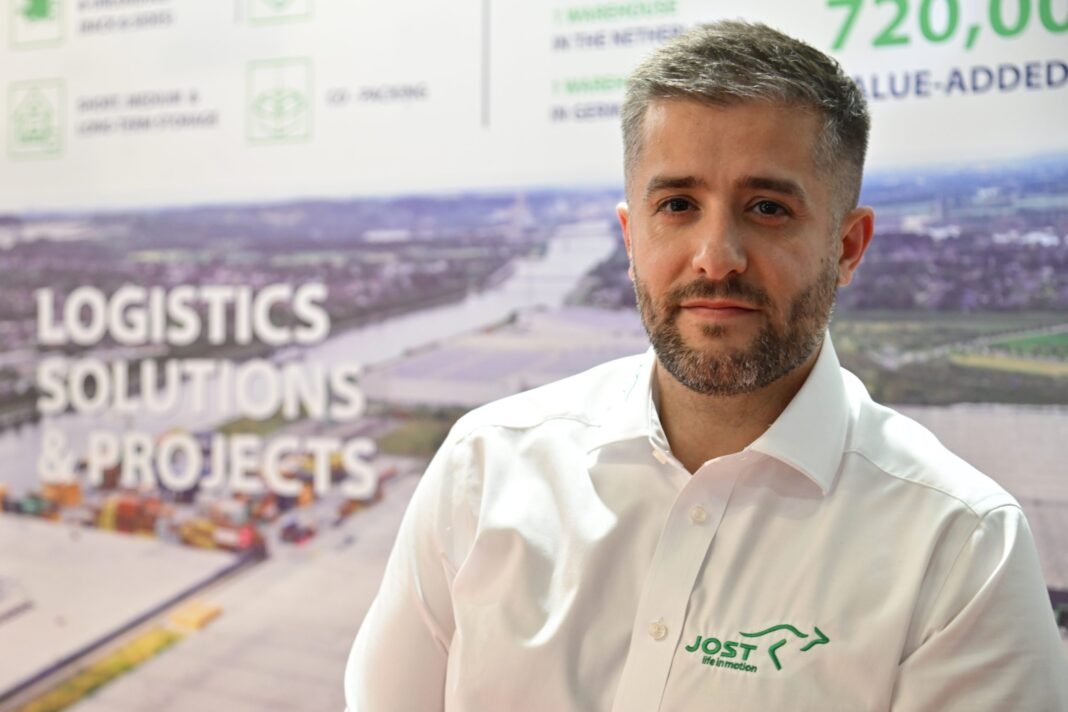

When you say Jost, you automatically think of the green trucks, ubiquitous on our roads. But behind this well-known transport image lies another dimension: a logistics activity in full growth, but rarely in the spotlight. However, this division is today one of the most important players on the Belgian market. We spoke with Mario Merli, Chief Logistics Officer of Jost, to get an update.
Can you briefly outline the logistics activities of Jost Group?
Mario Merli: Jost Group started with logistics 25 years ago. These activities have gradually grown, and today we have 14 sites with a total surface area of 710,000 m². Twelve of them are in Belgium, one in the Netherlands (Maastricht) and one in Germany (Eschweiler, near Aachen).
In Belgium, the logistics activities are mainly located in the Liège region: Trilogiport, Bierset, Herstal and Battice. In addition, there are three sites in the province of Luxembourg – Aubange, Messancy and Molinfaing – and one in Hainaut, in Ghlin. In Flanders we are active in logistics through the acquisition of Verbessem in Waarloos (2015), Be-Trans in Geel (2021) and last year Handico International in the port of Antwerp. I’ll come back to that in a moment.
What place does the logistics division take within Jost?
M. Merli: She represents 12.5% of the group turnover. This growth will continue in the coming years, as we aim for double-digit annual growth. Just like in transport, by the way. Today we employ 350 people, a number that can rise to 450 in peak periods. Transport and logistics are increasingly functioning as communicating vessels: a transport activity can create a logistics need, and vice versa. Sometimes in a marginal way, sometimes in an essential way.
To date, growth has been both through acquisitions and organically. What will be the priority in the future?
M. Merli: Our priority is growth, without placing one method above the other. We want to expand further and have the resources to invest. If opportunities arise, we will certainly make further acquisitions. But we also have important opportunities for organic growth. After all, we have a considerable land reserve: 300,000 m² that we can build on our own sites, strategically excellently located. In several cases we can build additional buildings of 30,000 m².
I would like to emphasize that our growth has accelerated significantly since 2017 and that we have even doubled our logistics area in the past four years. A real cultural change has taken place: logistics is now seen as an essential activity, fully integrated into our identity. Jost has grown into a full-fledged 3PL.
Trilogiport
Is Trilogiport your flagship site?
M. Merli: Absolutely. We currently operate 170,000 m² of buildings there, which will expand to 220,000 m² in January. The location is ideal – at the crossroads of Belgium, the Netherlands and Germany – and the trimodal connections (inland shipping, road and rail) are a huge advantage. Trilogiport is a tailor-made logistics tool thanks to its quays and excellent road infrastructure. Container freight moves quickly from inland shipping to the depots, from where the goods are easily distributed to the hinterland.
The position is mainly international. For example, we provide logistics for a large German FMCG group. The containers from Asia are unloaded in Antwerp and go by barge via the Albert Canal to Trilogiport. There they are unloaded and placed on a chassis, which is driven to our warehouses by a terminal tractor. There the containers are stripped, the products are placed on pallets, stored and then transported to the customer’s distribution centers. This is a significant activity: for this customer alone we process 50 containers per day, each good for 1,800 packages. This means that we handle 90,000 parcels per day in Trilogiport, on 70,000 m². This concerns a wide variety of non-food products: do-it-yourself materials, household appliances, kitchen items, promotional items, etc.
We have also developed a polymers activity in Trilogiport for a customer, which has served as a magnet for other chemical companies. Products are palletized and depalletized, converted from and to big bags or octabins, etc. The flows of goods go both to the whole of Europe and to export markets such as the US and Saudi Arabia. These relatively conventional logistics have created a snowball effect. So much so that we are considering building a silo park there for polymers and other powdery products.
Another activity in Trilogiport is the storage management and distribution of household products, such as washing powders, cleaning products, etc. They represent 30,000 to 40,000 pallets. The storage is supplemented with services such as co-packing, picking, assembling displays, and so on. No fewer than 12,000 pallets per month are distributed from Trilogiport.
In addition, this site is ideal for the storage of products with high added value: it offers a highly secure environment that guarantees the protection of sensitive goods. We will soon strengthen this security with an intelligent access control system based on ‘slot booking’, for optimized and traceable management of incoming and outgoing flows.
What activities take place in your other logistics centers?
M. Merli: Very diverse activities, ranging from e-commerce to Seveso logistics and classic storage. Let me give some examples. In Bierset we have a building in the second line of the airport zone of Liège Airport. We handled up to 450 tons of e-commerce packages per day. Because the area is closed and access controls are strict, we also use the site to store very high value products, such as proton therapy machines worth several million euros.
At Maastricht Airport we also have a second-line warehouse that is completely dedicated to e-commerce packages. It is a specialized activity, with ‘pick, pack & ship’ of watchmaking products and medical equipment, including consumables.
In Messancy, in the south of Belgium, we have four halls of 10,000 m² each for classic logistics (in, stock, out), cross-docking and for managing a large part of the packaging of a large company nearby that manufactures chocolate-based products. I would also like to mention Waarloos, near Antwerp. This site is intended for very fast operations for the beverage industry. Since the acquisition in 2015, we have significantly developed the facility and installed specific machinery, which has allowed us to increase activity by almost 25%.
Handico International
In Antwerp, this time in the port, you took over Handico International last year. What are the plans there?
M. Merli: Handico International (now Jost CFS & Storage) was originally a port-related service provider for the handling of containers, mainly loaded with heavy and large parts. This site has two warehouses with a storage area of 11,000 m², with the possibility of developing new buildings.
You also have a site in Germany…
M. Merli: In Eschweiler, after an acquisition in 2023, we have a Seveso site, the first in our portfolio. We provide logistics for household products, cosmetics and perfumes – hence the Seveso statute. The site includes an automatic high-bay warehouse of 32 meters, good for 16,000 pallets. In addition to traditional storage, we also do ‘pick, pack & ship’, including for putting together perfume sets that go to all corners of the world. We pick between 7,000 and 8,000 products per day.
The logistics activities are very diverse. Is that a conscious strategy?
M. Merli: Mr Jost understood years ago that logistics reinforces transport and vice versa. Gradually we saw that the more we can offer added value and niche services, the more we can retain customers, attract new ones and generate profits. In pure in-stock-out activities, margins – such as in transport – are relatively low. It’s the volumes that count. For example, activities such as ‘pick, pack & ship’ or value-added logistics provide much better returns than conventional storage.
Our intention is to further develop those specific services. We are currently analyzing the specific needs of our customers. There are no barriers except profitability and technical feasibility. We have the financial resources to realize our ambitions.
Logistics Academy
What is the biggest challenge in realizing those ambitions?
M. Merli: Human resources. We have the advantage of having customers in different and complementary sectors, allowing us to shift staff from one site to another according to peaks in demand. To facilitate this, we have established a Logistics Academy. This serves to pool personnel, map everyone’s skills via an internal database and strengthen competencies through adapted training.
This way we can also compensate for the staff shortage in the sector. We also experience this, for example in the south of the country due to competition with Luxembourg, where net wages are higher. This problem is less prevalent in Liège, partly thanks to this Logistics Academy. There, the problems lie more in the area of staff mobility, including inadequate service by public transport.
What is the most important future project at the moment?
M. Merli: Of course we have projects around sustainability and electrification, but I would especially mention digitalization, which has become increasingly important in recent years. We have worked, among other things, on predictive tools that, based on historical data, allow us to predict return indicators and the required resources with an accuracy of a few percent.
To achieve this, we have a dashboard that displays occupancy rates in real time, and we continuously develop our WMS. We are currently working on the integration of artificial intelligence to optimize flows and processes and refine the prediction models.

