
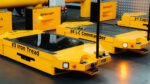

At Continental’s ContiLifeCycle (CLC) retreading plant for truck and bus tires in Hanover-Stöcken, Germany, seven autonomous mobile robots (AMRs) have been transporting green tires around the plant since March. The AMRs handle tire moves between stations so employees can focus on machine setup and quality control. The company said the automation is designed to make production more ergonomic and efficient within its tire manufacturing operations, supporting Industry 4.0 initiatives for retreading.
“Self-driving robots have been supporting our production workflow for six months now,” said Felix Hantelmann, head of the ContiLifeCycle plant. “They handle simple, repetitive transport tasks such as moving a tire from one point to another. The robots are directly connected to our digital order system. So they know exactly where to go and how to coordinate with each other to get there. They are a valuable addition to our daily operations and help create a safe, efficient and ergonomically optimized production environment.”
Tire Transport
The robots navigate independently through the production hall using sensors, 360-degree camera systems and AI-based control technology. At speeds up to 2 meters per second, they move tires between the tire-building machine, curing presses and quality control in the retreading process. Before AMRs, employees moved tires with cranes and trolleys that weighed up to 250 kilograms (approx. 550 lbs) when loaded with two tires, requiring multiple manual steps and trips between stations.
“Our employees no longer have to move tires across the hall. That means less physical strain for them. Instead, they can focus on more demanding tasks like machine operation and quality control,” Hantelmann said.
Hot-Retreading Workflow
- A handling robot transfers the buffed tire carcass to the tire-building machine, where—depending on size—it is fitted with up to 18 kilograms (approx. 40 lbs) of fresh rubber heated to about 100 C for the tread and sidewalls.
- Once the tread and sidewall are applied, the handling robot places the tire on a transport trolley. An AMR, connected to the digital order system, then moves the trolley either to the curing press or to intermediate storage, depending on capacity.
- In the curing press, the roughly 75-kilogram tire is vulcanized at 160 C, giving it its final shape and tread pattern. It is then transferred via conveyor to quality control.
These updates target consistent flow through retreading stages. Continental said it affects turnaround time and finished tire quality for fleets focused on tire maintenance and tire repair programs.
Training and Workforce Integration
Continental said it supported the rollout with training to build acceptance among employees, who also helped name the robots. Examples include Cargo Knight, Rubber Ranger and LifeCycle Commander. The company reports similar AMR solutions are now in use at other Continental tire plants, including Mount Vernon and Clinton in North America; Púchov and Otrokovice in Europe; and Hefei and Rayong in Asia.
The CLC plant has retreaded worn truck and bus tires since 2013. Used tires are inspected, stripped of old tread, then receive a new tread, are vulcanized and undergo quality and safety checks. Continental said this process can reuse up to 70% of the original tire. Since opening, the Hanover plant has retreaded more than 1 million tires. Worldwide, Continental reports producing around 8 million retreaded truck and bus tires across its retreading plants.
The post Continental Deploys Autonomous Robots at ContiLifeCycle (CLC) Retreading Plant appeared first on Tire Review Magazine.

