
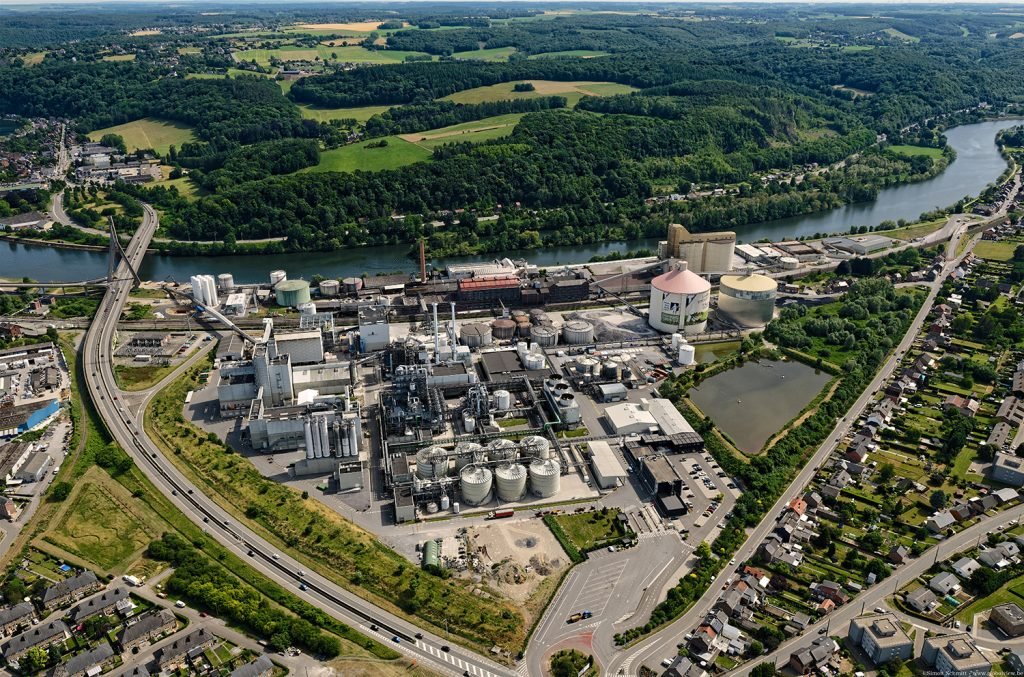

Thirty-five thousand fewer trucks on Walloon roads in favor of inland shipping in one year: that is BioWanze’s balance sheet for 2025. A commitment that has been confirmed since 2008 and which earned the company of the CropEnergies group (Südzucker) the DTIM Prize during the Day of Intermodality in Wallonia, organized on May 27 in Quévy by the SPW Mobilité et Infrastructures.
Every year for a quarter of a century, the DTIM (Directorate for the Transport of Goods and Intermodality) has rewarded a company that has particularly distinguished itself in the field of inland shipping and modal shift. After Nexans last year, it is now BioWanze, producer of sustainable and renewable products based on biomass, that has won the prize. Laurent Lambert, director of the factory in Liège, received his prize from Minister François Desquesnes, Vice-President of the Walloon Government and responsible for Infrastructure and Mobility.
As the largest producer of renewable ethanol in Belgium, BioWanze will have transported 938,000 tons of goods by ship in 2025, a new historical record. Since operations began in late 2008, more than 13 million tons have been transported by waterway, which equates to 500,000 fewer trucks on the road. A result that is praised with this prize, both in terms of logistics and the environment.
The award ceremony took place at the end of a day full of speeches. The general manager of SPW Mobilité & Infrastructures, Pol Flamend, provided an overview of Walloon mobility. Although inland waterway transport will decline to 30.96 million tonnes in 2025, the lowest level in two decades, the first months of 2026 show an encouraging stabilization.
Sustained efforts
Intermodality is progressing with six active terminals. Ghlin-Baudour is now fully operational and TCA has been given the green light for the redesign and expansion. There are now 48 weekly connections, with new rail connections for LLI (Romania and Italy), Trilogiport (Slovakia) and Garocentre (Antwerp). As far as inland navigation is concerned, Minister Desquesnes has confirmed that Wallonia is investing 312 million euros in the inland navigation network in the context of the multi-year investment plan 2026-2029. While the new port area of Engis was inaugurated on May 12, many works are in progress or are due to start this year, in particular in the context of the Seine-Escaut programme: widening of the Nimy-Blaton-Péronnes canal, modernization of the Ronquières ramp, raising the bridges of the Albert Canal, strengthening the 3R Port Engis quay, doubling the Obourg lock, renovation of lock complexes in Andenne, Péronnes, Maubray, Monsin, Ittre and Grands-Malades… Studies are also underway to improve the performance of the waterway network. The GMAO, the management tool for the maintenance of water infrastructure, is also contributing to this, the development of which is about to replace corrective maintenance with predictive maintenance.

