
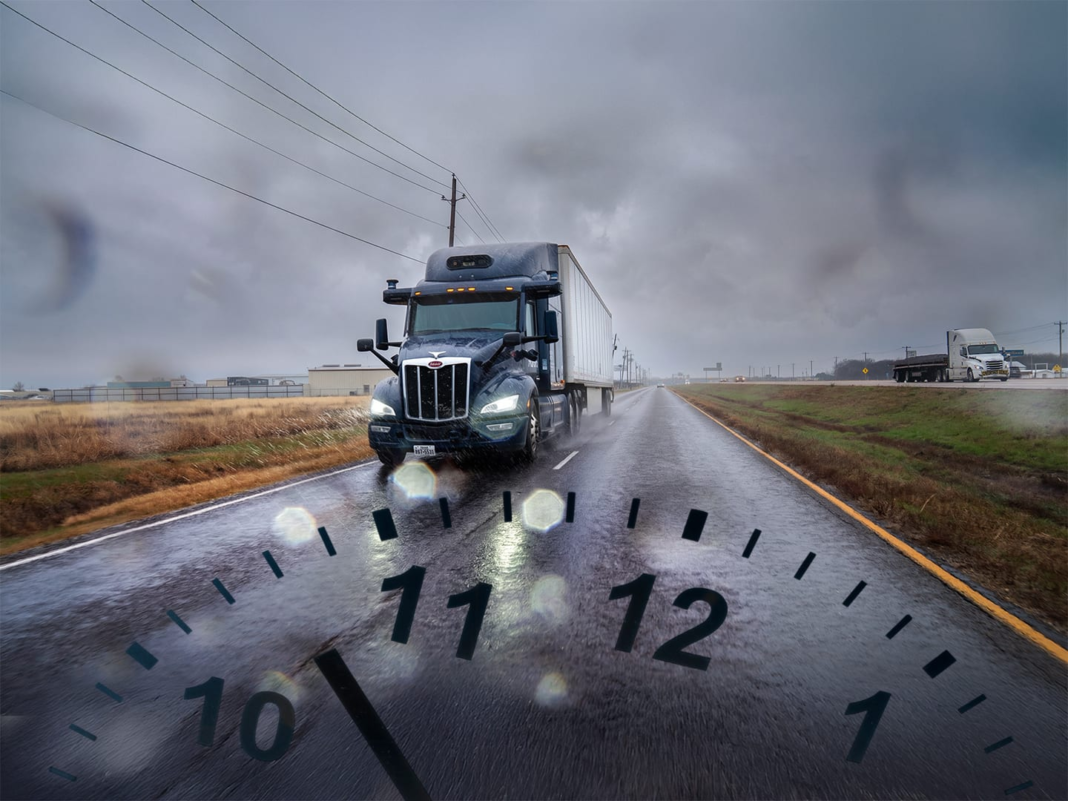

The press release from Aurora Innovations hit my Inbox just before Valentine’s Day.
And it was, by any standard, a modest one – a fairly standard update on the company’s recent activities.
Most of the release looked at the company’s expanding operations. Aurora is now running 10 driverless routes across the Southwestern United States. It is working closely with International to have its next-generation autonomous control system integrated into LT Series tractors in the second quarter. And it continues to scale toward producing more than 200 autonomous trucks by the end of the year.
But the real news – potentially industry-rattling news, in my opinion – was buried in the middle section of the press release. Namely, the fact that Aurora is now driving 1,000 autonomous miles during a single autonomous run. And it is doing so (legally) beyond Hours of Service regulations that limit human drivers to 10 hours on duty.
And Aurora isn’t the only wasn’t the only one with huge, under-the-radar autonomous news.
On March 3, PlusAI announced the launch of its SuperDrive 6.0 autonomous control system. The company called SuperDrive 6.0 a “major advancement” of autonomous vehicle control. It noted that the control system will allow for safe navigation of construction zones. It will also allow for night-time operation – a move the company noted “could potentially more than double the productivity of a truck compared with typical daytime operations.”
Autonomous Game-Changer
And there it is, folks: The first tangible evidence that autonomous trucks are about to upend everything in this industry.
These are press releases/headlines I have literally waiting on for over a decade now. Ever since I watched in wonder, way back in 2015, as the first Freightliner Inspiration Truck confidently cruised across Hoover Dam as the dying desert sun sank into the western horizon.
The next day, Freightliner took us for a drive in their new truck. And behind the wheel of the Inspiration Truck on a jam-packed stretch of I-15 north of Las Vegas, it was apparent to me that this already worked well right off the box. It was going to need some work, of course. But it was evident to me, even then, that autonomous technology would massively disrupt and transform trucking in my lifetime.
PlusAI’s SuperDrive 6.0 is optimized for nighttime driving — which could potentially double the daily operational use of a Class 8 long-haul truck.
I often tell people that autonomous technology is largely a “party trick” for passenger cars. But there is a very real, extremely solid business case for self-driving vehicles in the commercial vehicle market.
And now, Aurora and PlusAI are giving the world a little glimpse of what that business case is.
In a nutshell, the company is proving that fleets can double the use of a tractor-trailer while slashing operating costs by using autonomous technology.
24/7 Freight Operations
Last year, I interviewed Nils Jaeger, president of Volvo Autonomous Solutions, on this very topic. He told me that in theory, autonomous trucks can operate around the clock. The only limiting factors in daily operations are refueling and safety/payload inspections.
But once self-driving trucks were in regular use, Jaeger thinks running 22 hours a day – again, stopping only for fuel and inspections – will be commonplace.
Aurora didn’t include any details on its 1,000-mile run: average speed or time in transit, for example. I have seen some speculative news reports that it takes approximately 15 hours for Aurora to make the run. Which works out to an average speed of about 65 mph. Which sounds about right.
Volvo and DHL’s New Take on Autonomous Trucks
It would take a human driver the better part of two days to cover that distance.
So, we’re talking about delivery times halved. Asset use doubled. Optimal fuel economy. A consistent, unrelenting focus on safety. Minimal powertrain wear. And, oh yeah – truck drivers (consistently one of the top three operating costs for fleets) completely removed from the equation.

