
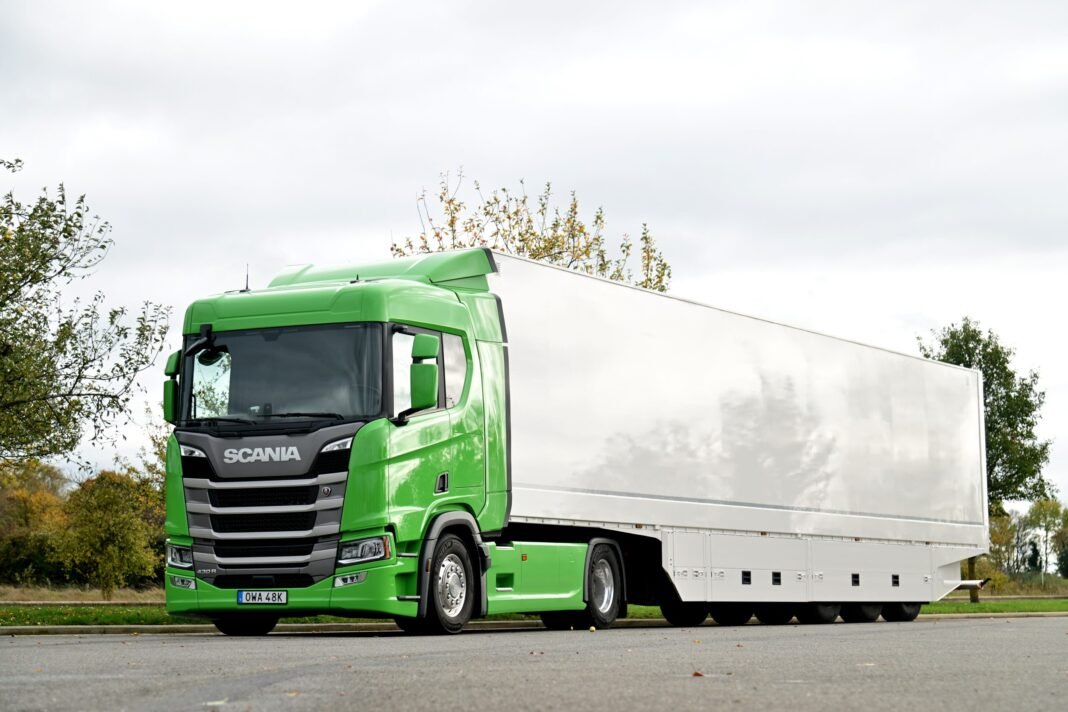

The launch of Scania’s Super range dates back to 2021, with the introduction of an all-new 13-litre engine that required five years of development and an investment of 2 billion euros. All the more reason to introduce an 11-liter version with one less cylinder. The brand thus fills a ‘gap’ in the range.
The Super 11 engine positions itself neatly between the 9-liter and 13-liter platforms. After all, there was a gap between the two engines. The target group consists of regional and urban transport, with applications that require a lighter and more economical alternative to the Super 13.
One cylinder less
With a displacement of 11 liters, this engine is 85 kg lighter than the Super 13. This result was achieved by simply deleting one cylinder, while 85% of the parts remained identical. The Super 11 is also more efficient, with an energetic efficiency that is up to 7% higher than that of the 9-liter engine.
Technology. The Super 11 is available in three power versions: 350 hp, 390 hp and 430 hp. We drove the most powerful version, which delivers 2,200 Nm of torque over a wide range of 950 to 1,360 rpm. The Scania EGR is therefore a thing of the past.
In addition, the Super 11 benefits from several innovations, such as Scania’s own camshaft adjustment technology for variable valve control. This enables real-time thermal engine management and ensures more efficient combustion. In addition, new engine management software and balance shafts are added to limit vibrations. The result is a thermal efficiency of approximately 50%, a value that was until recently unattainable for combustion engines.
Brakes. Here too, the progress is clearly visible: the engine brake delivers a braking power of 230 kW or even 344 kW, depending on the selected setting (standard or high). This is thanks to Scania’s VVB system (Variable Valve Braking), which at the same time maintains the smoothness of the gear changes. The choice for an auxiliary brake does not arise, given the context and the expected working conditions.
The drivetrain is coupled to the new Opticruise G25 gearbox, developed for lighter applications. Thanks to all-aluminium housings, it is more compact and approximately 60 kg lighter. This transmission is especially tailored to low-speed engines, with a wider spread, a twelfth gear in direct drive and a real overdrive as the highest gear.
Cabin & life on board. Our 430 R was equipped with the CR20N three-step cab. That is not the largest cabin in the range, but more than sufficient for regional transport. The comfort level does not reach that of the large S cabin, but that is not the intention. Despite everything, the driver can still spend the night comfortably.
More complex dashboard
The only real interior innovation is the Smart Dash dashboard. One central touchscreen, fewer buttons… it takes some getting used to. Some drivers prefer to have all the information on one screen, but care must be taken to ensure that the menus and submenus do not become too complex. In general, we have to admit that the Scania interior today looks quite austere compared to some competitors.
Driving impression. Cruising at 950 rpm is the ultimate solution to keep consumption under control. With a new rear axle fitted with long ratios, our 430 R constantly tries to select twelfth gear, as it is direct and therefore produces the least transmission losses. The overdrive is only switched on when conditions are favorable (lighter load, empty driving or gentle descent), which was often the case during the test. As a result, we notice that the truck shifts more than drivers are used to, with the aim of optimizing fuel consumption as much as possible.
Performance and consumption. The test took place in conditions that closely match the intended area of use: the total weight was 30 tons, far below the usual 40 tons. However, the results are impressive, with an average consumption of 20.6 l/100 km at a cruising speed of 84 km/h. For comparison: a 460 R with a 13-litre engine recorded 27.84 l/100 km (average speed 81.54 km/h) and a 560 R achieved 26.81 l/100 km (average speed 82.26 km/h), both at 40 tonnes. The result is excellent, although the Twin SCR system does require more AdBlue. Over a total distance of 400 kilometers we consumed almost double what is normally used.
Conclusion. The Super 11 seems to be preparing for a great success. He positions himself in a very specific segment for a clearly defined customer profile. Based on proven technology, it is characterized by particularly low fuel consumption, as announced.

