
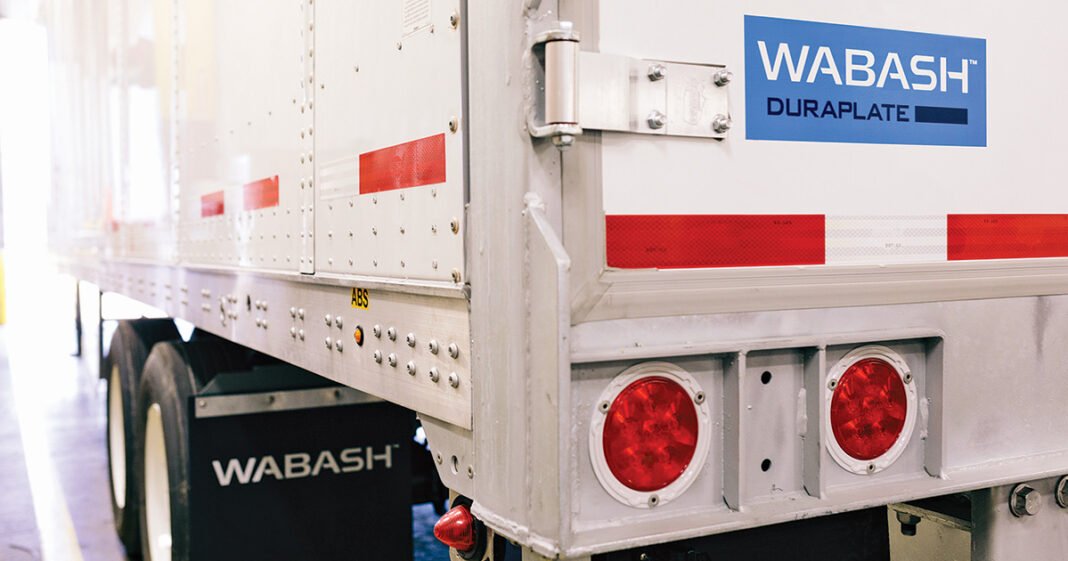

Wabash shipped 5,901 trailers in Q4, a decrease of 12.8% from 6,770 a year earlier. (Wabash)
March 2, 2026 2:56 PM, EST
Key Takeaways:
- Wabash is expanding its service and upfitting network while idling plants in Goshen, Ind., and Little Falls, Minn.
- The company cites prolonged weak freight and trailer demand as it reduces production capacity and manages costs.
- Fourth‑quarter results show lower sales and shipments as Wabash anticipates a difficult start to 2026.
Trailer manufacturer Wabash is continuing to expand its parts and service center operations while trimming manufacturing capacity as part of a strategic pivot to cut its cloth to current market circumstances.
Demand for trailers remains weak, industry data shows, with fleets extending the lifespan of rolling stock in what has been the longest freight downturn in memory.
Wabash CEO Brent Yeagy said during the company’s fourth-quarter 2025 earnings call Feb. 4 that although there are early signs of stabilization in parts of the freight market, demand hasn’t risen sufficiently to boost sales. “We remain cautious. Capital spending decisions continue to be highly managed,” he said.
Lafayette, Ind.-based Wabash opened a parts and service center in Phoenix on Feb. 26. The facility includes Ready-to-Mount upfitting capabilities, in which a pre-built dry freight and platform body is deployed. Wabash launched the program in February 2025 and touts shorter delivery times to fleets.
“Our next facility in Phoenix expands the reach of Wabash in the West and brings our services closer to where our customers operate every day,” said Dave Hill, vice president of recurring revenue. “We continue to see strong demand for our Ready-to-Mount solutions and upfitting services, with our 2025 upfit volumes nearly doubling volumes from the previous year,” he added.
Wabash already operates parts and service centers in Southern California; Dallas; Chicago; Columbus, Ohio; Philadelphia; Atlanta; and Tampa, Fla.
In September, Wabash opened two parts and service centers in Gary, Ind., and Atlanta. The Gary site offers greater access for customers in Illinois, Indiana, Wisconsin, Michigan and Iowa.
At the same time as it expands its parts operations, Wabash plans to idle its Goshen, Ind., and Little Falls, Minn., manufacturing facilities.
A total of 214 jobs will be cut at Goshen, and 56 employees will lose their jobs at Little Falls, according to a Jan. 5 Securities and Exchange Commission filing.
Wabash notified the Indiana Department of Workforce Development on Jan. 5 that as many as 144 staff would be laid off March 6.
Further phases of layoffs will occur before the plant closes, the company said in the filing.
“These actions were taken to better align our production capacity with current demand levels and to manage near-term operating cost but are also part of a longer-term play to reduce overall fixed costs and other cost drivers over the next market cycle,” Yeagy told analysts.
Idling Little Falls and Goshen resulted in about a $16 million impairment charge in Q4, and the company expects an additional $4 million to $5 million in charges in 2026.
Yeagy emphasized that idling the plants does not signal a pullback from any trailer segment.
“We are not pulling out of … the refrigerated market. As we sit here right now, with the Little Falls closure, we are … looking at how do we reposition the product going forward specifically into the improving market, which we believe will exist in 2027,” he said. “It’s just a prudent move that we’re making right now as we kind of re-envision what our fixed cost structure will be as we position for the market upswing.”
“We retain refrigerated truck body capacity throughout our network. That is not compromised in any way, shape or form,” Yeagy said, adding that idling Goshen is about optimizing overhead and leveraging structural changes in the organization.
However, Wabash is not optimistic about 2026. “We … expect the demand environment to remain difficult as we move into the first quarter as customers seek sustainability in the current early signs of a freight market rebound,” Yeagy said, adding: “Across our end markets, demand remains soft as freight, construction and industry activity continue to operate below normalized levels.”
Patrick Brennan of Cox Fleet talks about the common missteps that fleets make in planning for future maintenance and operational needs. Tune in above or by going to RoadSigns.ttnews.com.
Wabash’s fourth-quarter loss widened to $49.9 million from $1 million a year earlier. Q4 sales totaled $321.5 million, down 22.8% compared with $416.8 million in the same period.
The company shipped 5,901 trailers in Q4, a decrease of 12.8% from 6,770 a year earlier. It shipped 1,343 truck bodies in the quarter, a slump of 55.4% compared with 3,010 a year earlier.
ACT Research preliminary data showed industrywide orders increased 9% year over year to 23,000 units in January but fell 8% compared with December. Orders typically decline in January.
FTR Transportation Intelligence data showed orders slid 4% year over year to 24,206 trailers and were flat compared with December. FTR said the 2026 order season, which ended in January, was down 16% year over year.

