
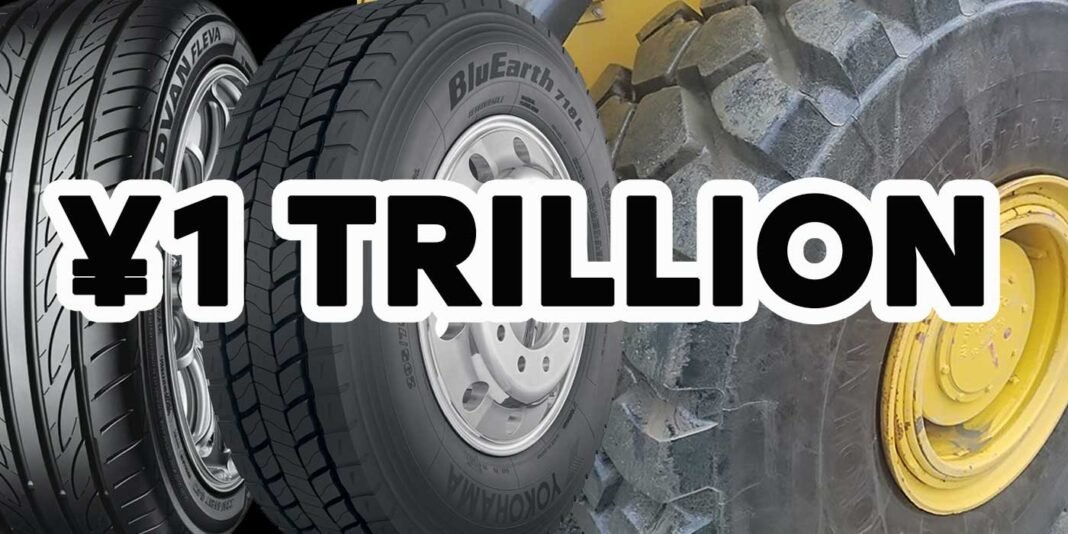

In fiscal 2024, Yokohama produced one of the company’s biggest milestones to date. For the first time, the company posted sales revenue above ¥1 trillion (approx. $6.7 billion) and business profit above ¥100 billion (approx. $667 million). That marked the third consecutive year of record results, and after reviewing the company’s 2025 integrated report, it’s clear that this achievement is largely due to the latest Yokohama tire strategy.
For independent tire dealers, these numbers represent more than a financial plaque for C-suite executives to hang on the wall. Look deeper, and the report points to stability of supply, a wider product range, and a strategy positioning Yokohama across multiple categories.
Let’s dig into what’s behind the Japanese company’s latest success story.
How the Yokohama Tire Strategy Balanced the Portfolio
Just a decade ago, Yokohama’s sales leaned heavily toward consumer tires. In 2016, the company’s consumer-to-commercial tire ratio stood at 4:1.
“We have corrected this distortion through M&A, starting with our acquisition of ATG in 2016, TWS in 2023, and finally Goodyear’s OTR business in February 2025,” Yokohama Chairman and CEO Masataka Yamaishi said in the report. “As a result, our consumer tire to commercial tire sales ratio is now in line with the overall market’s 1:1 ratio.”
This change reflects a major tire manufacturer reshaping its portfolio. The report emphasizes that balancing passenger and commercial segments reduces risk, since downturns in one area may be offset by stability in agriculture, mining, or truck/bus.
Off-Highway Tires: A Core Pillar of the Yokohama Tire Strategy
According to the report, Yokohama views off-highway tires (OHT) as a central growth driver. Passenger and truck/bus tire segments remain crowded, but in comparison, OHT offers higher barriers to entry.
“Our acquisitions of ATG and TWS have given us the top share in the market for agricultural machinery tires, and our TRELLEBORG, Mitas, ALLIANCE and GALAXY brands have products in all price ranges,” the report states. “By optimizing production for each brand and adjusting the product mix to match demand during different economic conditions, we have been able to maximize profits and our market share.”
The February 2025 acquisition of Goodyear’s OTR business corrected a product imbalance, Yokohama states in the report. Yokohama’s OTR business leaned toward construction, while Goodyear’s leaned toward mining. Together, the lineup now reflects the global 6:4 mining-to-construction ratio.
“We have secured the No. 3 position in the global mining and construction tire market. We will use this acquisition to establish an even stronger global presence,” the company noted.
For tire dealers, Yokohama’s scale in OHT means broader product coverage in agriculture, industrial, and mining segments. With multiple brands spanning premium and value tiers, Yokohama indicates in the report that it is positioned to meet the diverse demands of specialty dealers and fleets.
Consumer Tire Growth as Part of the Yokohama Tire Strategy
In consumer tires, Yokohama says it is pursuing both premium growth and cost competitiveness.
“Our response has been to adopt a strategy to enhance profitability by exploiting our existing strengths in the passenger car tire market, and raise the sales ratio of our higher-value-added ADVAN, GEOLANDAR, and winter tires (AGW) from 40% to 50% within the Yokohama brand, which accounts for 99% of our passenger car tire sales,” Yamaishi said.
Premium OE fitments with Porsche, BMW M Series, Mercedes-AMG, and Lexus highlight that focus. Yamaishi added, “Yokohama brand tires tend to be chosen by car owners when changing their tires, especially after the second time, because our tires are proven to have the same performance and quality characteristics as the Tier 1 maker tires installed on new premium cars while being more affordable than Tier 1 national brands.”
At the same time, Yokohama says it is building cost competitiveness. For example, the “1-year plant” in Hangzhou, China, aims to move from groundbreaking to prototypes in just 12 months. For dealers, Yokohama’s hope is that this sharper cost base could translate into more competitive pricing in standard replacement lines.
Regional Strategies are Vital
North America
The report states that the U.S. remains a major profit driver, and Yokohama’s approach centers on the replacement market.
“Our strategy is to capture demand from customers trading down from Tier 1 brands due to high quality and reasonable prices,” the report says.
SUV and CUV demand continues to surge, and GEOLANDAR serves as the growth axis. The company sees particular potential in the Northeast, where its market share lags compared to other U.S. regions.
Yokohama also points to fleet and truck/bus tires as growth areas in North America. The expansion of local capacity, including its Mississippi plant, supports that push. With GEOLANDAR positioned for consumer demand and expanded truck/bus offerings, Yokohama says it is targeting growth across both retail and commercial dealer channels.
For independent dealers, this North American strategy matches current economic realities. Customers who once bought Tier 1 brands are increasingly price-sensitive, and Yokohama says it believes this creates an opportunity for alternatives that carry OE credibility but come in lower than more expensive competitors. GEOLANDAR, in particular, gives dealers a recognizable, OE-backed product to position against both Tier 1 and emerging low-cost options, Yokohama says.
Europe
Yokohama described Europe as its “fastest-growing region.” Efforts include high-inch fitments, premium OE, and truck/bus sales. A new ADVAN WINTER launch is planned, and partnerships with wholesalers in Germany, the UK, and Eastern Europe are expanding distribution.
For U.S. dealers, Europe’s growth trajectory matters less directly. But, strong OE wins and expanded distribution reinforce Yokohama’s global brand credibility, the report states.
China
The report highlights a rather ambitious goal: “We will become the No. 1 foreign tire maker in the Chinese market.”
To achieve this, Yokohama says it is working closely with Chinese automakers, localizing development, and accelerating launches.
Although centered on China, the report indicates that expanding local production scale could increase overall capacity and cost efficiency, with potential effects on global supply and pricing.
Technology and Manufacturing
Yokohama’s COO Shinji Seimiya stressed cost and speed are keys to success going forward.
“If we are to compete in these Red Ocean markets, we must address two major issues: reducing costs and improving production efficiency,” he said.
AI-driven development supports this goal. For example, the report describes HAICoLab, which combines simulation data with artificial intelligence to speed up the company’s design cycles. Yokohama says engineers can test concepts virtually instead of relying solely on physical prototypes, which cuts time and cost.
“HAICoLab… enables our younger employees to quickly acquire the knowledge they need to create basic tire designs. It also enables our development staff to know the factors that led to AI-generated answers, giving them new insights into new areas.”
New plants in China and Mexico also reflect Yokohama’s push for faster, localized output. Lessons from acquisitions in India and Europe shaped a blend of speed and Japanese quality. For dealers, this could mean shorter lead times for product launches and replenishment.
How Sustainability has Been Woven Into the Yokohama Tire Strategy
Yokohama links sustainability with cost, Yamaishi said.
“Our carbon neutrality initiative is based on efforts that will also reduce costs and contribute to the company’s growth,” he said.
Examples within the report include replacing silica sand with plant-derived silica, which lowers costs and environmental impact. The company is also expanding the use of renewable and recycled materials.
“Our ADVAN racing tires already use 46% renewable or recycled materials,” the report says.
In Thailand, Yokohama’s rubber processing plant is piloting traceability systems.
“This effort is being led by plant managers who know and understand local farmers, which makes it possible to prevent deforestation and respect human rights while procuring raw materials at a low cost,” the company reported.
Some dealers are finding that ESG-friendly products are becoming increasingly important. Fleets and retailers tied to corporate or government contracts often require proof of compliance. Suppliers with a clear sustainability strategy could have an advantage.
What’s the Bottom Line for North American Tire Dealers?
The Yokohama tire strategy implemented over the past two years has reshaped the company’s portfolio, manufacturing approach, and sustainability goals.
In the report, Yamaishi summarized the company’s ambition: “Moving forward, we plan to implement measures that will further solidify our grand design aimed at achieving sustainable growth in the years ahead. We hope to make this strategy part of our organizational culture and maintain our current sales and profit growth momentum as long as possible.”

