
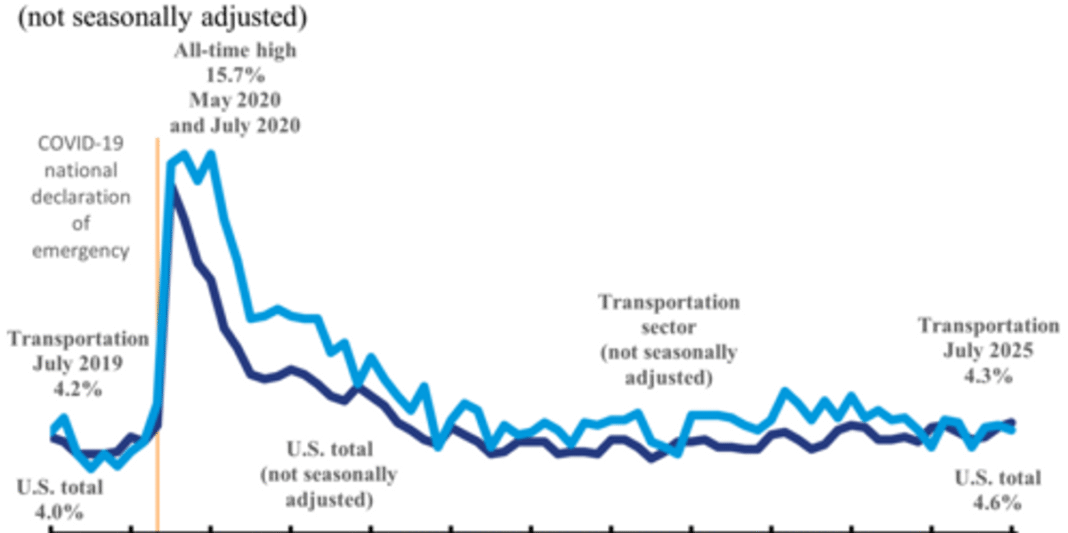

While the overall U.S. employment rate for July rose slightly—setting off a political maelstrom that resulted in President Trump firing the Bureau of Labor Statistics Commissioner Erika McEntarfer—the transportation sector’s rate showed improvement.
The U.S. Bureau of Labor Statistics (BLS) reported that the unemployment rate for the U.S. transportation sector (not seasonally adjusted) was 4.3% in July, down 1.4 percentage points from July 2024. To calculate the rate, BLS includes employment numbers for warehousing and passenger transportation as well as freight transportation.
While the July 2025 unemployment rate is below July 2024’s rate of 5.7% , it is still above the pre-pandemic July 2019 level of 4.2%. The unemployment rate in the transportation sector was lower than the overall unemployment rate, which was 4.6% (not seasonally adjusted) for July 2025.
Seasonally adjusted employment in the transportation and warehousing sector rose to 6,738,200 in July 2025, up 0.1% from the previous month and up 1.2% from July 2024. Employment in transportation and warehousing grew 18.5% in July 2025 from the pre-pandemic July 2019 level of 5,687,800.
BLS announced the following seasonally adjusted employment numbers by mode:
- Air transportation (which includes passenger services) rose to 579,500 in July 2025, up 0.4% from the previous month and up 2.6% from July 2024.
- Truck transportation rose to 1,523,200 in July 2025, up 0.2% from the previous month and up 0.4% from July 2024.
- Rail transportation (which includes passenger service) remained virtually unchanged in July 2025 at 153,200 from the previous month but down 1.8% from July 2024.
- Water transportation (including passenger service) fell to 71,400 in July 2025, down 0.3% from the previous month but up 1.0% from July 2024.
- Pipeline transportation fell to 60,400 in July 2025, down 0.7% from the previous month but up 7.3% from July 2024.
- Warehousing and storage fell to 1,818,300 in July 2025—down 0.4% from the previous month and down 2.1% from July 2024.
- Transit and ground passenger transportation fell to 489,500 in July 2025,down 0.4% from the previous month but up 4.9% from July 2024.
Paul Bingham, director of Transportation Consulting for S&P Global Market Intelligence, cautioned that it is important to keep in mind that labor force participation rates, a key factor in unemployment calculations, can fluctuate over time. Workers who are not seeking employment within the four-week period or who have left the sector for employment in another sector are not counted in the percentage unemployed. For freight transportation, according to Bingham, it is likely that peak labor force participation in recent years was during the pandemic when transportation worker wages rose and companies saw a surge in demand for goods as well as inefficiencies in the system due to congestion.
“Compared with before the pandemic, the warehousing sector saw the greatest employment gains and remains the largest [sector], even as warehousing employment has fallen slightly with the recent softening of e-commerce delivery demand and increased use of automation within warehouses and distribution centers,” Bingham wrote in an e-mail response to questions. “Trucking employment levels now are below the numbers from before the pandemic, as are rail jobs, which declined more and have not recovered. Sustained, multi-year weakness in U.S. industrial and manufacturing production have restrained demand for trucking and rail services, and therefore employment in those sectors.”
Companies looking to hire workers heading into peak season should find adequate pool of workers available, according to Bingham, who says there is little risk expects that labor availability will impact peak season freight performance or costs.

