
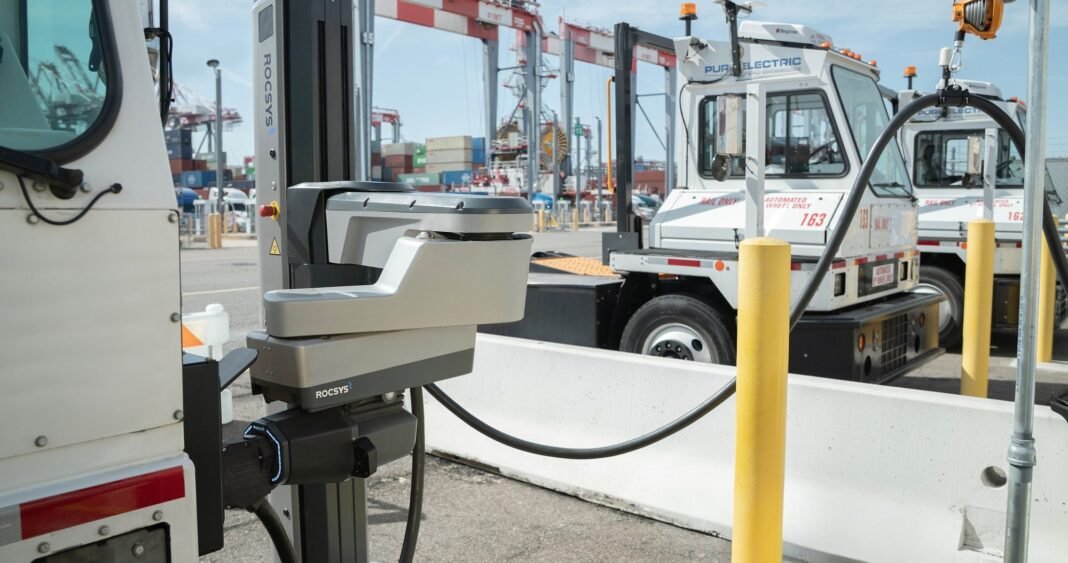

Rocsys, the global leader in hands-free charging for electric and autonomous vehicles, today launched the S2, its next-generation hands-free charging solution for heavy-duty electric vehicles operating in demanding environments. Part of Rocsys’ expanding portfolio of stewards, including the recently unveiled M1, the S2 is now available to order for ports, distribution hubs and other logistics facilities.
Image: Rocsys
Rocsys has delivered its first S2 to a large-scale port customer, marking the solution’s move into active customer deployment. For American organizations with domestic sourcing requirements, Rocsys can provide configurations that support Build America, Buy America compliance.
As heavy-duty electric fleets scale, charging operations need to keep vehicles ready without adding complexity to already demanding site workflows. In ports, terminals and logistics hubs, repeated plug-in tasks must be coordinated across shifts, vehicle types, chargers, weather conditions and tight operating schedules. Rocsys S2 is designed to make that process more consistent, predictable and easier to integrate into day-to-day operations, delivering higher utilization, tighter coordination and safer day-to-day performance.
Drawing on the field-validated success and learnings of Rocsys’ previous generation, ROC-1, the S2 delivers a smaller footprint, simpler installation, greater range of motion and enhanced durability for outdoor operation in tough conditions. Trained on more than six years of Rocsys field experience, including ROC-1 deployments in Europe and North America, the Rocsys S2 is engineered for maximum reliability in live operations, keeping vehicles charged and ready whenever they’re needed, even in the most challenging work situations.
S2 is available in two configurations. The standard S2 is intended for general fleet environments, while the S2-H heavy-duty version adds more protective features, including enhanced coating, beacon lighting and reflectors, for harsher industrial settings. IP-rated components, adaptable force absorption, and a 7-motor controller architecture support safe, consistent, and predictable performance.
Image: Rocsys
Using computer vision and motion intelligence, the S2 identifies the position and orientation of a vehicle’s charging inlet with sub-millimeter precision and adapts in real time to variations in parking position and site conditions, including rain, dust, shadows and low light. The result is a 99.9% plug-in success rate and continuous improvement through machine learning, making it well-suited to high-throughput operations where consistency and uptime are key.
The S2 supports multi-vendor interoperability across mixed fleets and charger types. Vehicle-to-steward communication is enabled by the in-house-designed Rocsys Smart Cover, which allows any vehicle to connect with any steward via Ultra-Wideband (UWB). The arm’s flexible motion and wide vertical work range accommodate different vehicle geometries and parking variations, while the reduced footprint and easy-to-deploy design simplify integration into existing sites with minimal or no civil work.
Part of the Rocsys Platform, a complete ecosystem combining hardware, software, and remote and onsite services, the S2 can also be integrated with fleet management and terminal systems via APIs, giving operators greater visibility and control over charging operations.
Rocsys is showcasing the S2 at ACT Expo in Las Vegas, May 4-6, and at TOC Europe in Hamburg, Germany, May 19-21. See the S2 in action here.
Crijn Bouman, CEO and Co-Founder of Rocsys, said: “Rocsys S2 brings our hands-free charging technology into its next commercial phase. Heavy-duty electric fleets need charging infrastructure that works reliably in real operating conditions, across mixed vehicles, chargers and site layouts. Built on more than six years of field experience, S2 gives customers a practical way to add hands-free charging to existing operations and keep vehicles ready when they are needed.”

