
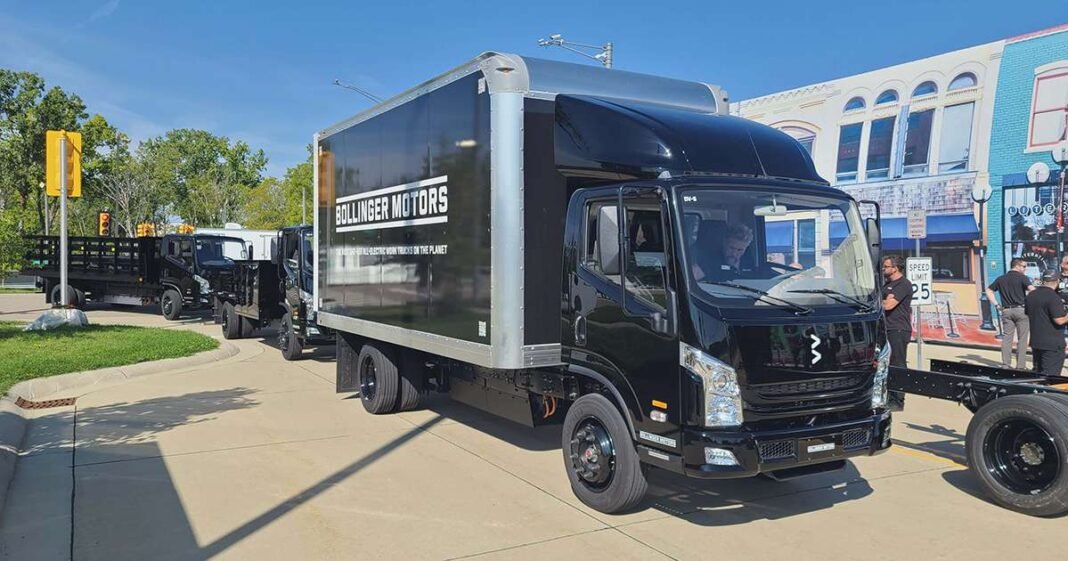

(Henry Payne/The Detroit News/TNS)
December 1, 2025 8:18 AM, EST
[Stay on top of transportation news: Get TTNews in your inbox.]
More than a year ago, the future looked bright for Oak Park, Mich., electric vehicle maker Bollinger Motors: It had just started producing its first B4 work trucks and customer orders were pouring in amid plans to soon release a larger version, the B5.
“The odds of us getting to this point are so astronomically against us, and we actually did it,” founder Robert Bollinger, who is no longer involved with the firm, said at a September 2024 launch event in Michigan for the B4.
The plucky startup had laid out major growth plans — ramping up production in metro Detroit and adding 237 jobs under a deal with the state’s economic development agency that promised $3 million in grant funds. Gov. Gretchen Whitmer praised the firm.
But Bollinger’s fortunes shifted quickly. By late last week, workers were opening emails stating the company was shutting down. “We received word late last night that the day has arrived, we are to officially close the doors of Bollinger Motors, effective today, November 21st, 2025,” said the note from Helen Watson, the company’s vice president of human resources.
After repeated rounds of layoffs and delayed or missed paychecks in recent months, a final group of Bollinger employees arrived Nov. 24 at the company’s office on 11 Mile to drop off their company equipment and collect one of several paychecks that the company owes them.
Robert Bollinger founded the company about a decade ago. (Henry Payne/The Detroit News/TNS)
Two employees told The Detroit News earlier that staff are still missing paychecks for three weeks of work. Other promised bonuses have also not been paid out.
The Michigan Department of Labor and Economic Opportunity is investigating about 70 active claims against parent company Bollinger Innovations for unpaid wages or benefits, spokesperson Keely Lovern confirmed this week.
The Michigan Economic Development Corp., meanwhile, said it had paid out almost $950,000 of the $3 million grant committed to Bollinger in 2023. But it’s now seeking to claw back the money as the company hasn’t maintained the necessary jobs and amid “reports of their apparent closing,” spokesperson Danielle Emerson said. MEDC issued a notice of default to the company on Nov. 5.
The future of parent company Bollinger Innovations Inc. — previously known as Mullen Automotive Inc. and formally headquartered in Southern California — remains unclear. The company said in a filing that it had “initiated a cost-reduction plan intended to streamline operations and preserve liquidity.”
The filing said it was cutting employees and closing its office in Troy, with plans to “consolidate the remaining staff” into the Oak Park building. The company also halted factory service and warranty support for dealers selling the B4 and other EV vans and trucks that Mullen has separately marketed in recent years.
Bollinger’s collapse is, in part, a story of a stumbling EV market struggling under the Trump administration, which has moved to strip away key supports for the industry. Other prominent EV startups are also struggling to survive or have filed for bankruptcy as investors have turned their focus elsewhere.
But Bollinger Motors’ troubles can also be traced to problems at parent company Mullen, now known as Bollinger Innovations, and its CEO, David Michery, lawsuits and employee interviews indicate.
The company and Michery have faced a series of lawsuits filed by shareholders accusing the company of mismanagement and fraud. Records show it has piled up an accumulated deficit of well over $2 billion since going public in 2021.
Jim Connelly, chief revenue officer at Bollinger Motors, alongside the B4 electric truck. (Clarence Tabb Jr./The Detroit News/TNS)
One frequent concern raised across several lawsuits and even a Reddit page focused on Mullen is the company’s nine reverse stock splits that it has carried out since 2022. Mullen’s aim with the frequent maneuvers was to combine multiple shares into one in order to keep its price above a $1 Nasdaq minimum and avoid getting delisted.
But shareholders say the company’s strategies have ultimately caused them to lose money while benefiting insiders and certain favored investors. After the company’s shares continued to drop below $1, the company tried one last reverse stock split in September and promised it would be the last one for years, but it didn’t work. The firm was finally delisted by the Nasdaq exchange by October.
Another primary concern: the company’s frequent announcements and promises in recent years that at times helped briefly create an inflated stock price, according to court papers, but frequently didn’t come to fruition.
“Although Mullen presents itself as an EV manufacturer, in reality, it functions as a personal slush fund for its founder (Michery),” said one shareholder lawsuit filed this fall in California federal court.
That complaint states that even as Mullen has faced a “deteriorating financial condition” — and reported a gross profit of $92,118, just once dating back to 2022 — Michery received well over $50 million in total compensation. The suit also alleges he has “diverted company funds for personal purposes” including payments to his daughter, for a luxury car collection, a luxury suite at Anaheim Ducks games, and financing other ventures.
In 2023 alone, according to company filings, Michery was awarded $49.6 million in total compensation, including large stock awards — slightly more than the Microsoft CEO’s total package that year, and higher than any other automaker executive except Elon Musk.
In other recent years, he received smaller but still handsome payouts that included stock awards: $2.4 million in 2021, $6.4 million in 2022, and $3.25 million in 2024, with one lawsuit stating he also received $500,000 in annual reimbursement for personal expenses from the company. He reported having just one share of Bollinger Innovations stock in an August filing.
A prototype B4 Chassis Cab Class 4 truck at Bollinger Motors headquarters in Oak Park, Mich. (Clarence Tabb Jr./The Detroit News/TNS)
A separate shareholder lawsuit filed against Mullen and Michery — alleging false and misleading statements to increase the stock price — was closed earlier this year after the plaintiffs secured a $7.25 million settlement. A creditor suit earlier this year resulted in Mullen coughing up a massive manufacturing plant in Indiana as part of the settlement deal.
Michery, 59, who worked for several companies in the entertainment industry, among other ventures, before coming to electric cars more than a decade ago, didn’t respond to several requests for comment for this story.
Bollinger Motors had already faced dire financial trouble once earlier this year. Founder and former CEO Robert Bollinger had filed a lawsuit seeking to recoup a $10 million loan he’d given the company. The lawsuit expressed concern that under Mullen’s majority ownership and the company’s lack of ongoing financial support, the truck maker was about to go under, and that he would lose his money. A federal judge briefly placed Bollinger into receivership as it faced a production halt, missed rent payments and several supplier lawsuits.
But at the last minute — instead of watching the company die or get sold off — Mullen and Michery decided to double down on Bollinger. Mullen paid off Robert Bollinger’s loan and other suppliers it owed, increased its ownership stake in the truck maker, outlined plans to shift more of Mullen’s workforce to Michigan, where employees could work more closely with the Bollinger team, and even changed Mullen’s name to Bollinger Innovations. Robert Bollinger couldn’t be reached for comment.
Michery told The News in a June interview that his company had secured enough investor commitments to keep Bollinger humming in a challenging EV environment, albeit with a leaner staff. He said Mullen believed in Bollinger’s products.
Michery pledged to restart production of the B4 at a plant the company owns in Mississippi within weeks. He also promised to focus on developing two prototype boxy off-roading vehicles, the B1 and B2, that he believed could be Humvee successors for the military, or sell to the general public as a Mercedes G-Class competitor.
“You’ve got to kill me to beat me,” said Michery at the time, adding there was “a method to what we’re doing.” He admitted his company had become something of a “meme stock.”
Michery pointed to a $150 million equity line of credit that the company could tap from an outfit called Esousa Holdings. He said the wealthy investor behind Esousa, Michael Wachs, had already put close to $1 billion into the company over the previous four years, and remained firmly committed to the cause.
Reed Loustalot of Truck Parking Club discusses how a combination of public funding and private innovation can ease the truck parking problem. Tune in above or by going to RoadSigns.ttnews.com.
Wachs, who in 1997 pleaded guilty to embezzling millions of dollars from Chase Manhattan Bank and was barred from the industry, didn’t respond to an email requesting comment about his involvement at the EV company. Financial filings show that another major Mullen and Bollinger Innovations funder in recent years has been the firm Acuitas Capital, which was run by another financial felon, Terren Peizer. He was sentenced earlier this year for insider trading at a health care company he led.
On June 4, Michery came to Bollinger’s Oak Park office to tell employees that the company’s funding was solid and that it still had a bright future, despite prior operational struggles and the court case with Robert Bollinger, according to two employees who were in attendance.
But workers said problems started arising again within weeks inside the truck maker as it ran into more cash problems. At least a half-dozen new supplier lawsuits have been filed against Bollinger in recent months, according to Oakland County Circuit Court records. And employees said they weren’t aware that B4 production ever restarted at the factory in Mississippi that the company owns; the trucks were previously being made by a contractor in Livonia that had refused to keep building them earlier this year due to missed payments.
And by early October, parent Bollinger Innovations had been delisted from the Nasdaq, after which Michery got on a video call with employees to again reassure them that everything would be OK. The company, in a statement at the time, sought to portray the move to the over-the-counter market as a good thing because it would save time and costs being spent on meeting certain Nasdaq regulatory requirements.
Employees said they haven’t heard any direct updates from the CEO since October despite their requests for information. Instead, throughout the late summer and fall, employees have faced repeated rounds of layoffs as well as multiple delayed or missed paychecks, according to interviews and internal emails reviewed by The News.
“We have been exploring every possible avenue for additional funding, but as of now, nothing has been secured or finalized,” said one email several weeks ago to staff from Chief Operating Officer Walter Collins.
By late last week, it was all over: “It is the end of an era but one you should all be very proud of,” said the email from Watson, the HR executive.

