
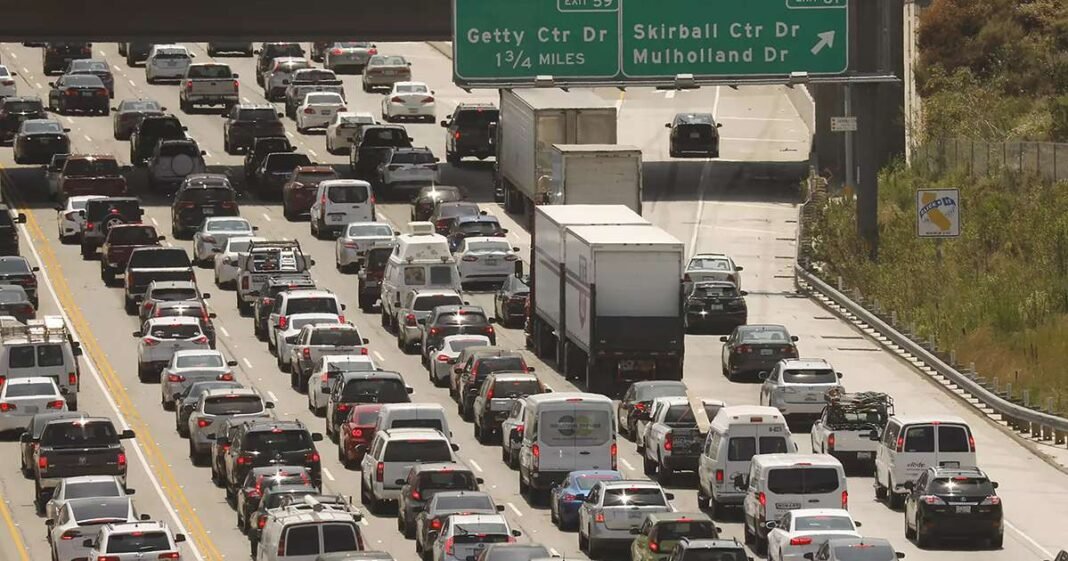

Traffic on the 405 freeway traffic in Los Angeles. (Al Seib/Los Angeles Times/TNS)
January 22, 2026 2:04 PM, EST
Key Takeaways:
- California has adopted a language-proficiency mandate that aligns with a USDOT standard.
- FMCSA revoked $40.6 million in Motor Carrier Safety Assistance Program grants for CHP.
- The state’s lawsuit to force USDOT to return its federal grants is advancing despite CHP’s adoption of the ELP rules.
[Stay on top of transportation news: Get TTNews in your inbox.]
Law enforcement in California has begun enforcing English-language proficiency standards for commercial drivers, a shift made after the state lost $40 million in federal transportation funds amid a battle with the U.S. Department of Transportation over rule compliance issues.
The state on Dec. 23 adopted updated regulations for the California Highway Patrol to follow. Included are a language-proficiency mandate that aligns with a USDOT standard that was revived last year, as well as Commercial Vehicle Safety Alliance criteria for placing drivers out of service if they don’t meet the criteria.
“Consistent with California and federal law, as well as national safety standards, the California Highway Patrol enforces the English-language proficiency requirement for commercial drivers,” CHP Communications Director Jaime Coffee told Transport Topics. “This requirement is intended to bring consistency and roadway safety during commercial vehicle inspections.”
The police agency was chiefly affected by the loss of $40.6 million in Motor Carrier Safety Assistance Program grants, which the Federal Motor Carrier Safety Administration permanently revoked in October.
California and USDOT for months battled over compliance with the ELP mandate. The state maintained that its commercial driver license requirements complied with the federal ELP standards since elements of the regulation were contained in its laws. However, FMCSA countered that California has not met a deadline to update a 2024 California Highway Patrol Commercial Enforcement Manual that stated the state’s ELP requirement “shall not be enforced” or appear on any enforcement document because the federal regulation “is not adopted by California.”
CHP-English
U.S. Transportation Secretary Sean Duffy announced the funds had been permanently pulled on Oct. 15, and accused California of being “the only state in the nation that refuses to ensure big rig drivers can read our road signs and communicate with law enforcement. This is a fundamental safety issue that impacts you and your family on America’s roads.”
FMCSA said, “California’s reliance on its state driver licensing laws fails to address the English proficiency of the thousands of interstate drivers licensed in other jurisdictions who operate within California’s borders each day. The ELP requirement is a continuing safety obligation, and its enforcement must be equally continuous.”
Details of California Law
Under California’s law, a trained CHP inspector during a commercial vehicle inspection may give any driver a standardized ELP evaluation in accordance with FMCSA guidance if the driver is suspected of failing to meet verbal and written comprehension requirements. Drivers who fail the evaluation may receive a violation noted on their inspection report, or may be placed out of service in accordance with revised out-of-service criteria CVSA issued June 25. Duffy last summer reinstated a long-dormant federal ELP out-of-service policy.
If the CHP places a driver out of service, the motor carrier must arrange for a qualified, licensed driver to operate the vehicle or have the vehicle towed to a safe location.
The state’s law will also ban California-licensed commercial drivers who are placed out of service for ELP violations from operating a commercial motor vehicle until the California Department of Motor Vehicles re-evaluates their qualifications and determines their license status. From there, the DMV will either provide a letter stating the driver has met ELP requirements or downgrade that CDL to prevent the driver from operating a commercial motor vehicle.
Truckers Lend Support
The California Trucking Association voiced support for the new law.
Keep ’em compliant and driving. Caltrux Business Solutions has ELP help for you. Our partner IUK English offers focused three-month training programs tailored specifically for non-native English speaking truck drivers. CTA members save $50 per student. https://t.co/pp2Z0imKlu pic.twitter.com/bCRdwE2PJD
— California Trucking Association (@Caltrux) November 17, 2025
“Ensuring that qualified drivers can effectively communicate and understand highway road signs is essential to roadway safety and the protection of all road users,” said Eric Sauer, the group’s CEO. “The association continues to work closely with our partners in commercial motor vehicle safety, the California Highway Patrol, to support enforcement that is objective and consistent with federal guidelines.”
Sauer added that CTA offers English-language classes to motor carriers and drivers “as a resource to support compliance and safety.”
Lawsuit Over Funds Continues
Meantime, the state’s pending lawsuit asking a federal court to force USDOT to return its federal grants is ongoing.
The case, which remains in motion in the U.S. District Court’s Northern District of California, is advancing despite CHP’s adoption of the ELP rules.
On Jan. 13, the California Attorney General’s office filed a voluntary consent motion enabling a U.S. magistrate judge from the Ninth Circuit of the U.S. Court of Appeals to preside over all further case proceedings, including a trial and final judgment. The court has set a series of deadlines for both California and DOT counsel to meet stretching from February through March.
Want more news? Listen to today’s daily briefing below or go here for more info:

