

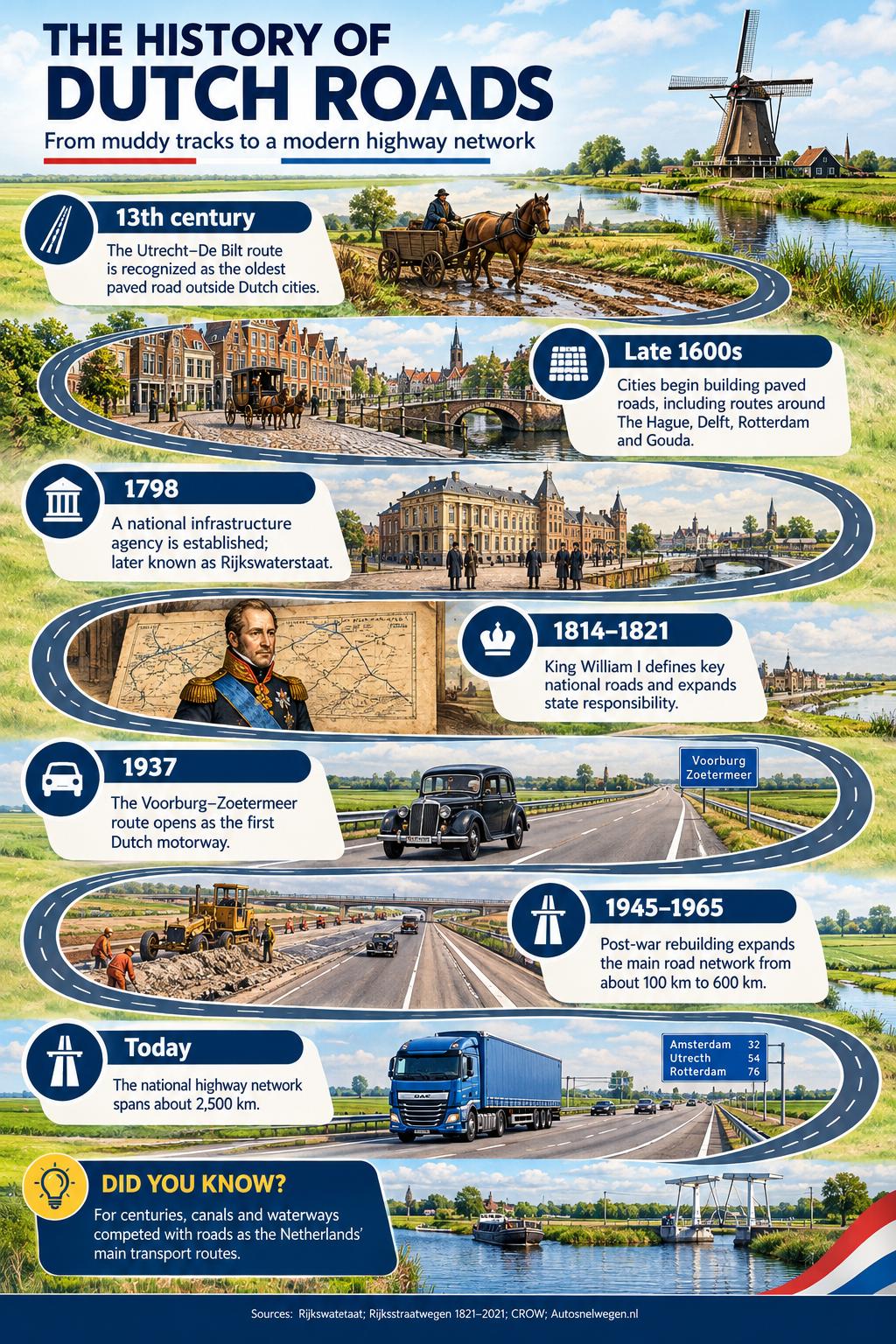

The history of Dutch roads starts with soldiers. Around AD 85, Roman army engineers laid a gravel road about five metres wide along the Rhine. They raised it on rows of posts and dug drainage ditches on both sides. They also cut it straight across the river’s bends, so troops and messages lost no time. Utrecht’s city archaeologists call it the “A1 of Roman Netherlands”.
The question on that corridor has barely changed in 2,000 years: who pays for the road, and how?
Short answer: The Dutch road network began with Roman military and supply roads built about 2,000 years ago. The network grew through canal towpaths, Napoleon’s numbered imperial roads (1811) and the first motorway (A12, 1937). Tolls on the national roads were scrapped in 1899. Trucks paid a time-based Eurovignette from 1996 until 30 June 2026. Since 1 July 2026, they pay per kilometre.
Roman roads: where the history of Dutch roads begins
The Limesweg linked every fort on the empire’s northern border and was maintained into the third century. In December 2024, Utrecht archaeologists found a branch of it leading to the fort under today’s Domplein. One of the finds was part of a harness for a horse- or ox-drawn cart.
The frontier itself, the Lower German Limes, became a UNESCO World Heritage site in July 2021.
In the south ran an older artery. The road later known as the Via Belgica dates from the reign of Augustus. It connected Cologne with Tongeren and Amiens, passing Maastricht’s Meuse crossing and Heerlen (Coriovallum). Its job was supply: the Roman army on the Rhine needed overland transport, especially on the Maastricht–Cologne stretch. The Fourteenth Legion used it in AD 71 during the Batavian Revolt.
Before asphalt, the Dutch moved by water
In the wet delta, water did much of the heavy lifting. Work on the Haarlemmertrekvaart began in 1631. The canal ran in an almost straight line between Amsterdam and Haarlem. Its first towed passenger barge sailed in 1632, carrying up to 30 people. Freight was not allowed.
The service ran until a railway made it obsolete in 1839. For two centuries, the reliable scheduled link between the two cities was a barge, not a road.
Napoleon numbers the roads
Between 1810 and 1813 the Netherlands was part of the French Empire. In 1811 Napoleon decreed a network of paved imperial roads, each with a number, which was new at the time. Route Impériale no. 2 tied Amsterdam to Paris. Its Amsterdam–Utrecht section survives inside today’s A2.
After independence, the plan kept growing: 26 national roads in 1814, 31 in 1816 and 42 in 1821. These Rijksstraatwegen were paved up to about 1850, and users paid tolls on them.
How Dutch roads lost their tolls
Tolls slowed traffic and felt like a tax. A 2002 ESB analysis by economist P.D. Groote dates the abolition of tolls on the national roads to 1899. Local leftovers lingered, and twelve toll points still existed in 1949.
The state raised road money in other ways. A weight-based road tax arrived in 1926, paid into a national road fund. The first Rijkswegenplan followed in 1927. In 1934 the government dropped a plan to toll new river bridges and raised the petrol excise instead.
That choice set the Dutch pattern for a century: road users paid through fuel and vehicle taxes rather than at the roadside.
The motorway age
The numbers from Rijkswaterstaat tell the story. The first car appeared in 1896. By 1920 there were about 15,000 cars, and by 1940 about 90,000.
- 15 April 1937: the first motorway section opens, rijksweg 12 (now the A12) between Voorburg and Zoetermeer.
- 1973: a national motorway speed limit is introduced. Before that, there was none.
- 1976: roads get letter prefixes, A for motorways and N for other roads.
Here’s a quiz question for your drivers: why is there no A3? It was planned from Amsterdam via Gouda to Rotterdam and never built.
The Eurovignette years: 1996–2026
In 1994, Belgium, Denmark, Germany, Luxembourg and the Netherlands signed a treaty for a shared time-based charge on heavy trucks. The Dutch law (Staatsblad 1995, 563) is dated 29 November 1995 and let the first tax period start on 1 January 1996. A year cost 1,614 guilders for up to three axles or 2,690 guilders for four or more. A day cost 12.90 guilders.
By 2025, a Euro VI truck with four or more axles in CO2 class 1 paid €1,274 a year or €13 a day. A zero-emission truck with four or more axles paid €318 a year.
The club shrank over time. Germany dropped the vignette in 2003 and started its distance-based LKW-Maut in 2005. Today, Luxembourg and Sweden still require a Eurovignette for trucks from 12 tonnes.
Tolls returned, but only on new links
The 1899 principle bent in this century. The Westerscheldetunnel opened as a toll tunnel in 2003. Since 30 December 2024, cars and motorcycles cross free, but freight still pays.
The A24 Blankenburgverbinding opened with a toll on 7 December 2024, collected by the RDW. The ViA15 near Arnhem will follow and is expected in 2031. The 2016 law behind these two roads allows tolls only on new connections that have a toll-free alternative route.
How the Dutch truck charge works since 1 July 2026
The vrachtwagenheffing applies to every N2 and N3 vehicle with a technical maximum mass above 3,500 kg, Dutch or foreign, loaded or empty.
- Network: about 3,000 km. That covers all motorways, plus selected N-roads and some local roads near large cities.
- Rate: an infrastructure charge plus external-cost charges for air pollution, noise and CO2. The rate depends on the technical maximum mass of the combination (four bands), the CO2 class and the Euro class.
- Equipment: a satellite on-board unit (OBU) from a service provider. NedLinq is the state-appointed provider, but its units work only in the Netherlands. Accredited EETS providers include Telepass, TotalEnergies, Eurowag, Axxes and tolltickets.
- Important: the OBU must be on and recording for the whole time the truck is in the Netherlands, including on roads that are not charged.
Enforcement is real. The RDW oversees the system and the ILT inspects with ANPR cameras, DSRC readers and mobile teams. Fines are €800 for having no service contract. A switched-off or faulty OBU, or one assigned to another vehicle, costs €500. Until 1 January 2027 the fines are halved, and only one fine per vehicle can be issued in 24 hours.
The launch went mostly smoothly, with some friction. Almost all of the roughly 165,000 Dutch trucks had a toll box on day one. For owners who had ordered a box before 1 July but were still waiting for it, the government set up a grace arrangement: no fines up to and including 7 July 2026. It applied per licence plate and ended for a plate as soon as its box was delivered. Logistics association evofenedex added that carriers who urgently needed a box could collect one at a NedLinq pickup point.
Most of the problems clustered around the state provider. Nearly three weeks after launch, the RDW told Nieuwsblad Transport that NedLinq’s problems were not yet over: poor reachability, late box deliveries and faulty invoices. On 23 July, carriers’ association TLN said that it, the RDW and the Ministry of Infrastructure agreed improvements were needed in NedLinq’s customer service, pickup points, OBU handling and invoices. The RDW also put a form on its website for reporting problems with a toll service provider.
Tip: if a box stops working on the road, contact your service provider first and make sure a working unit is available within three hours. If that fails, collect a replacement at a NedLinq pickup point.
Before and after: what changed for hauliers
| Eurovignette (until 30 June 2026) | Truck charge (from 1 July 2026) | |
|---|---|---|
| Basis | Time: day, week, month, year | Distance: per kilometre |
| Vehicles | 12 tonnes and up | Above 3.5 tonnes (N2, N3) |
| Roads | Motorways | About 3,000 km: motorways plus selected N and local roads |
| Priced by | Axles, Euro class, CO2 class | Weight band of the combination, CO2 class, Euro class |
| Euro VI diesel, CO2 class 1 | €1,274/year or €13/day (4+ axles) | 20.1 ct/km over 32 t (15.6 ct, Sept–Dec 2026) |
| Zero-emission | €318/year (4+ axles) | 3.8 ct/km over 32 t (3.0 ct, Sept–Dec 2026) |
| Equipment | No on-board unit | Satellite OBU, always on in NL |
| Dutch vehicle tax (MRB) | Paid in full | Abolished up to 12 t; cut to EU minimum above 12 t |
The maths. At 20.1 ct/km, the old annual vignette of €1,274 equals 6,338 km. At the discounted 15.6 ct/km, it equals 8,167 km. The old €13 day pass covered unlimited motorway driving, while €13 now buys about 65 km at the full rate.
A foreign truck covering 200 km on a transit day now pays €40.20 at the full rate, or €31.20 while the discount runs, instead of €13. A Dutch truck driving 80,000 charged km a year pays €16,080 at the full rate. The lower vehicle tax offsets part of that.
The winners are clean fleets and occasional visitors. Under the vignette, a diesel paid four times what a zero-emission truck paid. Per kilometre, it now pays more than five times as much. Trucks of 3.5–12 tonnes pay for the first time: 11.3 ct/km for a Euro 6 in CO2 class 1. And a large share of the money now flows back to the sector through subsidies for zero-emission trucks and charging.
Watch for one trap. CO2 class 1 covers trucks registered before 1 July 2019, and newer diesels are classed from their documentation. TLN warns that thousands of class records may be wrong. Check the RDW register before you price a lane.
What to expect next
- Higher rates on 1 January 2027. The 2027 rates rise 2.6% for inflation, to 20.6 ct/km for a Euro VI over 32 tonnes and 4.0 ct/km for electric. The 22.3% discount also ends on 31 December, so the real jump from December to January is about 32% (15.6 to 20.6 ct).
- Full fines. The halved penalties end on 1 January 2027.
- Vehicle tax returns for heavy trucks. A temporary zero MRB rate runs until 1 January 2027. After that, trucks above 12 t pay the reduced EU-minimum level.
- Subsidies, if you are fast. The AanZET zero-emission truck round opened on 29 September 2026 with €119.2 million. It was fully claimed in three days, for just over 2,100 vehicles. The next round is expected around mid-March 2027.
FAQ
Is the Eurovignette still valid in the Netherlands?
No. It stopped being valid on 1 July 2026. Holders of annual vignettes running past that date can request a refund for the unused period, but the refund is not automatic. You still need a Eurovignette for trucks of 12 tonnes and over in Luxembourg and Sweden.
Do vans need a toll box in the Netherlands?
Only N2 or N3 vehicles with a technical maximum mass above 3,500 kg need one. Some vans driven on a B licence are caught, because their mass was reduced only on paper and the technical maximum mass is what counts.
Do I need the OBU switched on outside the charged roads?
Yes. It must be active and recording for the whole time the vehicle is in the Netherlands, even on uncharged roads. A switched-off unit carries a €500 fine (€250 until 1 January 2027).
When did the Netherlands open its first motorway?
On 15 April 1937, between Voorburg and Zoetermeer on rijksweg 12. That road is now part of the A12 between The Hague and Utrecht.
What to do this week
If you run trucks into the Netherlands, check each vehicle’s CO2 class in the RDW register this week. Then price your 2027 lanes at 20.6 ct/km, not today’s discounted 15.6 ct. For the wider picture, read our guide to truck tolls across Europe and our German truck toll guide.
Two thousand/netherlands-truck-tolls/ years after the Limesweg, the history of Dutch roads has come full circle: the people who use the road pay for it directly again.
Rates, fines and dates last checked 24 October 2026 against vrachtwagenheffing.nl, vrachtwagenheffingsbeleid.nl and TLN.

