EU Truck Tolls 2026: A Complete Country-by-Country Guide
EU truck tolls 2026 explained: per-km rates by country, the new CO2 charges, and what changed in Germany, Austria and the Netherlands.
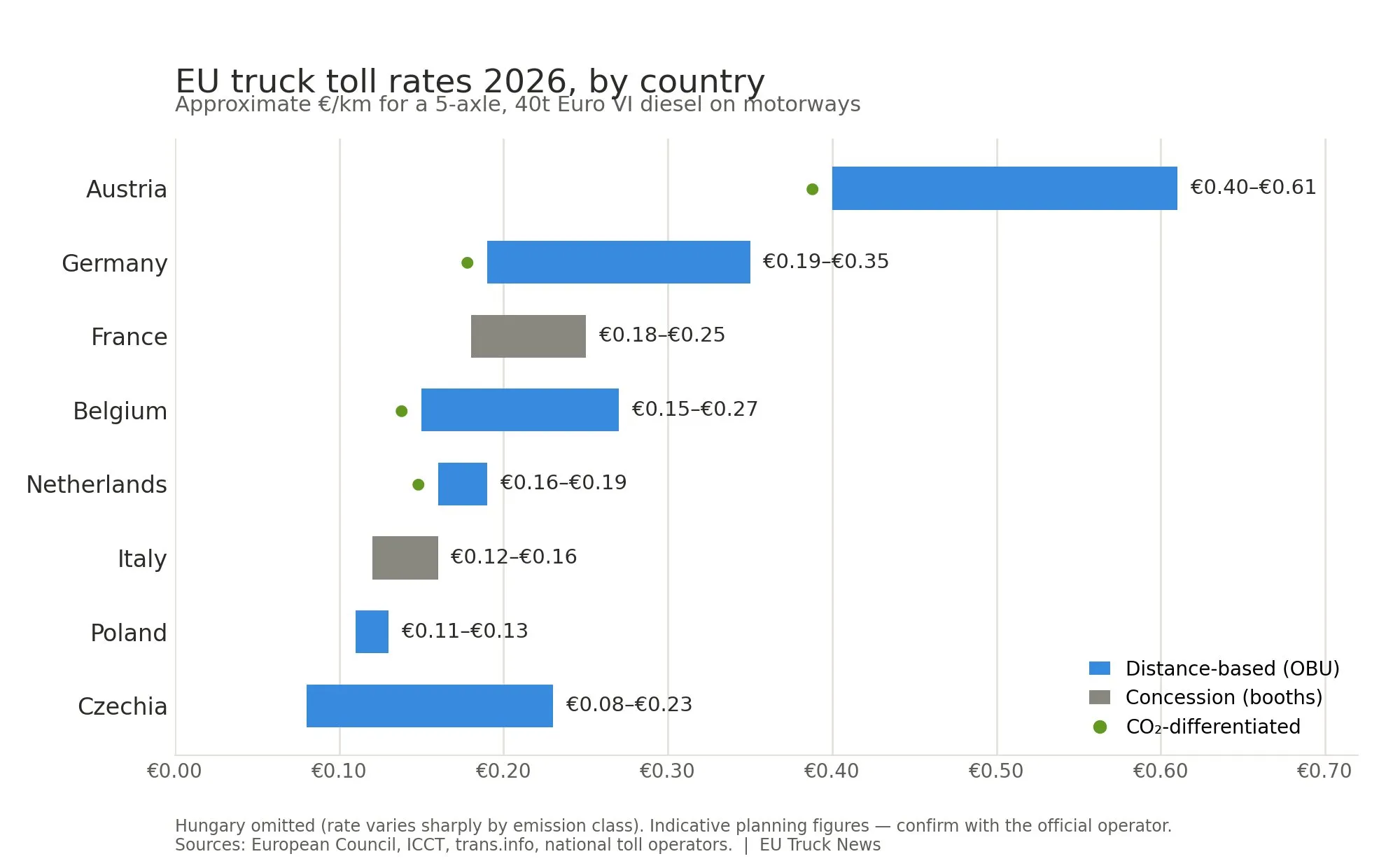
Tolls are one of the largest costs in European haulage that an operator can still influence. On many routes they now cost more than the diesel in the tank. Across the continent, tolls are moving from flat time-based charges to per-kilometre charging, and more and more countries add a truck’s CO2 emissions to the rate. On international loads, a well-planned route can save thousands of euros a year per truck compared with a careless one.
Below: how truck tolls work in 2026, what changed this year, and the main rates for every large freight market. Figures are approximate and assume a standard heavy diesel truck on motorways (roughly a 5-axle, 40-tonne Euro VI combination). Your exact rate depends on weight, axle count and emission class.
Two toll systems: distance-based and concession
European tolling splits into two broad models. The first is distance-based electronic tolling, where an on-board unit (OBU) records every kilometre and your account is billed. Germany, Austria, Belgium, Czechia, Poland, Hungary, Slovakia and, since July this year, the Netherlands work this way. The second is concession-based tolling, used mainly in France, Italy, Spain and Portugal, where you pay at physical booths for each stretch of privately operated motorway.
More countries are moving to the first model. The EU’s revised Eurovignette Directive pushed member states to charge by actual distance and to set different rates by CO2 emission class, so a cleaner truck now pays less toll.
What changed in 2026
Several countries changed their tolls this year:
- The Netherlands ended the Eurovignette on 30 June and switched to per-kilometre charging on 1 July, collected through a mandatory OBU. The average rate is around €0.19/km, and trucks without a unit may not use tolled roads.
- Poland raised e-TOLL rates by roughly 40% in February, the largest single increase in the EU this year. Polish kilometres are still among the cheapest.
- Austria introduced new rates from 1 January, with charges now reflecting axle count, CO2 class and noise. Zero-emission trucks pay as little as €5.77 per 100 km; the dirtiest classes pay over €61.
- Czechia raised motorway rates only slightly but put some Class I road categories up by more than 40%. That makes it more expensive to avoid motorway tolls by using other roads.
- Romania was set to replace its flat rovinieta with a distance-based system, TollRo, also from 1 July.
Rates by country (2026)
Approximate rate per kilometre for a heavy Euro VI diesel on motorways. Use it for planning, not for quotes.
| Country | System | Approx. €/km (Euro VI diesel) | CO2-based? | Notes |
|---|---|---|---|---|
| Germany | Distance (Maut) | €0.27 – €0.35 | Yes | 40 t, 5 axles: CO2 class 4 to class 1; rates unchanged since July 2024. Full German Maut guide |
| Austria | Distance (GO-Maut) | up to ~€0.61 (articulated) | Yes | Tolls now exceed fuel cost on many runs |
| Belgium | Distance (Viapass) | €0.15 – €0.27 | Yes | ZEV trucks pay €0 in Flanders & Brussels |
| Netherlands | Distance (from 1 Jul) | ~€0.19 | Yes | Eurovignette ends 30 June; OBU mandatory |
| Czechia | Distance (e-Myto) | €0.08 – €0.23 | Yes | Class I road rates jumped sharply in 2026 |
| Poland | Distance (e-TOLL) | ~€0.13 (heaviest Euro 6) | No | +40% in Feb 2026, still among the cheapest |
| Hungary | Distance (HU-GO) | varies; high for old trucks | Yes | Older Euro classes pay heavily |
| France | Concession (booths) | €0.18 – €0.25 | No | No CO2 differentiation yet |
| Italy | Concession (booths) | €0.12 – €0.16 | No | Higher on mountain sections |
For Hungary’s categories, route tickets and fines, see our complete HU-GO guide for 2026.
How the CO2 class changes your toll
Your truck’s CO2 emission class now sets part of the price per kilometre. Germany went first with a CO2 surcharge of €200 per tonne, which added around €0.16/km and raised German tolls by roughly 80% in one step. It also works the other way: a Euro VI truck in the best CO2 class can pay 20–25% less on German tolls than the worst class, and over a year the gap between CO2 Class 1 and Class 4 can reach €5,000–€10,000 per truck.
Zero-emission trucks do even better. Germany exempts them completely until 30 June 2031, Austria charges them around 25% of the standard rate, and Belgium’s Flanders and Brussels regions charge them nothing.
What operators can do
Keep gross weight, axle count, Euro class and CO2 class on record for every vehicle, because all four set the rate. Map your corridors: a single Rotterdam–Milan run can cross five toll systems, so the route choice changes the cost. And build the 2026 changes into your customer rates, especially the Dutch kilometre charge and the carbon pricing that ETS2 brings in 2027.
Fuel is the other big cost per kilometre: our weekly diesel prices in all EU countries (in German) show prices with and without VAT. And empty running across Europe is often the biggest cost of all. Driving in winter? Check the winter tyre rules for trucks country by country. Routing through Germany over Christmas or a public holiday? Our German holiday driving ban calendar for 2026/27 (in German) lists every day trucks over 7.5 t may not drive.
Sources: European Council; ICCT; trans.info; Toll Collect; ASFINAG; national toll operators. Rates are indicative and change often. Confirm current figures with the official operator before pricing a job.
Country guides
- HU-GO in 2026: The Complete Guide to Hungary's Truck TollHU-GO 2026 explained: J2–J5 categories, per-km rates, 300-minute route tickets, registration, OBU options and the fines that catch foreign trucks.
- German Truck Toll (Lkw-Maut) 2026: Rates, CO2 Classes and TollNowGerman truck toll 2026: every rate in cents per km, what a better CO2 class saves, who pays, exemptions, the TollNow app that replaced pre-booking, and fines.