


Picture a dispatcher booking a Rotterdam–Munich run today. The
truck’s on-board unit records its position on German motorways and
federal roads, and the toll follows from that record. It feels like a
very modern arrangement. It isn’t. The history of German roads shows
they have been built, guarded and charged for since Roman times, and the
Maut is only the latest chapter.
The short answer: German roads developed in five
stages: Roman military and postal roads, medieval toll-and-escort
routes, paved chaussees in the 18th and 19th centuries, motor roads and
the Autobahn from 1921 onward, and today’s distance-based truck toll,
which began on 1 January 2005.
Charging for road use is not new in Germany. What changes from era to
era is who collects the money and how. Here is the route from one end of
that story to the other, and what it means for anyone running freight
across the country.
Roman roads: the first
network
The Romans treated roads as infrastructure for armies and
administration. One well-studied example is the road from Trier to
Cologne, about 147 kilometres long, part of a network that started at
Lyon. Archaeological surveys along it found inns, posting stations and
military road posts at intervals of no more than three to four
kilometres. A state postal service, the cursus publicus,
depended on that kind of chain.
The frontier tells a similar story. The Upper German-Raetian Limes
ran roughly 550 kilometres between the Rhine and the Danube. It began as
little more than a simple road and was later reinforced with palisades,
ditches and walls. It had around 120 fort sites and almost 900
watchtowers. Until the mid-3rd century, crossing it meant controlled
entry and exit, including customs clearance. It won UNESCO
World Heritage status as part of the “Frontiers of the Roman Empire”
site on 15 July 2005.
The Middle Ages: roads that
charged
In the Middle Ages the Roman roads deteriorated. Alongside them grew
a system built around tolls and protection. In the Holy Roman Empire,
traders in certain goods were required to use designated roads. In
return they were normally guaranteed safe conduct, the
Geleitrecht. A route could be lined with toll stations, each
collecting a small amount.
For hauliers, this is an early ancestor of the Maut: you pay along
the way, and the payment is tied to the road you choose or are obliged
to use.
The chaussee era:
paved roads and toll houses
The paved “chaussee” arrived in the 18th century. The first one in
Swabia, between Öttingen and Nördlingen, dates from 1753. In Prussia
after 1807, chaussee building served military needs first and trade
later. Toll collectors lived in roadside houses placed roughly one
Meile apart, so charging was built into the road itself.
The payoff was large. When the Altona–Kiel chaussee opened in 1832, a
coach journey dropped from 16 hours to nine, and a horse and cart could
carry about three times the load. Better roads meant faster, heavier
freight. That logic has not changed.
The first
motor roads: AVUS, HAFRABA and Cologne–Bonn
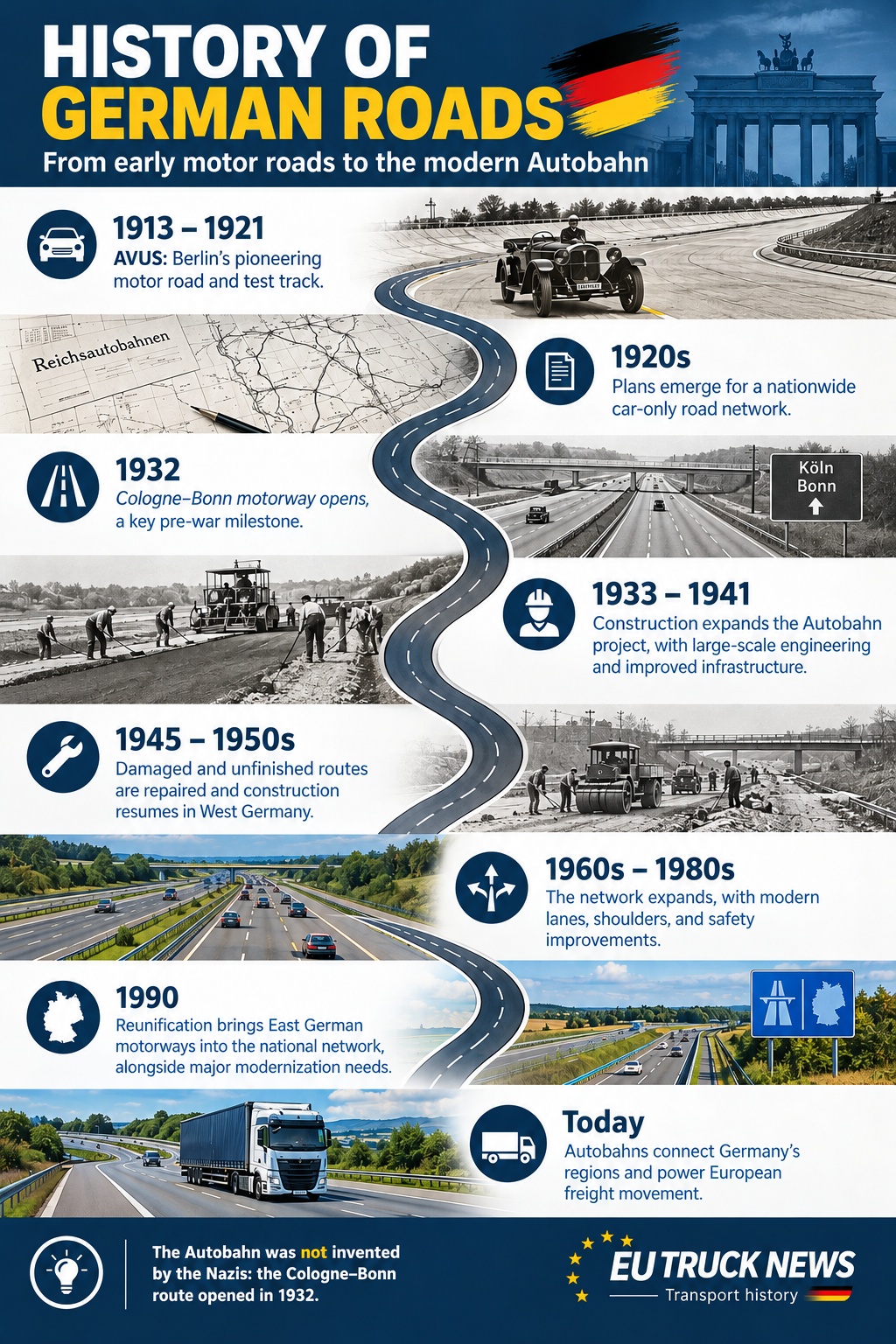
Motor traffic needed roads of its own. The AVUS in Berlin was
completed in 1921. It was almost ten kilometres long with separate
carriageways for each direction. Work had started around 1913 and
stopped in 1914 when the First World War began.
In 1926 a consortium formed to plan HAFRABA, an 880-kilometre
north–south route linking Hamburg, Bremen, Frankfurt and Basel. It was
never built as planned, because of cost, but its technical guidelines
were used later.
The road that made the idea real was Cologne–Bonn. Construction began
in autumn 1929 and Cologne’s mayor, Konrad Adenauer, opened it on 6
August 1932, according to the Rhineland heritage portal KuLaDig.
It was about 20 kilometres long, free of level crossings, with 28
underpasses and three overpasses, and designed for 120 km/h. Roughly
5,540 unemployed workers built it largely by hand. It was formally
upgraded to a federal Autobahn in 1958 and is known today as the A
555.
The 1930s and the postwar
Autobahn
In 1933, according to Planet
Wissen’s Autobahn history, the government announced a nationwide
motorway network of 7,000 kilometres and set up a dedicated construction
company. Ceremonial work on the Frankfurt–Mannheim section began on 23
September 1933, using planning inherited from HAFRABA. About 1,000
kilometres were finished by 1936. In 1939, shortly before the Second
World War, workers, machines and materials were diverted to military
projects.
By 1945 bombing had destroyed many sections. By 1949 most bridges
were usable again and about 2,100 kilometres of motorway were open. Then
the rebuilding model changed:
- 1951: the Federal Highway Research Institute (BASt) was
founded. - 1955: a law assigned part of the mineral oil tax to motorway
construction. - 1956: the Frankfurter Kreuz was finished as the first major postwar
project.
Today the federal motorway network is about 13,000 kilometres long.
Since 1 January 2021 it has been run by Die
Autobahn GmbH des Bundes.
From vignette to
satellite: the Maut timeline
Germany’s truck toll arrived in two steps. In 1995, trucks of 12
tonnes and above began paying a time-based fee for motorway use,
depending on the number of axles. The same system applied in Belgium,
the Netherlands, Luxembourg, Denmark and Sweden. At EU level, Directive
1999/62/EC, adopted on 17 June 1999, set the common charging
rules.
The distance-based toll started on 1 January 2005. It had been
planned for the end of August 2003, but technical problems pushed it
back. The Federal Ministry of
Transport describes it as a shift from tax funding to user funding
of federal road construction. Since then the scope has widened step by
step. (For current rates, see our guide to German Maut rates for trucks.)
| Date | Change |
|---|---|
| 1 Jan 2005 | Distance-based toll on motorways, trucks from 12 t |
| 1 Aug 2012 and 1 Jul 2015 | About 2,300 km of four-lane federal roads added in two stages |
| 1 Oct 2015 | Weight threshold lowered from 12 t to 7.5 t |
| 1 Jul 2018 | All roughly 40,000 km of federal roads (Bundesstraßen) tolled |
| 1 Sep 2018 | Federal government takes over Toll Collect |
| 1 Jan 2019 | Weight classes introduced |
| 1 Dec 2023 | CO₂-based rates introduced; rates and threshold follow technically permissible maximum mass |
| 1 Jul 2024 | Threshold lowered to vehicles above 3.5 t |
The Maut today
Toll Collect collects the toll and runs automated checks. The Federal
Office for Logistics and Mobility (BALM) handles monitoring. At the end
of 2023, the toll network measured 101,610 kilometres in tariff length,
counted in both driving directions. The actual route length is about
51,000 kilometres. In the second half of 2023, about 1.35 million
different trucks were toll-liable.
Two rules matter most to fleets right now. Goods vehicles above 3.5
tonnes pay, with an exemption for certain craft vehicles under 7.5
tonnes. And zero-emission trucks are exempt until 30 June 2031. A law
passed in November 2025 extended that exemption, which would otherwise
have ended on 31 December 2025.
Revenue was about €13.4 billion in 2025. After collection and control
costs, half goes to federal roads and half to mobility measures, mainly
rail. Rates rest on a cost-recovery study covering 2023 to 2027.
Non-payment is an administrative offence: the toll must be paid
retroactively, and a warning or fine may follow. EU rules are tightening
as well: CO₂-differentiated tolls have been required for heavy vehicles
since 2024.
What the
history of German roads means for your routes
Every era of German road history brought faster, heavier freight and
a new way of paying for it. The Maut continues that pattern with finer
detail: your vehicle’s weight basis, CO₂ class and route now decide what
you pay.
If you run trucks or vans through Germany, then check how your
vehicles are classed before your next trip, and read our guide to current German Maut rates for trucks. Running into the Netherlands too? See our overview of Netherlands truck tolls, or start with EU truck tolls.
Frequently asked questions
When did the German truck
toll start?
The distance-based toll for trucks started on 1 January 2005, on
motorways. A time-based fee for heavy vehicles had applied since 1995.
The toll was extended to all federal roads on 1 July 2018 and to
vehicles above 3.5 tonnes on 1 July 2024.
Which was Germany’s first
Autobahn?
The Cologne–Bonn road, opened on 6 August 1932 and about 20
kilometres long, is regarded as Germany’s first Autobahn project. It was
upgraded to a federal Autobahn in 1958 and is now the A 555. The AVUS in
Berlin, completed in 1921, was an earlier motor-only road.
Do electric trucks
pay the Maut in Germany?
Zero-emission trucks are exempt from the German truck toll until 30
June 2031. Zero-emission vehicles up to 4.25 tonnes are permanently
exempt. After mid-2031, a share of certain toll components is expected
to apply, according to current guidance.
Facts checked on 24 October 2026. Toll rules change; confirm
current rates with Toll Collect or the Federal Ministry of
Transport.

