By EU Truck News — June 1, 2026
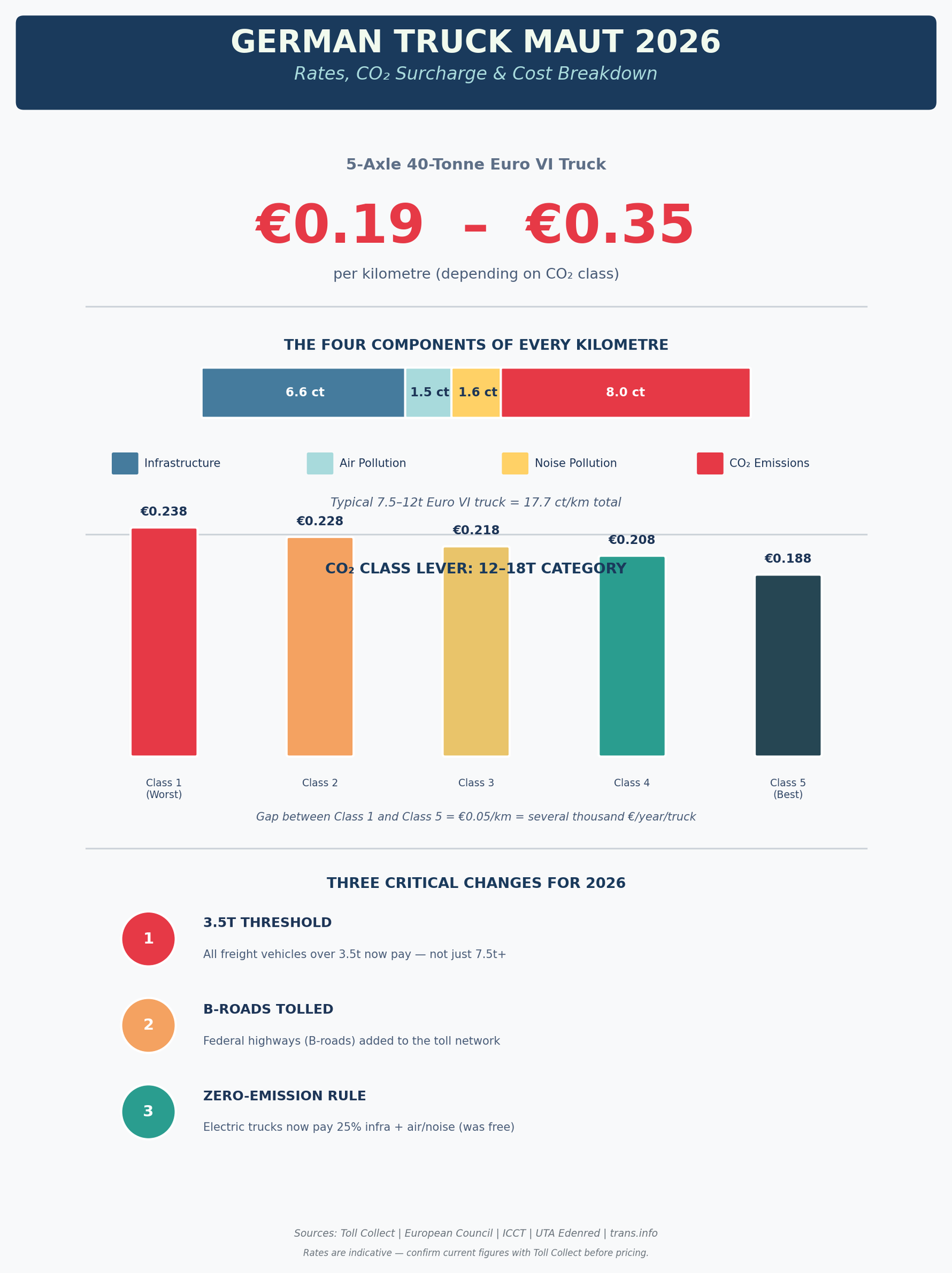
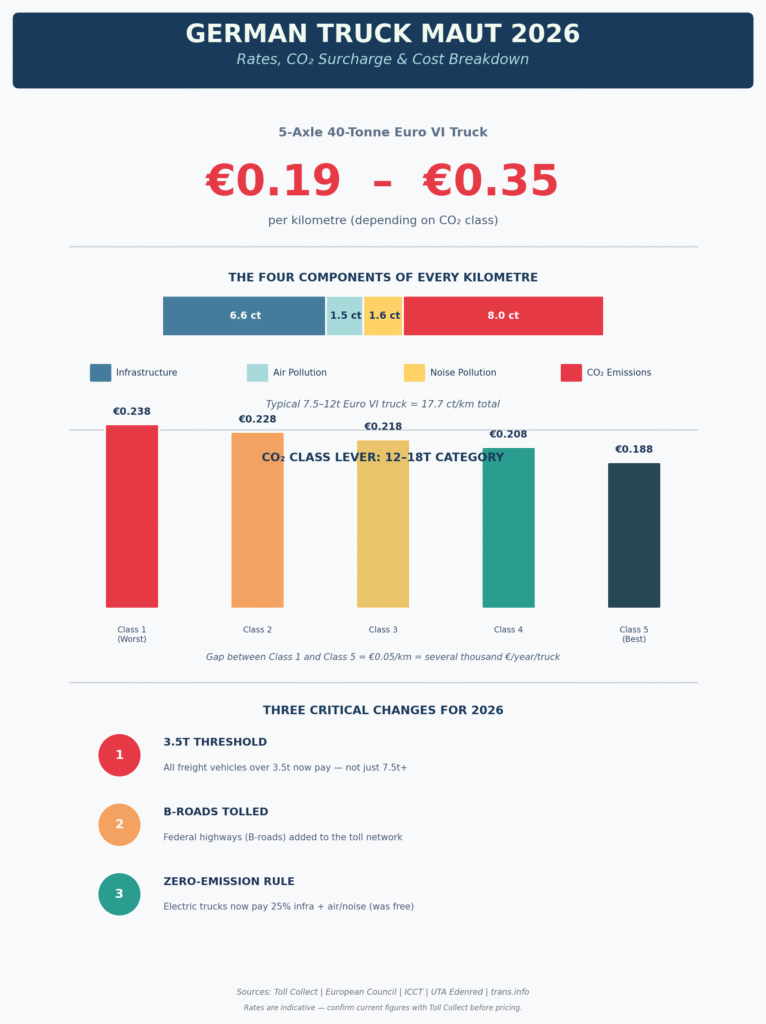
German truck Maut 2026 rates have climbed sharply, and the Maut is now almost certainly your single largest road cost if you run trucks through Germany. A 5-axle, 40-tonne Euro VI truck now pays roughly €0.19 to €0.35 per kilometre depending on its CO2 class, because a €200-per-tonne carbon component added around €0.16/km and pushed German tolls up by close to 80%. Furthermore, the toll now covers all vehicles over 3.5 tonnes on more than 52,000 km of motorways and federal roads. Therefore, understanding exactly how the German truck Maut 2026 system is built is the first step to controlling it.
Germany sits on almost every major European freight corridor. Consequently, for most international operators the Maut is not optional — it is a fixed cost on nearly every load heading south or east.
How the German truck Maut 2026 system works
The Lkw-Maut is a distance-based toll that Toll Collect collects electronically. There are no booths: an on-board unit (OBU) in the cab tracks your kilometres by satellite, and the system bills your account automatically.
The four components of your German truck Maut 2026 rate
Since the CO2 surcharge arrived, the per-kilometre rate is the sum of four separate parts:
- Infrastructure — the base cost of using the road
- Air pollution — a small charge tied to your Euro emission class
- Noise pollution — a fixed, small per-km amount
- CO2 emissions — the newest and largest variable, based on your CO2 emission class
For a typical Euro VI truck in the 7.5–12t band, the German truck Maut 2026 rate breaks down roughly as 6.6 ct infrastructure, 1.5 ct air, 1.6 ct noise, and 8.0 ct CO2 — about 17.7 ct/km in total. However, for heavier trucks the CO2 element is now the biggest single lever in the whole calculation, which is the key insight for managing your costs.
Who must pay the German truck Maut in 2026
Since 1 July 2024, the German truck Maut 2026 rules apply to all freight vehicles over 3.5 tonnes technically permissible gross mass — not just the old 7.5-tonne threshold. That change swept a large number of vans and light trucks into the system for the first time. Moreover, it applies to German and foreign-registered trucks equally; there is no exemption for passing through. Evasion is an offence carrying fines up to €20,000, and enforcement is fully international.
What changed for German truck Maut 2026
Two changes matter most this year.
The zero-emission rule tightened on 1 January 2026
Until the end of 2025, zero-emission trucks were fully exempt from the Maut. From 1 January 2026, however, they now pay 25% of the infrastructure rate plus the air and noise components — still a discount of around 75% versus a diesel equivalent, but no longer free. Full exemption for zero-emission vehicles up to 4.25 tonnes remains, and the broader electric-truck toll advantage runs to mid-2031.
The network and scope keep widening
The German truck Maut 2026 system now covers most federal highways (B-roads) on top of motorways. Therefore, the old tactic of dropping onto parallel A-roads to avoid charges no longer works across much of the country. Combined with the 3.5-tonne extension, far more of your mileage in Germany is now chargeable than two years ago.
The CO2 class lever: where your German truck Maut 2026 money goes
Your truck’s CO2 emission class is now a direct line item, and the gap between classes is large enough to matter to your margins.
How the classes work
Toll Collect initially assigned every registered vehicle to CO2 class 1, the most expensive. Cleaner, more efficient trucks qualify for classes 2 through 5, each cheaper than the last. Crucially, many operators are paying class-1 rates simply because their vehicle has not been reclassified — that is money left on the table.
What the difference is worth
A Euro VI truck in the most efficient CO2 class can pay materially less per kilometre than the same truck in class 1 — in the 12–18t category, roughly €0.188/km versus €0.238/km. Across a year of German mileage, the gap between the best and worst CO2 class can run into several thousand euros per truck. Consequently, checking and, where possible, correcting your fleet’s CO2 classification is one of the highest-return administrative tasks available to you.
How to reduce your German truck Maut 2026 bill
Here are five practical moves, in order of impact:
1. Verify your CO2 classification
Confirm what class Toll Collect has assigned each vehicle. If a truck qualifies for a better class than the default, getting it reclassified directly lowers every future kilometre.
2. Plan routes with toll cost in mind
Because B-roads are now largely tolled too, the saving from detours has shrunk. However, route choice across borders still matters enormously. A load from Rotterdam to northern Italy can cross several toll systems, and the German leg is usually the most expensive. Therefore, modelling the true per-km cost of each option before you quote is now a pricing necessity, not a nicety.
3. Recover the cost in your rates
The operators who absorb toll rises quietly lose margin; those who itemise and pass them through protect it. Build the current German truck Maut 2026 rate into your customer pricing explicitly, and revisit it whenever rates change.
4. Look hard at the zero-emission maths
With diesel tolls high and electric trucks still heavily discounted until 2031, the total-cost-of-ownership gap on toll-heavy German routes is narrowing faster than many fleets realise. It will not suit every operation, but it is worth a proper calculation rather than an assumption.
German truck Maut 2026: Frequently asked questions
How much is the German truck Maut in 2026?
For a 5-axle, 40-tonne Euro VI truck, roughly €0.19 to €0.35 per kilometre depending on CO2 class. Lighter vehicles and cleaner CO2 classes pay less; older, higher-emission trucks pay more.
What is the CO2 surcharge on the Maut?
A carbon component of €200 per tonne of CO2, introduced in December 2023, which adds roughly €0.16/km for a typical diesel truck and is the main reason German tolls jumped.
Do foreign trucks have to pay the German Maut?
Yes. The Maut applies to all freight vehicles over 3.5 tonnes regardless of country of registration. Enforcement is international and fines reach €20,000.
Are electric trucks still exempt from the Maut in 2026?
Not fully. From 1 January 2026 zero-emission trucks pay 25% of the infrastructure rate plus air and noise charges — about a 75% discount rather than free. Full exemption remains for zero-emission vehicles up to 4.25 tonnes.
How do I pay the German Maut?
Through an on-board unit (OBU) from Toll Collect or a certified EETS provider. The unit tracks your kilometres automatically and your account is billed; manual booking is also possible for occasional trips.
If you go the manual booking route you have to do the following steps:
Go to the Toll Collect App
Install the Toll Collect App on your smartphone or tablet to reserve your route either up to 24 hours ahead or just before setting off. Secure payment options include fuel cards (such as DKV or UTA) and credit cards.
The Toll Collect Website
Visit the Toll Collect Online Log-on portal to plan and book your journey. This option works well for users who aren’t registered and can be accessed from any computer prior to departure.
At a Payment Terminal
Alternatively, you can register and pay in person at one of the more than 3,500 Toll Collect Terminals found at rest areas and fuel stations across Germany and nearby regions.
Information Required for Booking
Before logging in, make sure you have the following details ready:
- The precise number of axles and the vehicle’s weight.
- The truck’s Euro emission standard.
- The license plate number.
- Your intended starting location, destination, and any necessary route points.
Plan your German truck Maut 2026 costs before you quote
The Maut is now too large a cost to estimate by feel. Before pricing your next German load, work out the real German truck Maut 2026 per-kilometre figure for your specific vehicle and CO2 class. Our [complete EU truck tolls 2026 guide] puts Germany in context alongside every other major market. Getting the number right is the difference between a profitable load and a loss you only spot at month-end.
Sources: Toll Collect; European Council; ICCT; UTA Edenred; trans.info. Rates are indicative and change with inflation and policy — always confirm current figures with Toll Collect before pricing a job.

