Last updated: 29 May 2026 ·
Road tolls have quietly become one of the largest controllable costs in European haulage. On many routes they now exceed the cost of the diesel in the tank. The reason is no mystery: across the continent, tolls are shifting from flat time-based charges to per-kilometre charging, and a vehicle’s CO2 emissions are increasingly baked into the rate. For an operator running international loads, the difference between a well-planned route and a careless one can run into thousands of euros a year per truck.
This guide breaks down how truck tolls work in 2026, what changed this year, and the headline rates for every major freight market. Figures are for a standard heavy diesel truck (roughly a 5-axle, 40-tonne Euro VI combination) on motorways, and are approximate — your exact rate depends on weight, axle count, and emission class.
The two systems you’ll meet
European tolling splits into two broad models. The first is distance-based electronic tolling, where an on-board unit (OBU) records every kilometre and your account is billed. Germany, Austria, Belgium, Czechia, Poland, Hungary, Slovakia and — from July this year — the Netherlands all work this way. The second is concession-based tolling, used mainly in France, Italy, Spain and Portugal, where you pay at physical booths for each stretch of privately operated motorway.
The trend is firmly towards the first model. The EU’s revised Eurovignette Directive pushed member states to charge by actual distance and to differentiate rates by CO2 emission class. That second point matters more every year: a cleaner truck is now a cheaper truck to run.
What changed in 2026
Several markets moved at once this year, which is why route costs feel like a moving target:
- The Netherlands scraps the Eurovignette on 30 June and switches to per-kilometre charging from 1 July, collected via a mandatory OBU. The average rate lands around €0.19/km, and trucks without a unit won’t be permitted on tolled roads.
- Poland raised e-TOLL rates by roughly 40% in February — the steepest single increase in the EU this year — though Polish kilometres remain among the cheapest.
- Austria introduced new rates from 1 January, with charges now reflecting axle count, CO2 class and noise. Zero-emission trucks pay as little as €5.77 per 100 km; the dirtiest classes pay over €61.
- Czechia lifted motorway rates only slightly but hit Class I roads hard, with some categories up over 40% — bad news for anyone using alternative routes to dodge motorway charges.
- Romania replaces its flat rovinieta with a distance-based system, TollRo, also from 1 July.
Rates by country (2026)
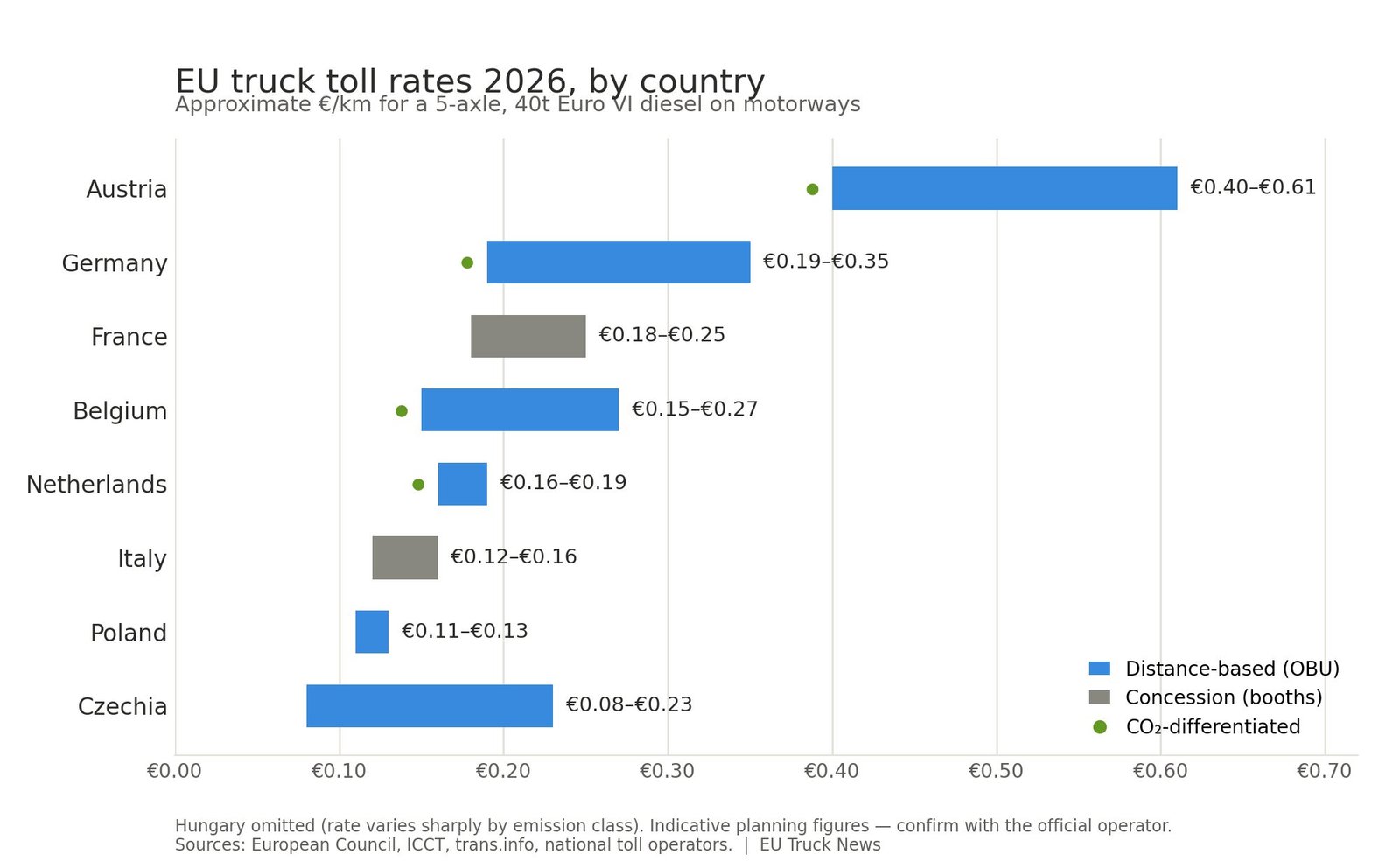
The table below gives an approximate per-kilometre figure for a heavy Euro VI diesel on motorways. Treat it as a planning guide, not a quote.
| Country | System | Approx. €/km (Euro VI diesel) | CO2-based? | Notes |
|---|---|---|---|---|
| Germany | Distance (Maut) | €0.19 – €0.35 | Yes | Most expensive major market; €200/tonne CO2 surcharge |
| Austria | Distance (GO-Maut) | up to ~€0.61 (articulated) | Yes | Tolls now exceed fuel cost on many runs |
| Belgium | Distance (Viapass) | €0.15 – €0.27 | Yes | ZEV trucks pay €0 in Flanders & Brussels |
| Netherlands | Distance (from 1 Jul) | ~€0.19 | Yes | Eurovignette ends 30 June; OBU mandatory |
| Czechia | Distance (e-Myto) | €0.08 – €0.23 | Yes | Class I road rates jumped sharply in 2026 |
| Poland | Distance (e-TOLL) | ~€0.13 (heaviest Euro 6) | No | +40% in Feb 2026, still among the cheapest |
| Hungary | Distance (HU-GO) | varies; high for old trucks | Yes | Older Euro classes pay heavily |
| France | Concession (booths) | €0.18 – €0.25 | No | No CO2 differentiation yet |
| Italy | Concession (booths) | €0.12 – €0.16 | No | Higher on mountain sections |
The CO2 class lever
The single most useful thing this guide can tell you is that your truck’s CO2 emission class is now a direct line item, not an abstraction. Germany set the benchmark with a CO2 surcharge of €200 per tonne, which added around €0.16/km and pushed German tolls up by roughly 80% almost overnight. The flip side is the saving: a Euro VI truck in the best CO2 class can pay 20–25% less on German tolls than the worst class, and over a year the gap between CO2 Class 1 and Class 4 can reach €5,000–€10,000 per truck.
Zero-emission trucks do even better. Germany exempts them almost entirely until 2031, Austria charges them around 25% of the standard rate, and Belgium’s Flanders and Brussels regions charge them nothing at all. Wherever your fleet sits today, the direction of travel is unambiguous: clean trucks are being made structurally cheaper to operate, and that advantage widens each year.
What to do with this
Three practical steps. First, know your numbers — gross weight, axle count, Euro class and CO2 class for every vehicle, because all four feed the rate. Second, map your corridors: a single Rotterdam–Milan run can cross five separate toll systems, and route choice between them is now a real cost decision. Third, factor the 2026 changes into your customer rates before they bite, particularly the Dutch switch in July and the carbon pricing coming through ETS2 in 2027.
Sources: European Council; ICCT; trans.info; Toll Collect; ASFINAG; national toll operators. Rates are indicative and change frequently — always confirm current figures with the official operator before pricing a job.

