
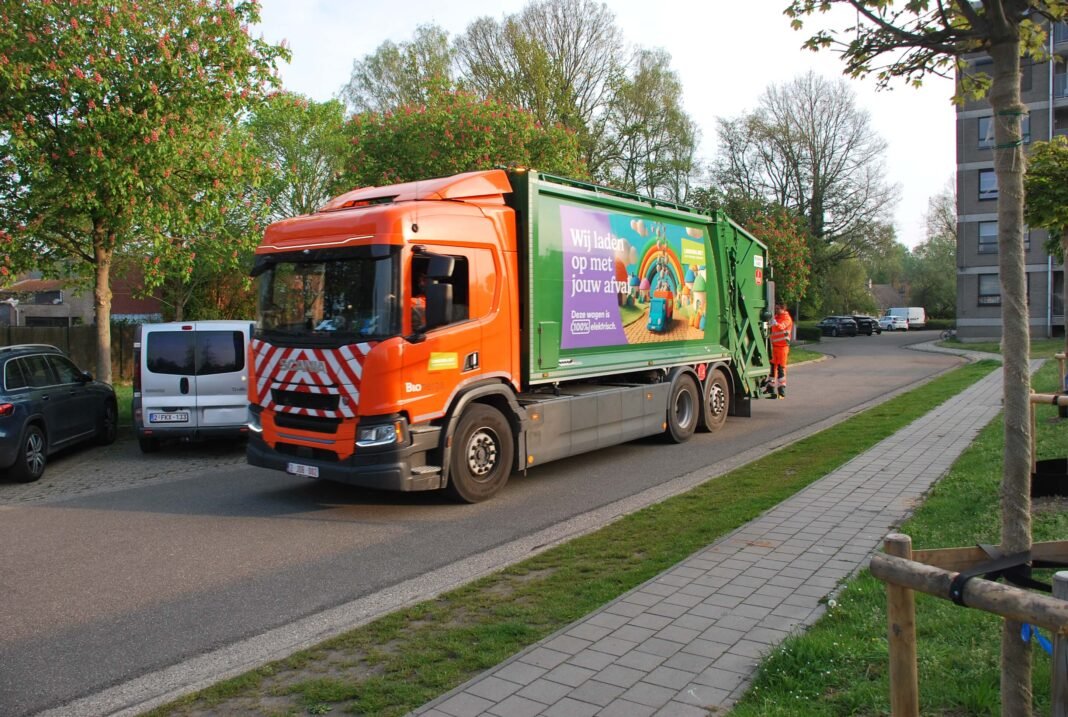

Limburg.net takes care of waste collection in the 38 municipalities of the province of Limburg and in the city of Diest. Bionerga Logistics supplies vehicles to Limburg.net for the collection of household waste and recently put its first electric truck into use: a Scania 23P 6×2*4 equipped with a Mol VDK body that is powered by the electric PTO.
This is a first for the provincial intermunicipal company. Limburg.net has chosen a Scania 23P with the largest battery pack, namely 624 kWh. “We made this choice because of the very extensive operating area: the entire province of Limburg, with large cities, municipalities and remote rural areas, which are more or less far away from our central location in Beringen. We also serve Diest, just outside the provincial borders. By deploying this new electric Scania on various existing routes and in different seasons, we want to build a dataset with which we can determine the required battery capacity for each route in the future. This way we avoid unnecessary investments,” explains Wim Govaerts, Innovation Manager at Limburg.net, out.
During the first tests, this Scania consumed approximately 1.5 kWh/km, while diesel vehicles consume an average of between 40 and 45 l/100 km. “An electric truck consumes less at low speeds and recovers energy during braking, making it a logical choice for us. We also expect less wear on parts such as the brakes, which will not only reduce costs, but also particulate matter emissions. And we haven’t even mentioned the silence and absence of exhaust fumes that are inherent to electric vehicles,” emphasizes Wim Govaerts.
The truck’s batteries are charged with energy produced by Bionerga’s biomass power plant in Beringen. “To optimize costs even further, we use dynamic charging to adapt to the demand registered by the electricity grid, with peak and off-peak hours that we want to make even better use of in the future. In this way, our electric fleet will also contribute to stabilizing the grid,” concludes Wim Govaerts.

