
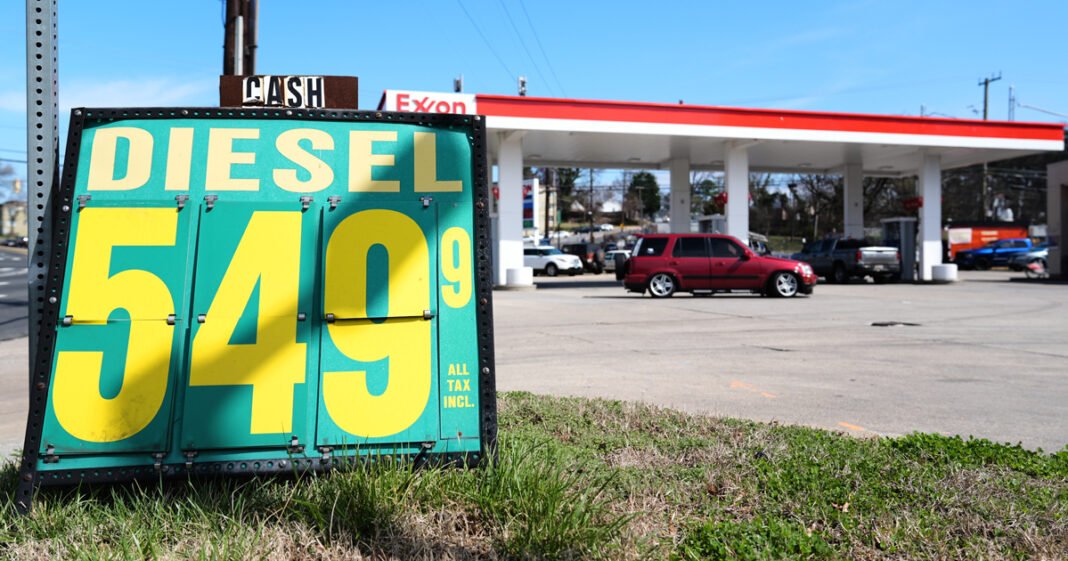

The price of diesel is displayed at a gas station March 19 in Hyattsville, Md. (Stephanie Scarbrough/Associated Press)
April 3, 2026 3:20 PM, EDT
Key Takeaways:
- Iran’s takeover of the Strait of Hormuz and regional attacks have lifted fuel prices and disrupted ocean and U.S. trucking markets since late February.
- Diesel prices jumped 38.6% to $5.401 a gallon by March 30, pushing oil above $100 and lifting spot rates and fuel surcharges, executives said.
- Carriers expect spot pricing to react first, contract rates to follow via surcharges and linehaul changes and freight inflation as rerouting and capacity tightness persist.
Diesel prices are climbing, ocean vessels are rerouting and U.S. trucking rates are responding as the conflict in Iran ripples through global energy and freight markets.
The disruption stems from Iran’s attacks on neighboring countries and its takeover of the Strait of Hormuz, a critical choke point for global energy flows. The escalation followed coordinated U.S. and Israeli strikes beginning Feb. 28 and has snarled the movement of oil and other energy-linked cargo, sending fuel prices higher, which has spilled into freight markets.
“This conflict is disrupting supply chains by injecting energy volatility into the freight market, raising transportation costs and reducing network predictability,” said Craig Geskey, vice president of strategic solutions at Traffix. “The result is higher landed cost, greater service risk and increased pressure on companies without flexible, well-structured supply chains.”
Geskey said the disruption is moving downstream across procurement, inventory planning and transportation execution as companies respond to shifting fuel costs, changing carrier behavior and less reliable transit flows. He expects U.S. trucking rates to rise, with the most immediate impact showing up in spot pricing and fuel recovery.
“Contract pricing adjusts more gradually through surcharge and linehaul changes,” Geskey said. “More importantly, it exposes how vulnerable a company’s network is to rapid fuel volatility, shifting carrier behavior and operational inefficiency.”
Diesel Prices Surge
The Energy Information Administration reported that diesel prices have jumped 38.6% since the start of the war, reaching $5.401 a gallon by March 30, as global supply disruptions pushed oil prices above $100 a barrel.
“Heightened risk and reduced traffic through the Strait of Hormuz are forcing vessel rerouting and extending transit times while tightening global shipping capacity,” said Ryan McDermott, director at Lincoln International. “Higher oil prices and war-risk premiums are driving sharp increases in ocean freight, bunker fuel and insurance costs across these lanes.”
RELATED: How Does a California Fleet Tackle $7 Diesel?
McDermott said energy-driven cost inflation is filtering into manufacturing, chemicals, consumer goods and other sectors, a trend likely to become increasingly visible to consumers beyond the pump. Rising diesel prices, he added, are putting upward pressure on both contract and spot trucking rates.
“Carriers/brokers with lagged surcharge mechanisms may see temporary margin compression but cost pass-through should normalize over time,” McDermott said. “The opposite is true for carriers that have fuel cost-plus models.”
He also warned that while global disruption could drive inventory builds and modal shifts that support domestic trucking volumes in the near and medium term, sustained energy inflation ultimately could sap demand and offset near-term rate strength.
Trucking’s Cost Structure
“Fundamentally, the most obvious is the rising fuel prices,” said Ken Adamo, chief of analytics at DAT Freight & Analytics. “On the trucking side … it’s anywhere from 30% to 40% of that operating cost, depending on what fuel is doing at any one point in time. So that increase is obviously putting pressure on the bottom line.”
Adamo said fuel may be the primary industrywide impact but cautioned that exposure varies by sector, with recession- and energy-sensitive industries facing the most risk. Flatbed haulers tied to the fracking industry, he noted, often benefit from higher oil prices, while home construction remains a significant drag on demand.
Flatbed trucking rates have climbed in 2026 despite lackluster demand on the home construction front, DAT data shows. (Great Dane)
On the contract side, where most freight moves, fuel surcharges are the primary impact, Adamo said. He added that acceptance rates on contract loads typically rise during fuel spikes, as carriers with both spot and contract exposure favor contract freight because it provides more reliable fuel-cost recovery.
Adamo said routing guides are holding up better on contract freight, with fuel costs easier to explain and pass through. He expects current contract bids to come back higher across sectors starting in the second quarter, while carriers in the spot market are being forced to negotiate higher rates in real time to offset fuel spikes.
“The way that a shipper contract is locked in … is you have a fixed linehaul and floating fuel,” Adamo said. “Their linehaul is staying fixed, but their fuel component is up. On their spot business, it’s up about 20%.”
Spot Rates React Faster
Arrive Logistics said in its March Freight Market Update dry van spot rates have climbed 6% since the start of the year to $2.46, with similar increases for reefer and flatbed. Rising fuel costs pushed all-in contract rates higher in March, while spot linehaul pricing lagged as it struggled to keep pace with fuel increases.
RELATED: How Should Reefer Fleets Tackle the Diesel Double Whammy?
“A fuel shock like this, to this extent, is essentially unprecedented,” said David Spencer, vice president of market intelligence at Arrive Logistics. “The closest comparable … was the start of the Ukraine situation in 2022.”
A gas station sign in Englewood, N.J., shows diesel near $5 a gallon in March 2022. (Seth Wenig/Associated Press)
Spencer said meaningful differences remain, including stagnant carrier pay, a changed regulatory environment and a series of shorter disruptions such as winter weather events, leaving little historical precedent for how the market ultimately will respond.
“Depending on how much exposure you have there, from a shipper point of view, your costs are going up,” Spencer said. “From a carrier perspective on that contract side of things, if you’re lucky enough to have all your freight tied to contract fuel surcharge programs, you’ve gotten pay raises the last few weeks without having to do anything.”
Spencer added that higher revenue is largely offset by higher operating costs and the typical lag in fuel surcharge adjustments. He said confusion is most evident in the spot market, where carriers are negotiating amid fuel volatility and other ongoing rate pressures.
Disruptions Beyond Trucking
“Geopolitical tensions in the Middle East, combined with elevated energy prices, are driving increases in global freight rates across all modes,” said Eran Tamir, global CEO at ICL Global. He added that oil prices near or above $100 per barrel are directly increasing fuel costs across transportation modes.
Tamir said airlines are extending routes and fuel consumption to avoid high-risk airspace, while ocean carriers are adding 10 to 14 days by rerouting around the Cape of Good Hope to bypass the Strait of Hormuz and the Bab el-Mandeb Strait.
A man walks along the shore of Khor Fakkan, United Arab Emirates, as cargo ships line up in the Strait of Hormuz behind him March 11. (Altaf Qadri/Associated Press)
In the U.S., Tamir said higher diesel prices are quickly translating into increased fuel surcharges, linehaul rates and overall freight costs, while inventory repositioning and supply chain adjustments add pressure to trucking capacity.
He added that disruptions near the conflict, reduced ocean schedule reliability and port congestion are driving greater demand for inland flexibility, pushing freight rates, fuel surcharges and last-mile costs higher.
“Looking ahead, these dynamics are expected to continue impacting freight rates globally,” Tamir said. “In response, ICL Global and other leading global logistics providers are offering more flexible strategies, including multimodal solutions, diversified routing and regional warehousing, to maintain continuity.”

