
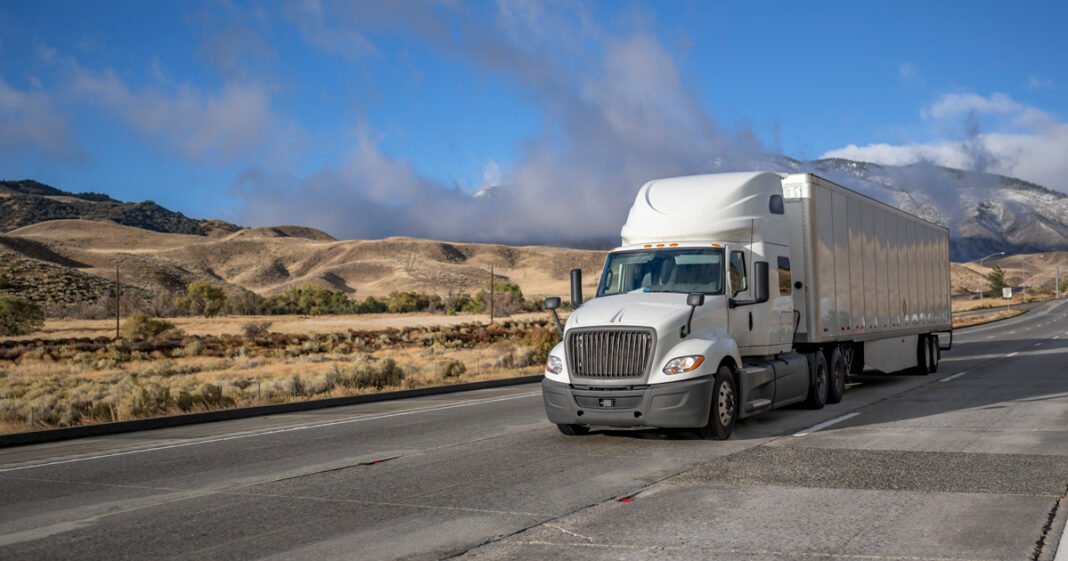

California diesel prices are above $7 a gallon and carriers are eyeing battery-electric trucks more closely again. (vitpho/Getty Images)
April 2, 2026 2:10 PM, EDT
Key Takeaways:
- California diesel prices jumped above $7 a gallon in late March, prompting carriers to revisit battery-electric trucks as fuel surcharges quickly rose across the freight market.
- Executives said geopolitical disruptions pushed prices up more than 50% since early March, squeezing shippers and making electric trucks cheaper than diesel with California incentives.
- Carriers are ordering longer-range electric tractors arriving in 2026, though executives warn adoption depends on incentives and pressure on manufacturers to lower prices.
California diesel prices are above $7 a gallon and carriers are eyeing battery-electric trucks more closely again, particularly as tractors with longer ranges become available in 2026.
In some cases, it can be cheaper than buying a diesel truck, carrier executives say, with newcomers’ prices also enticing.
The average on-highway price of diesel in California was $7.219 a gallon on March 30, a 44.7% increase compared with $4.99 a gallon on March 2 and up 55.6% from $4.641 on the first Monday of 2026, according to Energy Information Administration data.
The steepest segment of the increase came after Iranian Supreme Leader Ali Khamenei was assassinated and the U.S. and Israel began bombing targets in the oil-rich nation. Iran, in response, blocked traffic through the Strait of Hormuz and attacked overseas energy infrastructure.
The impact of the strikes and ensuing energy price volatility on the U.S. freight market was quick and discomforting. “Our fuel surcharge has gone up 20% in the last two weeks,” Rudy Diaz, founder and CEO of Long Beach, Calif.-based drayage carrier Hight Logistics, told Transport Topics in an interview.
“You know, it’s a lot, especially for small shippers. Customers that maybe do not have a lot of wiggle room,” Diaz said. “It hits their pockets, and then what happens, you start having the domino effect, right? We’re charging it, the steamship lines are charging it, the airlines are charging it and then the customer is going to charge the consumer.”
Hight has 75 tractors, of which 26 are battery-electric trucks, and around 100 employees. Of the battery-electric trucks, 17 are Volvo VNR Electrics and nine are BYD 8TTs.
In addition, the carrier has 15 Tesla Semis on order, and Diaz expects the tractors to arrive by September. Hight has six chargers with 12 dispensers behind the fence. The carrier intends to build more.
The standard truck will have a range of about 325 miles, while the long-range version’s range will be about 500 miles. (Tesla)
Tesla is set to offer two versions of its long-awaited Class 8 battery-electric tractor, the Semi — standard and long-range options — it confirmed Feb. 8. The standard truck will have a range of about 325 miles, while the long-range version’s range will be about 500 miles.
In a presentation accompanying the release of Tesla’s fourth-quarter 2025 earnings, the company said its Reno, Nev., plant was tooling up and remained on schedule to ramp up Semi production in the first half of 2026. The Reno factory is capable of producing up to 50,000 vehicles per year, according to Tesla.
(Hunter Logistics Los Angeles)
Drayage fleet Hunter Logistics Los Angeles operates 10 trucks and has seven drivers. One of the trucks is a Volvo VNR Electric. The carrier has five Tesla Semis on order and has been told to expect delivery in early or mid-2027, CEO Andrew Yuen told TT.
Yuen said he picked the Tesla Semi because of the 500-mile range, compared with the VNR Electric’s typical 200 to 250 miles.
“Right now, we charge probably at least once a day just to get through a day’s work. Whereas with the Tesla Semi, I charge maybe once every two days. Or, if I have nothing to do, then I will just top it off and charge,” Yuen said.
Hight’s Diaz told TT his reasoning is twofold. “For me, it’s environment. I care about the environment. I care about clean water, clean oceans. You know, when I go to the oceans and I see plastic bags, I mean, it just, it bothers me, right?” he said.
“Secondly, I see it as the way of the future. … You have a conflict, you have war. And the same thing happened with Ukraine back in 2022, when Russia invaded Ukraine, fuel spiked. Fuel was at $6.91, and it took almost 14 months for that fuel price to drop” to where it was before Russia invaded its neighbor, he added.
While Diaz and Yuen are buying Tesla Semis, both said it would not be possible without the grants available in California.
When all the incentives are added up, said Diaz, a fleet can receive up to 90% of the battery-electric truck’s value, or roughly $360,000 on a $400,000 truck. Sales tax and the federal excise tax add around $100,000 combined. A price tag of $140,000 is cheaper than the cost of a diesel truck in California, he noted.
The incentives have been pivotal to Hight buying battery-electric trucks and the company’s growth, because as Diaz told TT: “Without these incentives, there’s no way we can afford this.”
Battery-electric Class 8 drayage trucks operating at California ports are eligible for Port Plus grants of up to $100,000. (Eric Thayer/Bloomberg)
The Hybrid and Zero-Emission Truck and Bus Voucher Incentive Project offers up to $150,000 per truck in backing. Battery-electric Class 8 drayage trucks operating at California ports are eligible for Port Plus grants of up to $100,000. Air district and electricity company incentives are also available.
Still, carrier executives say the incentives won’t be around forever and as a result battery-electric truck lobbyists are calling on legacy truck manufacturers to cut their prices to encourage uptake.
In March, the International Council on Clean Transportation launched a Total Cost of Ownership Calculator for medium- and heavy-duty commercial vehicles that compares the lifetime costs of battery-electric and diesel commercial vehicles.
Both Tesla and fellow newcomer Windrose Technology, which manufactures its battery-electric R700 tractors in China, position the price of their Class 8 trucks at less than $300,000.
Belgium-based Windrose recently delivered its first U.S. tractor to a customer, a month ahead of the schedule the truck maker’s importer, dealer and aftermarket care provider Xos Trucks laid out to TT in March.
The typical U.S.-spec R700 offers about 420 miles of range. Windrose also offers a lightweight version with 200-plus miles of range.
“Tesla is disrupting the market, they’re disrupting the market by their price, by the distance of the truck can travel, by the weight and how quickly it can charge,” Diaz said.

