
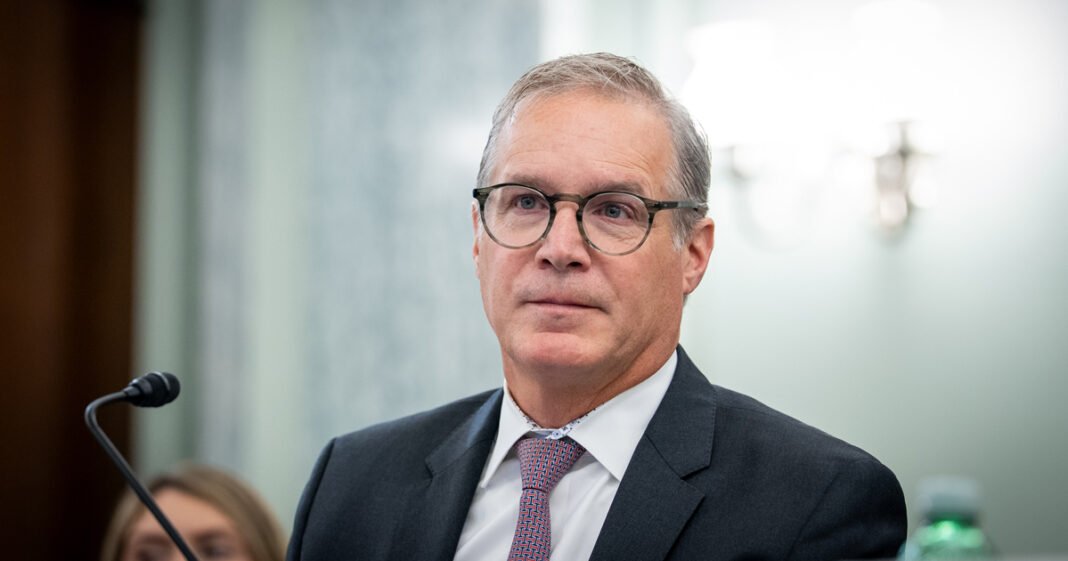

Spear speaks at a Senate Commerce Committee hearing in July 2025. (Camille Toussaint/American Trucking Associations)
March 31, 2026 5:10 PM, EDT
Key Takeaways:
- ATA and OOIDA urged Congress in a March 31 letter to modernize and expand FMCSA’s New Entrant Safety Assurance Program.
- The groups said earlier, in-person safety audits and stronger education would prevent fraud, boost compliance and anchor a prevention-focused FMCSA safety strategy.
- The push comes as Congress debates transportation bills, including Dalilah’s Law, with a House vote expected this month and a surface reauthorization due by September.
American Trucking Associations and the Owner-Operator Independent Drivers Association, in a joint letter to Congress, urged lawmakers to modernize and expand the Federal Motor Carrier Safety Administration’s New Entrant Safety Assurance Program.
The groups said that to ensure new carriers operate more efficiently, a stronger, prevention-focused program should continue to guide FMCSA’s broader safety strategy.
In the March 31 letter to top congressional transportation authorizers and appropriators, ATA President Chris Spear and OOIDA President Todd Spencer said FMCSA’s resources should be enhanced to conduct more timely and consistent safety audits of newly registered motor carriers. They argued that earlier engagement with new operators would help reinforce safety practices, improve regulatory compliance and prevent unsafe or fraudulent operations from developing.
Among their recommendations, ATA and OOIDA called on Congress to shorten or eliminate the window during which new entrants may operate without a safety audit, or to adopt a two-step review process that would condition the ability to operate on an initial vetting. They also urged a return to standardized, in-person safety audits, arguing that remote or off-site reviews limit investigators’ ability to comprehensively verify compliance, detect fraud and assess a carrier’s legitimacy.
The letter also emphasized strengthening the educational component of early safety audits. New entrants should receive clearer guidance on regulatory requirements such as driver qualification standards, hours-of-service rules, vehicle maintenance and drug and alcohol testing, the groups said, framing early audits as both compliance checks and learning opportunities.
“Earlier and more consistent engagement, coupled with meaningful entry qualifications and checks, will improve safety outcomes, reduce chronic noncompliance and strengthen [Department of Transportation’s] oversight and enforcement efforts.,” Spear and Spencer wrote.
The groups’ push for regulatory action comes as lawmakers prepare this year to debate major transportation funding and policy bills and consider legislation to toughen commercial driver license enforcement and English-language proficiency rules for commercial drivers.
Specifically, they pointed to the recent consideration of Dalilah’s Law. Led by Rep. David Rouzer (R‑N.C.), the legislation aims to tighten English-language proficiency requirements for commercial drivers and clarify states’ responsibilities for verifying CDL eligibility.
A Senate version of the bill was introduced March 26 by Sens. John Cornyn (R-Texas), Ted Budd (R-N.C.), Shelley Moore Capito (R-W.Va.), Cynthia Lummis (R-Wyo.) and Tommy Tuberville (R-Ala.). The bill’s proponents argue that federal CDL standards are inconsistently enforced across states.
Cornyn said the legislation is intended to address gaps in state enforcement of federal CDL requirements. Committee consideration of the Senate bill has not yet been scheduled, while a House floor vote is expected later this month.
“Every American who shares a road with an 80,000-pound commercial truck deserves to know that driver earned that license legally,” said Lummis, a member of the chamber’s transportation committees.
The push by ATA and OOIDA comes as lawmakers continue to negotiate large-scale transportation legislation. Congress must complete fiscal 2027 transportation appropriations as well as pass a multiyear surface transportation reauthorization bill by the end of September.
Dalilah’s Law is named for Dalilah Coleman, who was 5 years old when she suffered serious injuries in a 2024 multivehicle crash involving a truck driver federal officials said lacked legal immigration status. Coleman attended President Donald Trump’s Feb. 24 State of the Union address as a guest of the White House.
During the speech, Trump urged Congress to bar individuals without legal status from holding commercial driver licenses, arguing they cannot read basic road signs related to direction, speed and hazards. Supporters say the remarks helped galvanize Republican backing for the measure.

