
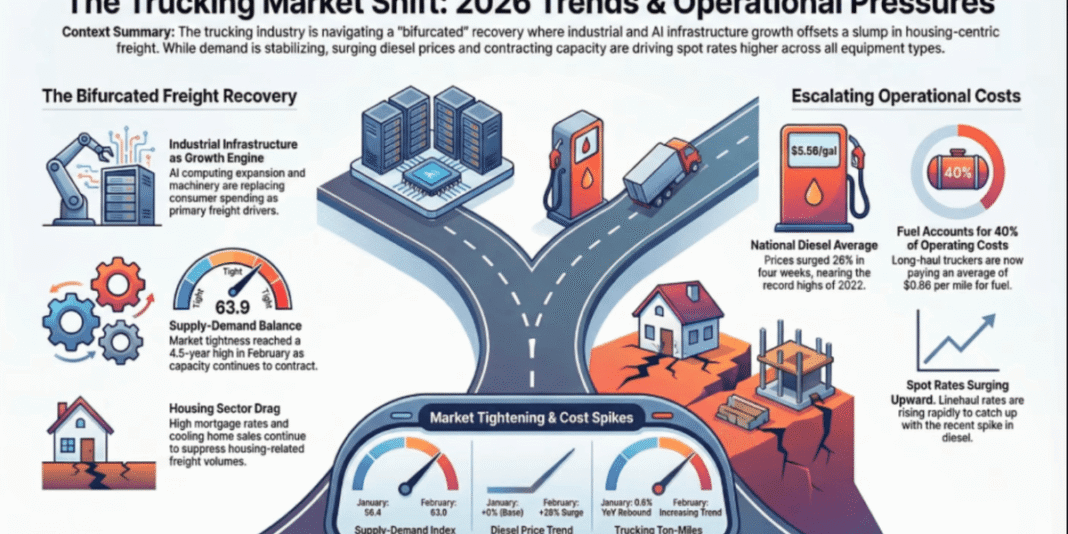

The cost shock of spiraling diesel prices is tightening freight capacity in American trucking markets as the Iran War enters its second month and maritime traffic through the Strait of Hormuz remains tightly restricted, reports say.
Diesel prices surged to $5.375 per gallon during the week of March 22-28—the highest weekly national average since late 2022—according to load board operator DAT One. In response, the available number of trucks posted fell across all three equipment types, with dry van, reefer, and flatbed each reaching their lowest Week 13 truck-post counts in at least 10 years of DAT data.
At the same time, total load posts rose slightly to 3.99 million last week, suggesting that demand remained steady as available capacity contracted. So following the law of supply and demand, fewer available trucks helped push rates higher across the board, the firm said. By the averages, dry van rates were $2.34 per mile, (up 6 cents week over week), refrigerated were $2.75 per mile (also up 6 cents), and flatbed were $2.80 per mile (up 10 cents).
But high costs at the pump are trumping those inflated rates, since the cost of fuel is up $1.31 per gallon over the past three weeks alone, said Dean Croke, Industry Analyst, DAT Freight & Analytics.
“Truckers are responding to fuel prices by cutting deadhead miles, looking for lighter loads, and slowing down. At current diesel prices, slowing from 75 to 65 mph saves roughly 8 to 9 cents per mile in fuel—the equivalent of a significant per-mile pay raise without hauling a single extra load,” Croke said.
“Carriers are also sitting on the sidelines or declining unprofitable loads, which for brokers increases the urgency of having deep carrier relationships rather than relying on transactional capacity,” he said.
The huge jump in the cost of gas will also hit the bottom line for fleet operators at a corporate level, according to market analysts with TD Cowen.
“Diesel prices have increased 55% [year to date] and will play a significant role in 1H results for [transport companies], at a minimum. The velocity of change in diesel prices is so significant that even carriers who have a fuel surcharge that re-prices weekly, will see a near-term squeeze (intraweek prices at pump outpacing [fuel surcharge] passed onto shippers),” TD Cowen analyst Jason Seidl said in an email.
“[Truckload] carriers will feel the largest negative effect in Q1, with one-way having the most exposure given more deadhead miles vs Dedicated. The diesel pressure is likely pressuring small fleets who cannot absorb diesel price increases as well as large carriers,” he said.

