
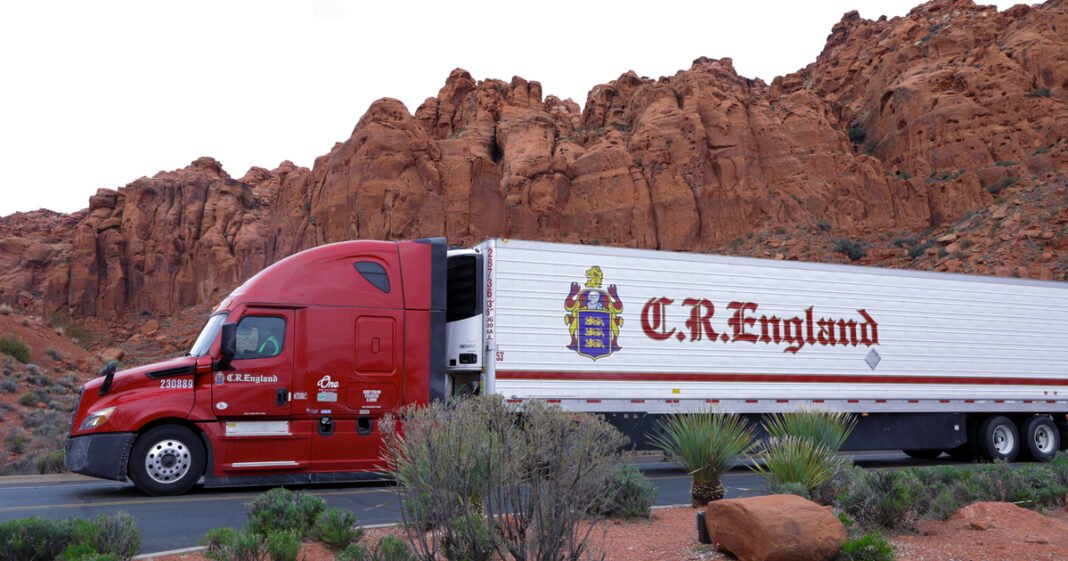

C.R. England had 2,483 refrigerated van trailers as of the end of February. (C.R. England)
March 31, 2026 1:37 PM, EDT
Key Takeaways:
- Diesel prices surged in March, sharply raising costs for refrigerated carriers that must fuel both trucks and TRUs, executives told Transport Topics.
- TRUs burn about 2,000 to 3,150 gallons yearly as diesel jumped 38% to $5.375 a gallon by March 23, squeezing margins.
- Carriers are revisiting fuel surcharges, driver coaching and TRU settings and reevaluating technology ROIs as futures signal prolonged high diesel prices.
Diesel prices soared in March, crimping margins even if a carrier has the option of increasing its fuel surcharge.
But one segment of the freight market is being hit by a double whammy — refrigerated fleets.
Diesel trucks with refrigerated loads are now paying a great deal more to haul a trailer to its destination and to keep the transport refrigeration unit (TRU) running.
So, such carriers are adapting ahead of what is shaping up to be a long period of higher prices, executives told Transport Topics.
The typical rule of thumb on diesel consumption for a single-temperature TRU is 0.8 gallons of diesel for every hour of runtime, according to Don White, TEN vice president of refrigeration and implementation. The average TRU runs about 2,500 hours a year, and that equates to about 2,000 gallons of fuel, he added.
Multitemperature units average around 3,500 to 4,000 hours a year, with the diesel consumption around 0.9 gallons per hour of runtime, equating to about 3,150 gallons of fuel per annum, White noted. Leasing and fleet management specialist TEN has a fleet of 14,000 refrigerated trailers. In 2025, TEN bought 1,246 reefer trailers.
In the three weeks ending March 23, the price of filling up jumped 38% to a nationwide average of $5.375/gallon of diesel from $3.897/gallon on March 2, according to the Energy Information Administration.
As of March 30, the price at the top 10% of truck stops and service stations in the U.S. averaged $6.30/gallon and the average in California was $7.30/gallon, according to GasBuddy.
Futures prices indicate traders do not expect a retreat any time soon. Front-month diesel futures jumped 10% over the weekend before March 2 and closed around $2.90/gallon. By March 23, the front-month price was around $4.50/gallon, a level matched March 29.
Underlying CME West Texas Intermediate crude futures were trading below $70/barrel on March 2 after gradually nudging higher since the start of 2026. The price was above $102/barrel March 30.
And the impact of constrained global supplies of crude and particularly diesel is likely to bite harder if U.S.-Iran hostilities escalate beyond air bombardment and a blockaded Strait of Hormuz, analysts say.
Fuel Surcharges
Contract truckload or less-than-truckload carriers typically have a fuel surcharge as part of any agreement with a shipper. However, there is usually a lag of a week between the EIA numbers being published and the recalibration of the surcharge — a window in which the diesel price can jump substantially and regularly did over the past month. During that period, fleets are hemorrhaging money.
Less ubiquitous are fuel surcharges for refrigerated van trailers, even among the larger players in the segment.
(C.R. England)
C.R. England had 2,483 refrigerated van trailers as of the end of February. The Salt Lake City-based company ranks No. 42 on the Transport Topics Top 100 list of the largest for-hire carriers in North America and No. 6 among TL and LTL refrigerated fleets.
Less than a third of C.R. England’s refrigerated freight customers have a refrigerated unit fuel surcharge, Vice President of Equipment and Fuel Ron Hall told TT.
The percentage of customers whose freight is carried without a fuel surcharge for the TRU is greater for over-the-road freight than for dedicated customers, he said. Indeed, some OTR segments of the market are unprofitable at present without a TRU fuel surcharge, he added.
C.R. England has 500 trucks in its OTR refrigerated fleet. The carrier has 3,000 trucks in its Dedicated fleet, with 30% of the Dedicated trailers refrigerated.
Spot carriers include the increase in the cost of fuel in any price booked, but with costs increasing, margins head in the opposite direction.
No matter the size of the carrier, an increase in diesel prices sharpens operational practices, NFI Senior Vice President of Transportation Operations Mike Hayden told TT.
NFI, which ranks No. 16 on the for-hire TT100 and No. 8 on the refrigerated segment list, operates about 1,100 owned and long-term leased refrigerated trailers, as well as several hundred customer-owned units.
“There’s heightened awareness between both the carrier and shipper around pre-cool times, dock loading and unloading times, and cooling modes. It’s a good time to revisit any procedures that have been in place for an extended period of time,” Hayden said in an email.
But the ongoing diesel price spike and projections of an extended impact as global crude and diesel markets reset are forcing a more thorough rethink, executives say.
(NFI)
“We’re taking a deeper look at and putting more attention towards fraud recognition. We are putting more emphasis on driver coaching for fuel economy. We are re-evaluating [a return on investment] that didn’t bear out in a lower cost fuel market, but may bear out now on both truck and trailer,” Hall said in a March 27 interview.
“The challenge there is trying to determine where the market’s going to settle out at. That’s the art in running ROIs is trying to prognosticate rather than analyze where the future is going to land on fuel pricing. But we are re-evaluating ROIs on technologies that we think the ROI may hold in a higher-cost fuel market,” he added.
Fleets also should work with drivers about retaining preset settings on TRUs to attain optimal performance, particularly for multitemperature trailers, according to White.
Continuous operation of a TRU for a trailer with multiple zones, meanwhile, can be reined in by managing tolerance levels, he said.
The Food Safety Modernization Act — a major overhaul of food safety practices in response to illness outbreaks traced back to foods such as lettuce, peanut butter and eggs — requires strict temperature controls and meticulous record-keeping.
Fleets have a number of channels to explore in responding to increased prices, Hall said.
Hayden added: “It’s important to leverage the technology and data you have available, from TRU monitoring to fuel optimization.”

