
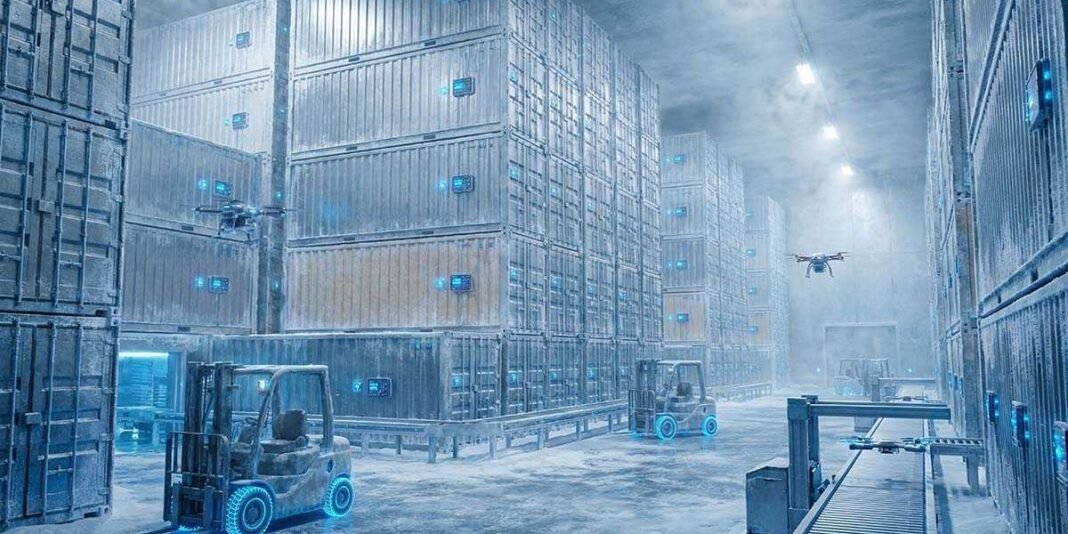

Rising e-grocery sales and growing investment in domestic food production are fueling demand for cold-storage warehouse space nationwide, and companies are responding in myriad ways—from building state-of-the-art automated facilities to adding technology that can make existing refrigerated and frozen space easier to manage. Recent industry deals announced by contract logistics services provider DHL Supply Chain and inventory drone developer Corvus Robotics help put the trend into perspective—and provide a glimpse of how warehouses are evolving in 2026.
DHL EXPANDS COLD-STORAGE FOOTPRINT
Earlier this year, third-party logistics services specialist DHL Supply Chain announced that it will work with real estate developer RLCold to build more than 5 million square feet of temperature-controlled facilities across North America. The companies signed a memorandum of understanding (MOU) in February and said design and pre-development will begin this year, with initial sites in Lakeville, Minnesota, and Mount Laurel, New Jersey, according to Dennis Lutwen, DHL Supply Chain’s president for consumer business, North America. He says additional sites will be added based on customer needs and regional market demands.
The partnership is part of a broader effort to expand DHL’s cold-storage footprint in response to customer requirements and shifting market dynamics. Rising consumer demand for fresh and frozen foods is creating more need for space among the grocery retailers, wholesalers, and others that utilize DHL Supply Chain’s services, for example.
“Our MOU with RLCold is part of a long-term strategy to further expand our cold-storage capabilities and footprint,” Lutwen said in an email to DC Velocity. “As consumers increasingly purchase more fresh, organic, and ready-to-eat foods, combined with the continued growth in online grocery sales, there is a heightened need for advanced, technology-enabled cold-chain infrastructure.
“Additionally, the average age of cold-storage warehouses in major U.S. markets is about 31 years, making the need for automation-ready facilities in the right locations a priority.”
Lutwen’s comments echo the findings of research from commercial real estate advisory firm Newmark, which released a report last October citing the country’s aging cold-storage infrastructure and resulting need for modernization. Newmark put the average age of cold-storage space nationwide at 42 years, adding that as of mid-2025, just 10% of the nation’s existing inventory had been built in the past five years.
Those statistics reinforce the findings of a separate 2025 report from industry research firm Interact Analysis forecasting strong demand in cold-storage automation through 2030. The research predicted that the global cold-chain automation market would grow from $1.3 billion in 2024 to more than $2 billion by 2030, driven by demand for automated storage and retrieval systems (AS/RS) and similar solutions that can address labor challenges associated with working in harsh environments. Refrigerated environments typically range between 32 and 40 degrees Fahrenheit, while the ideal temperature for frozen-storage operations is 0 degrees Fahrenheit and below.
Lutwen says customer needs will drive DHL’s approach to automating its expanding cold-storage network.
“We take a scaled approach to automation, meaning the customer’s operating profile drives the level of automation we deploy. Cold-storage needs vary widely, so applying a single, highly automated model can reduce flexibility and add unnecessary cost without improving performance,” he explains. “Our collaboration with RLCold centers on designing facilities that provide the appropriate amount of automation for each client. We also collaborate with customers to determine what combination of mechanization or robotics delivers the best outcome for their inventory mix, order profiles, and service expectations.”
The DHL Supply Chain/RLCold agreement follows other recent cold-chain expansions by parent company DHL Group. In December, DHL said its DHL Global Forwarding subsidiary would invest $1.5 million to expand its cold-chain facilities near Los Angeles International Airport. The expansion is part of an effort to grow the subsidiary’s pharmaceutical, life sciences, and health-care business. The project will incorporate advanced temperature-control systems and warehouse automation, among other features.
CORVUS LAUNCHES DRONES FOR SUB-ZERO WAREHOUSES
Photo courtesy of Corvus Robtoics
Also in February, inventory drone company Corvus Robotics announced the launch of its “Corvus One for Cold Chain” offering, an autonomous inventory management system engineered to operate continuously in environments ranging from -20 degrees Fahrenheit to ambient temperatures. Designed to withstand extreme cold, airflow, frost, and condensation, the artificial intelligence (AI)-driven system delivers frequent, accurate inventory cycle counts without human intervention, allowing operators to maintain real-time visibility without subjecting workers and equipment to harsh freezer conditions, according to the company.
Corvus Robotics CEO Jackie Wu says the company hit a milestone with the launch, fulfilling a longstanding industry need.
“When we first started the company years ago, people kept asking about our cold-chain [capabilities]—not just chilled, but freezer and deep-freezer environments,” Wu says. “I knew we were onto something because all these executives [recognized that] inventory tracking using robotics and AI is the future.
“They kept asking us, ‘Do you work in deep freezer yet?’ This is the year we can say, ‘Yes, we do.’”
Corvus One for Cold Chain operates in the same way as the company’s traditional inventory-auditing drone system: The custom-built drones use computer vision to navigate, scan, map, and count pallets and cases quickly, and they fly and recharge without human involvement, which means they can be deployed in lights-out environments as well as during normal business hours. And like their traditional counterparts, they have an accuracy rate of 99.9% as well as the ability to count inventory 10 times faster than humans can. The difference for cold and frozen environments is primarily internal: The cold-chain drones incorporate battery management technology, materials, and software that allow them to function in sub-zero temperatures.
Essentially, the cold-chain drones are built to work autonomously and accurately despite the frost, glare, airflow, and extreme temperature swings in cold-storage and deep-freezer facilities.
“[They’re] basically working in a blizzard,” Wu says.
National grocery chain Kroger is already using the Corvus One for Cold Chain system. Wu says Corvus piloted the technology at a Kroger warehouse last year and has since expanded its use with the grocer. He adds that Corvus is also working with other companies as demand for cold-storage automation heats up—in the grocery industry, but also among food and beverage, health-care, and life-sciences businesses. The technology’s flexibility makes it suitable for use in all types of facilities: To date, Wu says most of Corvus Robotics’ cold-chain drones have been deployed in customers’ existing facilities, but he says the company expects to work in many new facilities that are coming online as well.
“This is a game-changer for inventory,” Wu says. “If you have physical goods and they are chilled or in the freezer, you’ve got to check them.”
And if there’s a way to do that faster, cheaper, better, and that’s less painful for people, he says, it just makes sense to do it.

