
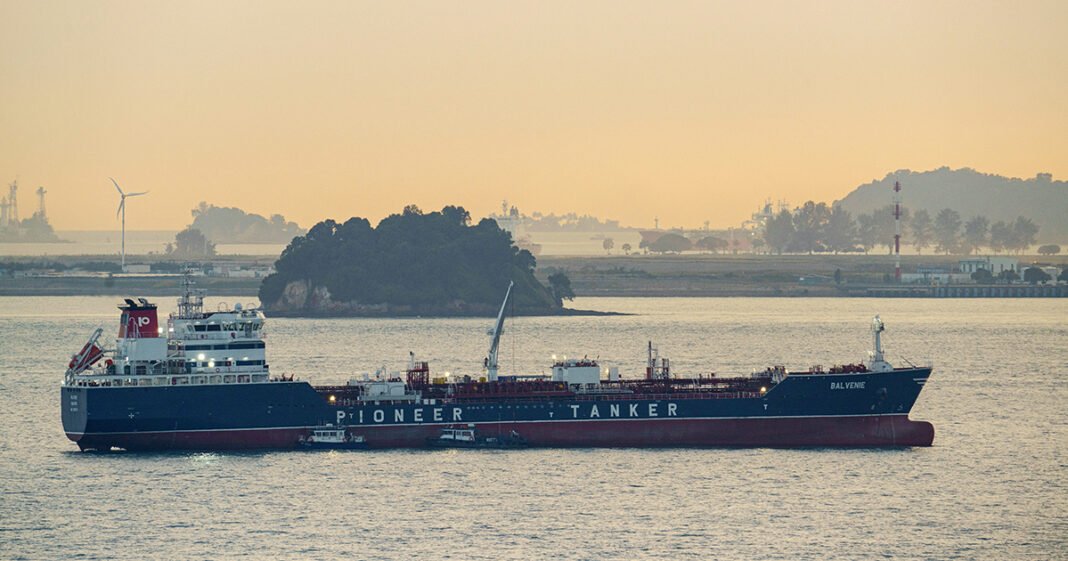

An oil tanker off the coast of Singapore. (Ore Huiying/Bloomberg)
March 20, 2026 10:23 AM, EDT
The closure of the Strait of Hormuz has thrown a vital part of the shipping market into chaos.
The problem lies in how to calculate the cost of hiring an oil tanker when the trade route used to calculate benchmark prices is shut down.
While some shipbrokers had been swapping in an alternative, still-functioning route for their pricing assessments, the 280-year-old institution that oversees the market’s key price has in recent days sent fresh shockwaves through the industry by clarifying that its Middle East-to-China tanker rate must continue to reference a port in Saudi Arabia that’s all but inaccessible.
The rate assessment from Saudi Arabia’s Ras Tanura port to China underpins many of the contracts between tanker owners and their customers, as well as an associated derivatives market. It also serves as a reference point for other routes, meaning anything that jolts the price has implications for oil companies hiring vessels, firms that own them, and traders who place bets on, or hedge, freight prices.
Known in the industry as TD3, the rate is published by the Baltic Exchange in London, but relies on submissions from shipbrokers. Now, with barely any real trades taking place from the Persian Gulf, the brokers have almost nothing upon which to base their assessments.
The market was pitted into chaos by a clarification that meant brokers effectively needed to put a price on owners’ willingness to put their ships and crews at risk — even though almost none are.
The benchmark surged to once-unthinkable levels but has since plunged down again, as brokers continue grappling with a chaotic market in which the key trade route is largely off limits at this time.
Email and Meeting
The turmoil started on March 13, when the Baltic emailed shipbrokers to remind them that the Middle East-to-China tanker rate should continue to be assessed based on cargoes loading from Ras Tanura, inside the Gulf.
The email referred to a circular from earlier this month, in which guidance was offered for how to assess markets where no bookings have been agreed. It also included extra guidance to make it clear that effectively told the brokers to figure out what owners would hypothetically charge to go through Hormuz.
Three contributing shipbrokers to the exchange’s price assessments said that prior to the email, they had been using rates from Yanbu, on Saudi Arabia’s Red Sea coast, and assuming that’s about what it would cost for Ras Tanura shipments — were the port accessible.
On March 16, the Baltic held a clarifying meeting with its panelist shipbrokers where it reiterated the guidance from its email: the benchmark should still reflect loadings from inside the Persian Gulf.
Price Spike
Hours after the meeting, the impact became clear.
The published rate surged, pushing daily earnings for supertankers to unprecedented levels of more than $600,000 a day. The gain on March 16 alone was $190,000, an increase that on its own would have been one of the highest-earning days in the history of the tanker market.
Freight derivatives jumped too. One market participant said they bought a large number of contracts as a direct response to the clarification, making a profit.
The next day, physical freight prices slumped back down as brokers continued grappling with where to assess a trade that’s not happening. Such volatility is unheard of. Last year, average daily increases on the route were closer to $4,000.
The wild swings on the TD3 route reflect a market with almost no real activity. There have been hardly any mainstream voyages from inside the Gulf since the conflict began.
Bob Toews of TruckDown explores how fleets can streamline their response to breakdowns and safely get their trucks back on the road as quickly as possible. Tune in above or by going to RoadSigns.ttnews.com.
“The volatility on TD3 mostly reflects the lack of real activity from inside Hormuz,” Clarksons Securities analysts including Frode Morkedal said in a note.
The Baltic Exchange, founded in 1744, has long been a cornerstone of global shipping, publishing the rates that help price everything from physical energy and commodity cargoes to financial derivatives.
The bourse confirmed it sent out the emailed guidance and held a follow-up meeting on March 16. It didn’t immediately comment in response to several other questions.
Written by Alex Longley, Alaric Nightingale and Sherry Su

