
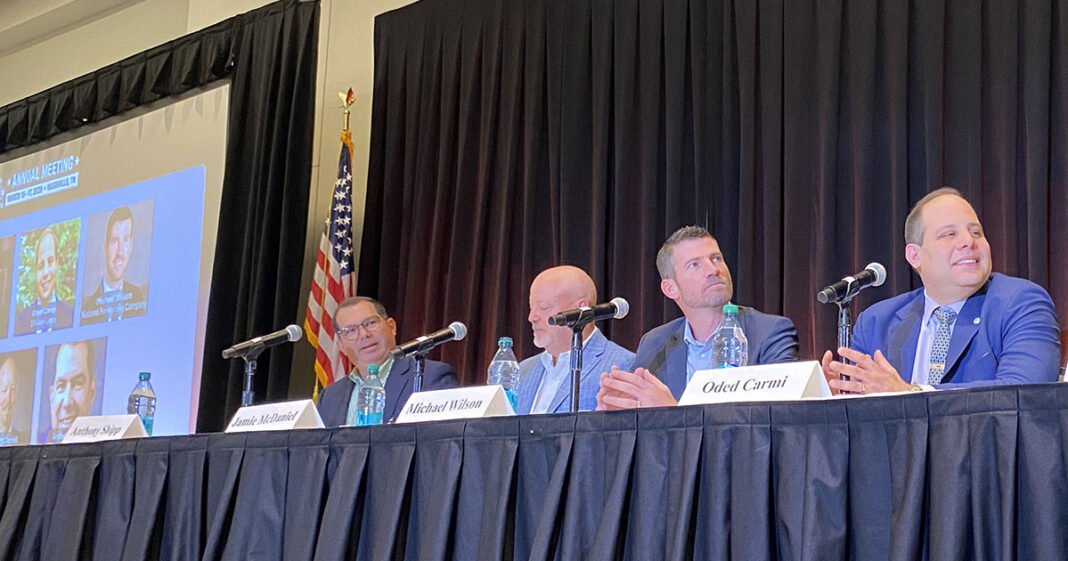

From left: M. Dyer Global’s Anthony Shipp, SGS Move Management’s Jamie McDaniel, National Forwarding Co.’s Michael Wilson and DN Van Lines’ Oded Carmi. (Connor D. Wolf/Transport Topics)
March 18, 2026 5:00 PM, EDT
Key Takeaways:
- Industry leaders said March 16 at ATA’s Moving & Storage Conference Annual Meeting that the Defense Department’s Best Value Score 2.0 improved shipment awards by emphasizing service quality.
- BVS 2.0 shifted weight from customer surveys to objective metrics, with performance at 70% and rate value at 30%, addressing inconsistency and low survey response rates.
- Panelists said further refinements are needed, particularly around communication with shipping offices and subjective survey elements that still influence multimillion-dollar shipment decisions.
NASHVILLE, Tenn. — The U.S. military can further improve its process for which companies are rewarded shipments within the moving and storage industry, according to a panel discussion March 16 at American Trucking Associations’ Moving & Storage Conference Annual Meeting.
The Best Value Score 2.0 is a quality rating the Department of Defense uses to determine the volume of shipments a moving company receives. The rate score — based on value relative to competitors — accounts for 30% of the total. The performance score makes up the remaining 70% and is based on on-time pickup and delivery, as well as a customer satisfaction survey.
“BVS 1.0 was the customer satisfaction survey,” said Michael Wilson, president at National Forwarding Co. “I think people adapted to it. The difficulties that we have today existed then with survey response rate. But the move managers were accustomed to reaching out, providing resources to attract customers, to take their customer satisfaction survey.”
RELATED: Moving and Storage Grapples With Whirlwind Economy
BVS 2.0 increased the focus on service quality when it replaced the earlier version in 2023. It reduced the weight of customer surveys and added objective performance measures. The earlier performance score was weighted much more heavily toward the surveys.
“They were trying to get to a point where they can increase the quality of the move for the transferees, and so they put in additional criteria,” said Anthony Shipp, president at M. Dyer Global. “In 2018, that year was a pretty bad year. I think that sort of became a catalyst for the need for some sort of change to put different metrics in place in order to improve the quality.”
MORE: DOD Creates Permanent Unit for Military Moves
BVS 2.0 also added a claims score measure aimed at addressing how the old system impacted a company’s ability to receive shipments based on how it handled claims. Shipp noted the data collection periods were shortened.
“What I really didn’t like about BVS 1.0 is that there wasn’t consistency,” said Oded Carmi, president at DN Van Lines. “You could look at yourself as an asset and service providing agent, and you look one year and your average score was one way, and the next year it’s another.”
The Best Value Score 2.0 is a quality rating the Department of Defense uses to determine the volume of shipments a moving company receives. (Dimensions/Getty Images)
Carmi stressed his opposition to how much the survey is weighted toward a subjective measure, especially since the newer customer survey replaced the 12-point score with sad-to-happy face icons to rate experiences with moving companies. He pointed out that, essentially, multimillion-dollar business decisions could be influenced by what smiley face the customer likes.
“They’ve broken down the criteria of that [BVS] to make it more reflective of actual service provided,” SGS Move Management CEO Jamie McDaniel said. “There’s 20% that’s still the customer service score — which, we’re still battling that naysayer bias and the low return rate that they have there — 20% is now claims, and this is something they’ve been trying to figure out for a while.”
McDaniel noted the survey initially had several criteria for evaluating claims — which he saw as impossible to live up to — but the number of criteria was reduced in the new survey.
“I know that for the people that aren’t really into this, that sounds like the most boring thing in the world,” Carmi said. “I can tell you that knowing the rules allows us to be a better provider. It allows us to do a better job for the move managers, which, in turn, makes them want to work with us more. So knowing this stuff is important.”
Patrick Brennan of Cox Fleet talks about the common missteps that fleets make in planning for future maintenance and operational needs. Tune in above or by going to RoadSigns.ttnews.com.
Carmi said that within the performance score, the pickup score has additional criteria, with 50% based on whether the pickup occurred within a designated seven-day load spread. The score also is based on whether the pickup happened within two government business days before its scheduled loading. The last major part is updating the Defense Personal Property System.
“It’s communication, especially during the summer, during peak season,” Carmi said. “Some of these things, you need buy-in from the [Joint Personal Property Shipping Offices], and you email them, and it just goes in a black hole. … Those are for the type of exceptions where you do need to pick up a shipment outside of the spread, or there is a situation where you don’t want to lose points. I think that’s the biggest challenge.”

