
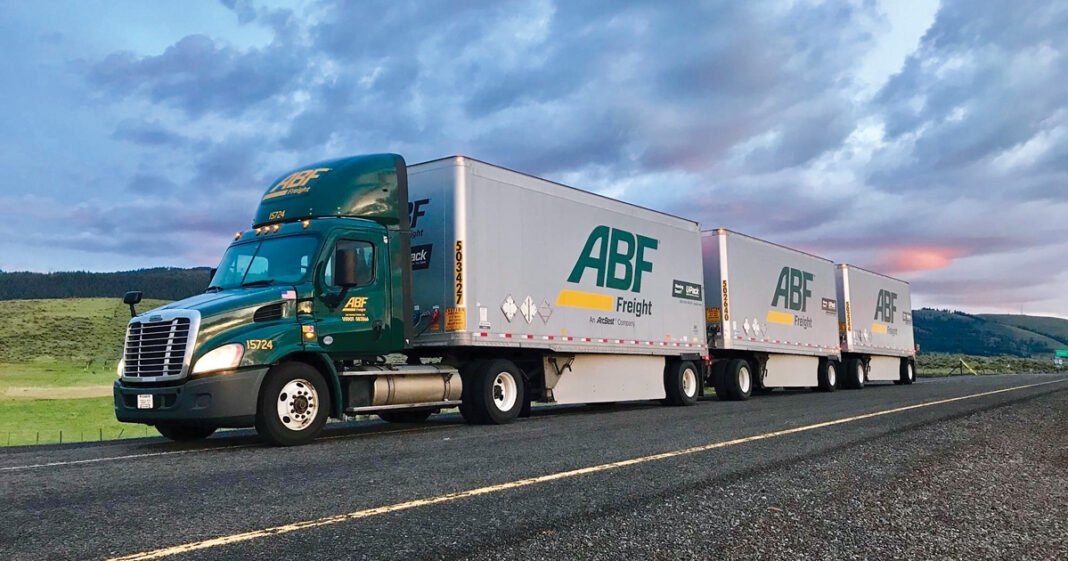

On a year-over-year basis, ArcBest’s tonnage per day rose 9.9% in January, 2% in February and 6% for the quarter. (ABF Freight via Facebook)
March 11, 2026 3:14 PM, EDT
Key Takeaways:
- February data from major LTL carriers showed improving market conditions as ArcBest, XPO and Saia reported stronger shipment and tonnage trends early in the first quarter of 2026.
- Executives said sentiment is increasingly positive as LTL profitability, industrial production and spot rates rise, signaling strengthening demand despite ongoing softness.
- Carriers expect gradual improvement through the quarter as indicators like manufacturing output and load volumes continue to show momentum.
February data from publicly traded less-than-truckload carriers indicated the health of the market segment is improving as the first quarter of 2026 progresses beyond just higher rates.
Sentiment among senior executives in the LTL space is positive in outlook, and underlying manufacturing data is supportive even as conditions remain challenging.
After a disappointing 2025, when first-quarter optimism evaporated in a flurry of tariffs and a truckload of uncertainty, leading players again expected a rebound in 2026, though the timing was unclear as the year began.
But ArcBest said its asset-based division, ABF Freight, saw a 1% increase from January to February in both shipments and tonnage per day. It also noted revenue per shipment increased 2% month on month.
On a year-over-year basis, ArcBest’s tonnage per day rose 9.9% in January, 2% in February and 6% for the quarter, the company said in a March 6 Securities and Exchange Commission filing.
Core LTL profitability also rose in the opening three months of 2026 compared with a particularly weak final quarter, the Fort Smith, Ark.-based company said in the filing.
Historically, the unit’s operating ratio weakens by about 260 basis points from the fourth quarter into the first quarter, where 100 basis points equals 1%.
The division’s Q1 OR is set to rise between 100 and 200 basis points sequentially, the company said, although this is due in part to a softer-than-normal Q4, and still reflected ongoing softness across the market.
A carrier’s OR provides insight on how well a company is balancing its costs and revenue generation. The lower the ratio, the better the performance.
ArcBest ranks No. 13 on the Transport Topics Top 100 list of the largest for-hire carriers in North America. ABF Freight ranks No. 8 among LTL players.
(XPO)
XPO’s LTL tonnage per day increased 0.2% compared with February 2025, which the carrier said March 2 was attributable to a year-over-year increase of 3% in shipments per day and a decrease of 2.8% in weight per shipment.
Greenwich, Conn.-based XPO ranks No. 5 on the TT for-hire Top 100 and No. 4 in the LTL segment.
Data from Saia, meanwhile, indicated that tonnage declines are slowing. Saia ranks No. 17 on the TT for-hire Top 100 and No. 7 in the LTL space.
Johns Creek, Ga.-based Saia said in a March 3 update that its LTL tonnage per workday declined 7% year over year in January, but that decrease slowed to 2.7% in February. In addition, January shipments fell 2.1% year on year while February shipments rose 0.3%.
(Saia)
Old Dominion Freight Line’s February figures weakened compared with 12 months earlier, and a March 3 update did not provide January details, but the company’s top executive remains optimistic.
“We are encouraged by trends that we have seen develop in our business. While our LTL tons per day declined on a year-over-year basis for the first two months of the quarter, we remain cautiously optimistic about the direction of the domestic economy,” CEO Marty Freeman said in comments accompanying the data.
LTL is the key transportation mode for smaller manufacturers, and carriers typically target small- to medium-sized businesses because of higher profit margins.
Federal Reserve data released Feb. 18 shows U.S. industrial production increased 0.7% in January after nudging 0.2% higher in December. In January, manufacturing output increased 0.6% after being flat in December, the central bank said.
Patrick Brennan of Cox Fleet talks about the common missteps that fleets make in planning for future maintenance and operational needs. Tune in above or by going to RoadSigns.ttnews.com.
Economic activity in the manufacturing sector expanded for a second consecutive month in February, but only the third time in 40 months, according to the Institute for Supply Management’s most recent survey of purchasing managers.
Contract rates typical of major LTL carriers lag spot rates, but data shows significant upside being achieved.
Spot rates were close to 15% higher in the week that ended March 6 than in the same 2025 week, according to truckstop.com and FTR Transportation Intelligence data.
Dry van spot rates were 19% higher in the week that ended March 6 than during the same week 12 months earlier, the data shows, while flatbed spot rates were 13.4% higher year over year.
Spot dry van load post volumes in the most recent week were 53% higher year over year and nearly double the 10-year average, if the pandemic years of 2021 and 2022 are excluded, according to DAT Freight and Analytics.

