
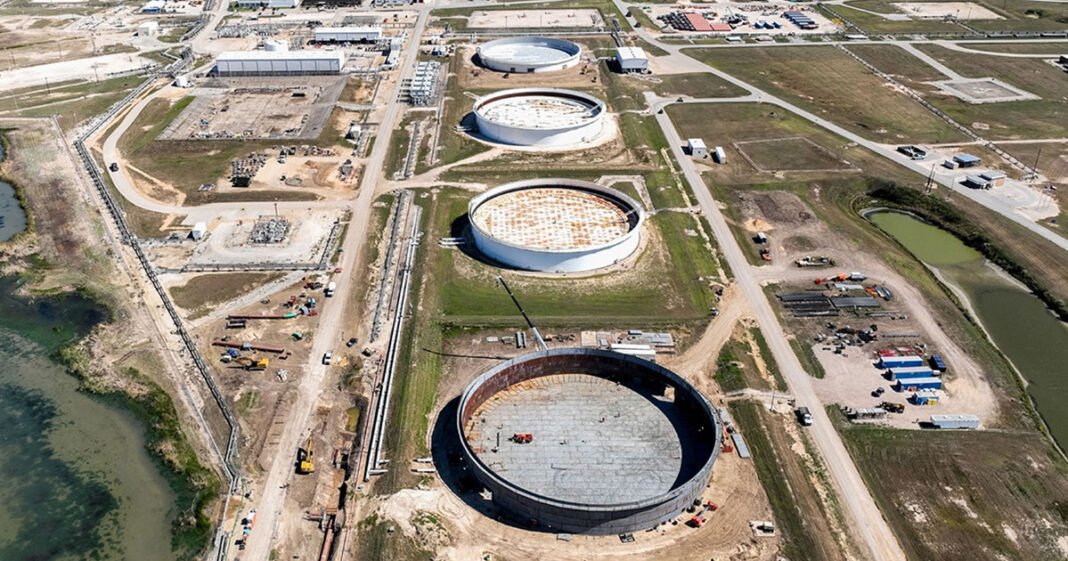

The Strategic Petroleum Reserve storage at the Bryan Mound site in Freeport, Texas. (Brandon Bell/Getty Images via Bloomberg News)
March 9, 2026 11:28 AM, EDT
| Updated: March 9, 2026 2:14 PM, EDT
Group of Seven finance ministers said they were ready to take any steps needed to support global energy supply, including releasing strategic oil reserves — although the group isn’t at the point of doing so yet.
“We will continue to closely monitor the situation and developments in the energy markets and will meet as needed to exchange information and to coordinate within the G-7 and with international partners,” the group said in a statement. “We stand ready to take necessary measures, including to support global supply of energy such as stockpile release.”
G-7 finance ministers held a virtual meeting on March 9 to discuss the conflict in the Middle East, its impact for regional stability, global economic conditions, and financial markets, and the importance of secure trading routes.
French Finance Minister Roland Lescure, whose country holds the presidency, said the group was “not there yet” in terms of a release but that it was monitoring the situation closely in conjunction with the International Energy Agency.
Brent oil futures surged as much as 29% at one stage on March 9 before sharply paring their gains when it emerged that the G-7 would discuss a possible stockpile move.
The war has led to producing giants including Saudi Arabia, Kuwait, Iraq and the United Arab Emirates lowering their output and the effective closure of the Strait of Hormuz, the oil market’s most important trade artery.
Developments over the past few days “convinced us to send very clear and firm messages and I hope very effective to reassure everyone,” Lescure told reporters ahead of a separate gathering of euro-zone counterparts in Brussels.
He added that there is “no problem of supply of oil or gas in the U.S. or Europe.”
Stock releases are normally coordinated by the IEA, which took part in the G-7 discussion along with the heads of the International Monetary Fund, World Bank Group and Organisation for Economic Co-operation and Development.
IEA chief Fatih Birol said after the call that the situation at Hormuz presents “significant and growing” risks to the oil market. On March 6, he emphasized how well supplied it was.
Coordinated releases of strategic stockpiles have been carried out only five times before, including twice in response to Russia’s invasion of Ukraine in 2022. Before that, reserves were tapped following supply disruptions in Libya, Hurricane Katrina, and during the first Gulf War.
Close Agreement
German Finance Minister Lars Klingbeil said it’s important there is close agreement within the G-7 before taking such a step.
Patrick Brennan of Cox Fleet talks about the common missteps that fleets make in planning for future maintenance and operational needs. Tune in above or by going to RoadSigns.ttnews.com.
“Now is not the right time, but we in Germany are open to doing so in a coordinated manner at the right time,” he told reporters ahead of the Eurogroup meeting in Brussels.
The need for coordination was echoed by Spanish counterpart Carlos Cuerpo, who said he was focused on the evolution of fuel prices and any potential impact on inflation.
Consumers across the world are already feeling the impact of the disruptions in the Middle East, with long queues forming at filling stations, and a surge in jet-fuel prices pushing up the cost of air tickets.
The current situation is among the most severe disruptions in the history of the oil market because 20% of the world’s oil and a similar portion of liquefied natural gas can’t pass through Hormuz.
Joaquim Miranda Sarmento, Portugal’s finance minister, cautioned it’s important to keep reserves for situations of low supply, “which is not the situation we are currently in.”
“We don’t have an oil supply problem at the moment,” he said. “The problem we have is with the price of oil markets.”

