
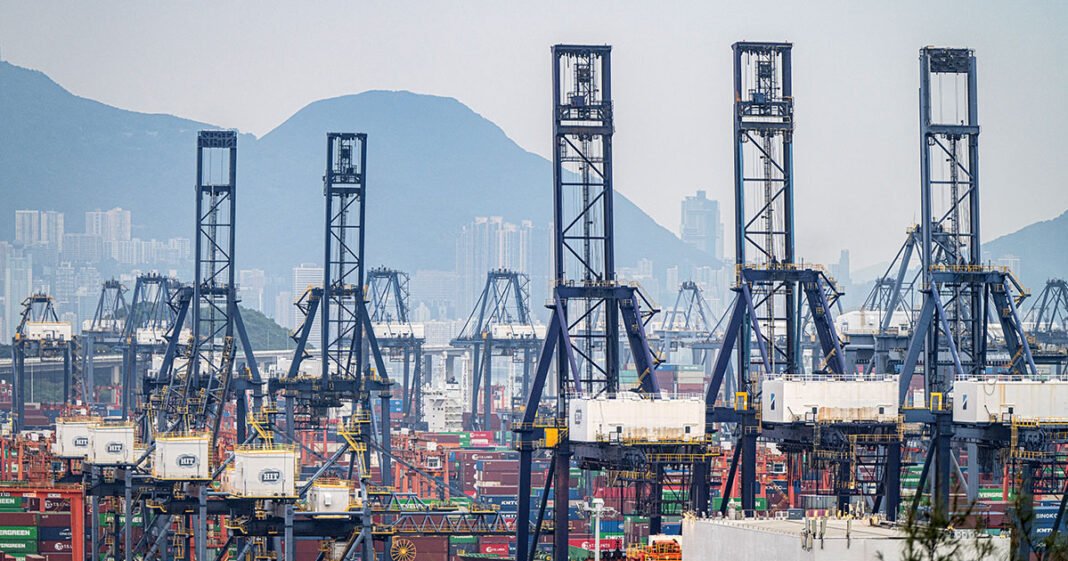

Gantry cranes at a port owned by a unit of CK Hutchison Holdings in Hong Kong. (Leung Man Hei/Bloomberg)
March 6, 2026 7:00 AM, EST
CK Hutchison Holdings’ plans to sell its suite of global ports are at an impasse a year after the deal was announced, with hopes now pinned on an upcoming meeting between Donald Trump and Chinese leader Xi Jinping to yield a political breakthrough.
Talks with the buyer consortium, which includes BlackRock Inc., Italian billionaire Gianluigi Aponte’s Terminal Investment and China’s state-owned Cosco Shipping Corp., made little progress in recent months, though the deal is not dead, people familiar with the matter said, asking not to be identified discussing private deliberations.
CK Hutchison, BlackRock, Cosco and the Aponte family’s Mediterranean Shipping Co., which controls Terminal Investment, didn’t respond to requests for comment.
Cosco and MSC rank Nos. 11 and 9, respectively, on the Transport Topics Top 50 list of the largest global freight companies.
The parties hope the planned summit between the U.S. and Chinese leaders will yield a political breakthrough that will pave the way for the sale’s completion, the people said. But there’s no guarantee that the transaction will be prioritized for discussion during Trump’s visit to Beijing between March 31 and April 2, they said.
It’s a bleak outlook for CK Hutchison, which a year ago had expected to receive more than $19 billion in cash for the group of 43 ports, including two strategically important ones along the Panama Canal. The Hong Kong conglomerate has instead become a prime example of how geopolitics now shapes the fate of multinational companies, as private assets become diplomatic bargaining chips.
The deal has faced one setback after another. Besides China’s protracted objections to the transaction, CK Hutchison has also lost control of the two Panama ports last month after Panama seized the assets amid pressure from Trump. The attack on Iran by the U.S. and Israel and resulting collapse of shipping through the vital Strait of Hormuz further underscore how exposed port assets are to geopolitical shocks. The uncertainty in the Middle East, where seven of the ports are located, now threaten to weigh on the deal’s valuation or potentially derail it altogether.
“Iran’s war has proven that the move to offload port business is intended to cut geopolitical risks, but it can get more complicated as governments may value ports’ strategic value even more,” said Gary Ng, senior economist at Natixis SA. “Everything can be viewed as a security threat nowadays, and multinational conglomerates can only rebalance and control the risks.”
Panama’s takeover of CK Hutchison’s canal facilities is expected to have little impact on the rest of the ports sale, and a transaction could also still go ahead without them, some of the people familiar said. The two ports account for about 4% of the deal’s value.
“I see no reason why the remaining ports will not eventually be sold, given their less-encumbered political nature,” said David Blennerhassett, an analyst at Quiddity Advisors. “But don’t expect such a sale to proceed anytime soon. Not when CK Hutchison is on the back foot and in the political spotlight.”
To ease Beijing’s opposition, CK Hutchison last year invited state-owned Cosco to join the buyer consortium. But talks became stalled over the shipping giant’s role and power in the group. In a bid to break the deadlock, the parties are considering putting the assets under different ownership structures, so Cosco may have larger stakes over ports in regions more friendly with China, people familiar said earlier.
Patrick Brennan of Cox Fleet talks about the common missteps that fleets make in planning for future maintenance and operational needs. Tune in above or by going to RoadSigns.ttnews.com.
Still, negotiations over some ports in the rest of Latin America and Europe that the U.S. considers to be of “national interest” are likely to be protracted, said Peter Alexander, managing director of Z-Ben Advisors in Shanghai.
How the impasse over CK Hutchison’s port deal is resolved could signal what lies ahead for other infrastructure assets caught in U.S.-China tensions. In Australia, Prime Minister Anthony Albanese has pledged to bring the country’s Darwin port — leased for 99 years to China’s Landbridge Group in 2015 — back under domestic control, citing security concerns given its proximity to military facilities hosting U.S. Marine rotations. China spoke out against the decision, while a U.S. private equity firm expressed interest in purchasing the lease.
“CK Hutchison, as a private enterprise, has been caught in a dilemma between the Chinese and U.S. governments,” said Shen Meng, director of Beijing-based investment bank Chanson & Co. “Although other ports are less critical than the two ports in Panama, they also carry geopolitical implications and will remain focal points of China-U.S. competition.”
Written by Shirley Zhao, Filipe Pacheco and Manuel Baigorri

