
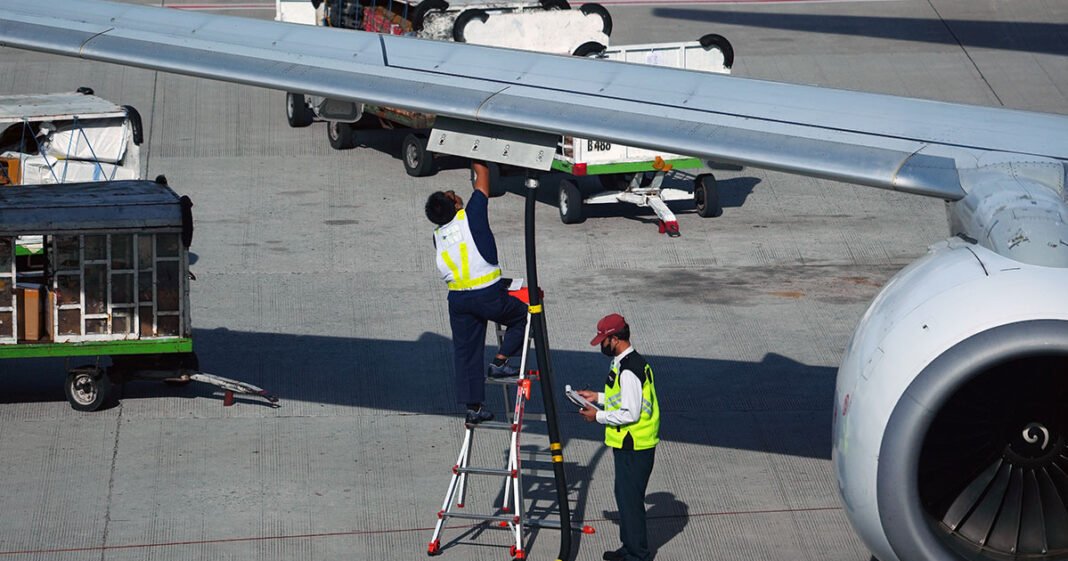

Workers refuel an aircraft at Soekarno-Hatta International Airport in Jakarta, Indonesia. (Dimas Ardian/Bloomberg)
March 4, 2026 3:00 PM, EST
Airlines and other large fuel buyers have been loading up on oil derivatives contracts in recent days to keep their bills from spiraling as the U.S.-Iran war pushes prices to multiyear highs.
Traders and brokers say consumer hedging has picked up since the conflict began, though buying has been more incremental than the aggressive moves to lock in prices seen by producers earlier this week. Much of the surge is showing up in higher call option volumes, as airlines, trucking firms and shipping companies seek protection against another leg up in a breathless jet fuel rally that has pushed European prices to their highest level since 2022.
The demand for hedges comes as Brent crude rose about 12% in three days to top $80 a barrel as a military standoff between the U.S. and Iran threatens a prolonged disruption of flows through the Strait of Hormuz.
The threat to the vital oil-shipping channel has spurred fresh worry among consumers about a further run-up in the price of a commodity that is typically their largest expense. Consumers are unlikely to feel the benefit of any fuel-cost savings, as hedging gains are realized gradually and could diminish if oil prices retreat.
“Geopolitical and policy risk remains high over major oil-producing countries, oil transit routes and sanctioned oil,” Richard Thomson, chief financial officer of Air New Zealand, said in an earnings call last week. “This means ongoing volatility and uncertainty over oil prices and refining margins that may impact our fuel costs, and we’ve seen that in the past week or so at an elevated level on both Brent and crack spreads.”
The company restructured part of its January and February hedges away from Brent-linked contracts and into jet fuel swaps. While the swaps are less frequently traded, they offer better protection when the gap between the price of jet fuel and crude oil — known as the crack spread — surges.
Airlines typically have used products like Brent and gas oil — or diesel — via instruments like options contracts and swaps to hedge their exposure as they are more liquid. In recent years, some major carriers have increasingly shifted to hedging the crack spread exposure directly after multiple blowups from relying solely on Brent hedges, as swings in refining margins have at times been the primary driver of jet fuel price spikes.
One major derivatives dealer, who also asked not to be identified discussing client activity, said that after weeks of trying to secure better levels, one carrier was forced to lock in protection near the peak of the March 3 rally for fear of further run-up.
British Airways parent IAG SA said in late February that its projected annual fuel bill has risen to about 7.4 billion euros ($8.6 billion) from 7 billion euros at the end of December in response to recent Middle East tensions.
Fuel hedging has been far more prevalent among Europe, Middle East and Africa-based carriers than their U.S. peers. Many U.S. airlines pulled back from derivatives after suffering heavy losses during the oil price swings around the global financial crisis in 2008. Southwest Airlines Co., one of the last major holdouts, formally ended its hedging program last year. As a result, U.S. carriers are generally more exposed to oil price volatility than their overseas counterparts.
“Our approach to hedging continues to be focused on the shorter-term horizon with the objective of providing some volatility protection to booked revenues,” said John Di Bert, executive vice president and chief financial officer of Air Canada.

