
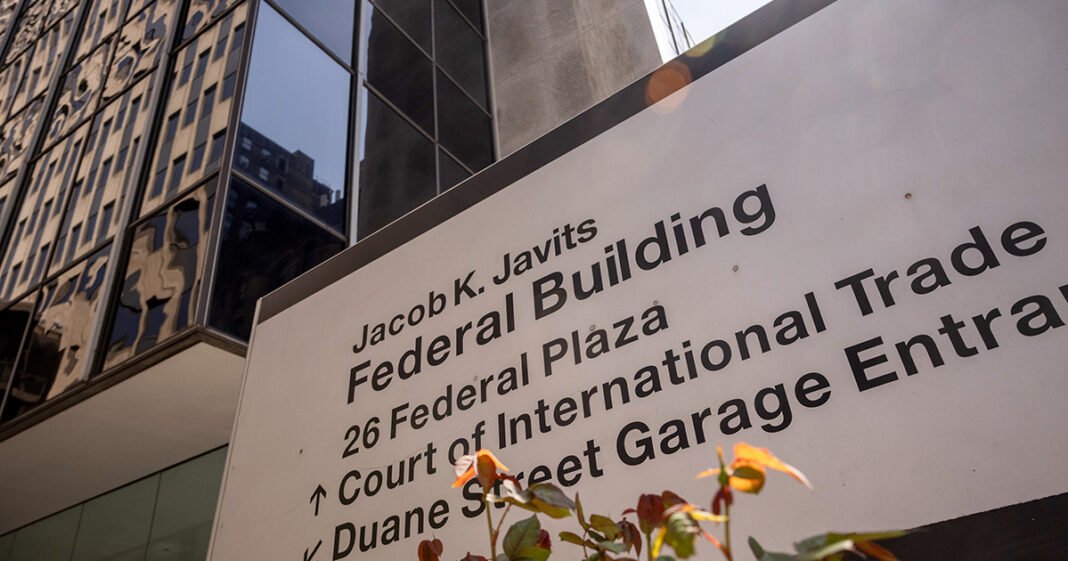

Signage near the U.S. Court of International Trade in New York. CBP is readying a new refund system that may be ready to use in as little as 45 days. (Yuki Iwamura/Bloomberg)
March 6, 2026 12:48 PM, EST
| Updated: March 6, 2026 4:47 PM, EST
A U.S. Customs and Border Protection official told a federal judge March 6 that the agency can’t comply with a court order to stop processing import duties that include President Donald Trump’s emergency levies that were struck down by Supreme Court.
CBP is instead “making all possible efforts” to create an automated refund system that “will be simpler and more efficient” than the current process and may be ready for use in as soon as 45 days, according to an affidavit filed with the judge by Brandon Lord, a CBP executive director.
Judge Richard Eaton, who sits on the federal trade court in New York and is overseeing thousands of lawsuits seeking refunds for the tariffs, later suspended the part of his order calling for immediate compliance.
On March 4, Eaton had ordered the CBP to remove Trump’s emergency tariffs from its massive backlog of importers’ paperwork. The judge said that doing so would make future refunds easier and he questioned why the government hadn’t already stopped after the Supreme Court’s ruling last month.
Lord said in his affidavit that the current automated system that processes hundreds of thousands of import entries each week cannot siphon out entries that include billions of dollars in tariffs that were collected by the Trump administration under the International Emergency Economic Powers Act, as the judge ordered.
“CBP is now facing an unprecedented volume of refunds,” Lord said in the filing. “Its existing administrative procedures and technology are not well suited to a task of this scale and will require manual work that will prevent personnel from fully carrying out the agency’s trade enforcement mission.”
In a 6-3 decision, the Supreme Court found that Trump unlawfully used IEEPA to impose so-called reciprocal tariffs on goods entering the country. Since then, questions have swirled around when and how importers may get refunded nearly $170 billion in IEEPA tariffs.
Patrick Brennan of Cox Fleet talks about the common missteps that fleets make in planning for future maintenance and operational needs. Tune in above or by going to RoadSigns.ttnews.com.
Eaton had ordered CBP to remove the IEEPA tariffs from importers’ paperwork before each entry is closed out in a process known as liquidation. In his filing, Lord said such a move isn’t possible, citing the need for what he described as extensive manual labor that isn’t realistic.
“Currently, it is not possible for CBP to immediately prevent any additional entries from liquidating without IEEPA duties,” Lord said.
A March 6 hearing on the matter in the Court of International Trade in Manhattan was closed to the public. The judge previously expressed skepticism about the Justice Department’s assertion that the refund process would be difficult, saying that CBP appeared to have all the data it needs to rapidly issue refunds through the process it has always used, albeit on a much larger scale.
During a March 4 hearing, Eaton said the refund process should “not result in a mess” and that “every single cent of IEEPA duties that was imposed must be refunded.”
In his affidavit, Lord said that CBP had identified about $166 billion of IEEPA duties that were collected from more than 330,000 importers with 53 million individual entries. About 20.1 million entries remain unliquidated, he said.
The CBP’s “existing administrative procedures and technology are not well suited to a task of this scale and will require manual work that will prevent personnel from fully carrying out the agency’s trade enforcement mission,” Lord said in the filing.
The CBP official also said that such a process would result in personnel being “redirected from responsibilities that serve to mitigate imminent threats to national security and economic security.”
The new automated process that CBP said it’s developing will be faster, Lord said, because it will issue consolidated refunds to individual importers rather than refunding millions of separate payments.

