
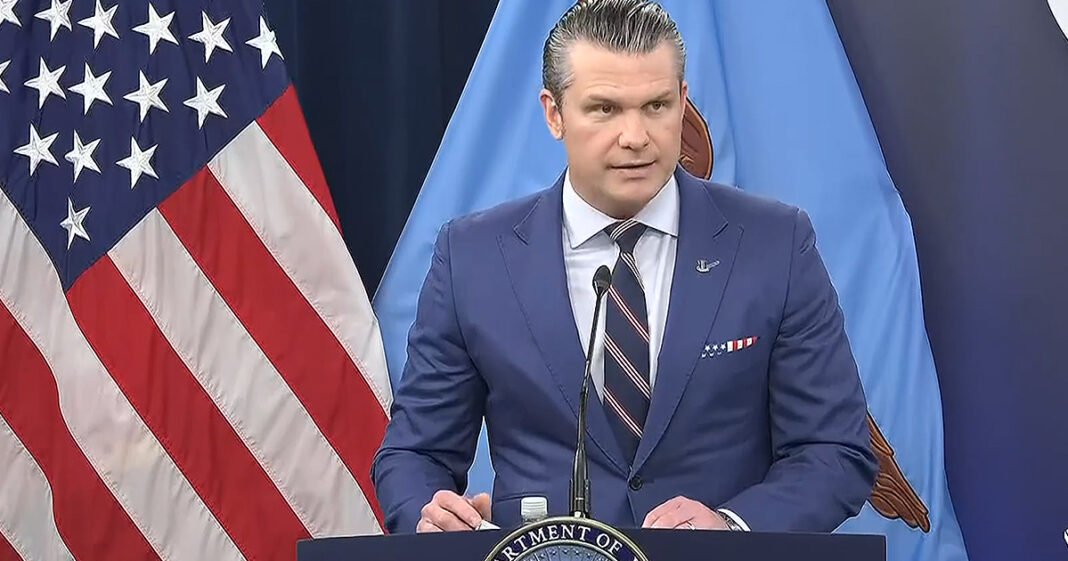

Secretary Pete Hegseth addresses a press conference March 10. (Department of War via X)
March 10, 2026 10:06 AM, EDT
The Pentagon said it’s conducting the most intense day of attacks against Iran and won’t give up until the Islamic Republic is defeated, striking a more aggressive tone after President Donald Trump’s suggestion the war could end soon.
Defense Secretary Pete Hegseth made the comments during a press conference March 10. They suggested the U.S.-Israeli campaign that began Feb. 28 may still have some way to run, creating further disruption in the oil industry and global markets.
Asked whether he would be willing to talk to the Iranians, Trump said it would be possible but was noncommittal, Fox News reported. Iranian officials have pushed back against that idea, with Parliament Speaker Mohammad Bagher Qalibaf saying the country is “absolutely” not seeking a ceasefire.
Foreign Minister Abbas Araghchi told PBS’s News Hour on March 9 that talks with the U.S. are not “on our agenda.”
The U.S. comments came as strikes continued into an 11th day. Washington and Israel continued to bomb Iran overnight and into March 10, with the Islamic Republic firing drones and missiles at targets across the Middle East in return.
“We’re concerned at the apparent lack of a joint plan on how this war can quickly be brought to a convincing conclusion,” German Chancellor Friedrich Merz told reporters.
LIVE: @SecWar and Chairman of the Joint Chiefs of Staff, Air Force Gen. Dan Caine, hold a press briefing at the Pentagon. https://t.co/MLd6Uwpdc1
— Department of War 🇺🇸 (@DeptofWar) March 10, 2026
The biggest oil refinery at Ruwais in the United Arab Emirates halted operations after a drone strike caused a fire in the industrial area in which it’s located, according to people familiar with the matter. Abu Dhabi National Oil Co. was assessing damage at the plant, the people said.
Addressing concerns about soaring energy prices, Trump said March 9 that the U.S. Navy will escort tankers to maintain a steady oil supply through the Strait of Hormuz. The effective closure of the waterway — vital to the world’s flow of petroleum — has created bottlenecks and caused regional energy giants to slash production.
Brent crude, having climbed to almost $120 a barrel early March 9, eased to about $91 following Trump’s comments about the war ending soon. That’s still more than 50% higher than at the start of the year.
Saudi Arabia, Iraq, the United Arab Emirates and Kuwait have lowered their collective output by as much as 6.7 million barrels a day, people with knowledge of the matter said. That amounts to about 6% of global supply. There’s little sign Hormuz can be opened quickly without at least a pause in hostilities.
Saudi Aramco CEO Amin Nasser called the disruption “the biggest crisis the region’s oil and gas industry has faced.”
“We have already warned everybody in the region,” says Iranian Foreign Minister Abbas Araghchi. “Since we cannot reach American soil, we have to attack their bases in the region.” https://t.co/iu4JqX4d5G
— PBS News (@NewsHour) March 10, 2026
Trump told Republican lawmakers on March 9 that the U.S. and Israel are “crushing the enemy in an overwhelming display of technical skill and military force.” He later said the U.S. had hit 5,000 targets in Iran, reducing the country’s missile capability to a 10th of what it was. The military objectives of the war could be described as “pretty well complete,” he said.
Even so, Iran pressed ahead with attacks on Israel and Arab states on March 10. The United Arab Emirates said it was responding to a missile threat from the Islamic Republic, hours after it reported a drone attack on its consulate in Iraq’s Kurdistan region. One person was killed in an attack on the Bahraini capital of Manama, while Kuwait intercepted six drones.
There are early signs the attacks on some countries, including the UAE, are waning. Countries from Australia to South Korea and the U.K. have either helped to boost defenses of Gulf allies or are assessing requests to do so.
Iranian President Masoud Pezeshkian said Tehran is prepared to scale back the conflict “on the condition that the airspace, territory, and waters” of neighboring countries aren’t used to launch attacks on the Islamic Republic, according to semi-official Mehr news agency.
Pezeshkian made those remarks during a phone call with Turkey’s President Recep Tayyip Erdogan, following the interception of an Iranian missile in Turkish airspace by NATO’s air defenses on March 9. He has made similar comments in the past week, yet Iran continues to attack the likes of the UAE and Saudi Arabia, which say they aren’t allowing Israel or the US to use their airspace for strikes.
NATO is increasing air defenses in southeast Turkey, where the U.S. operates a key radar supporting the alliance’s ballistic missile shield.
More than 1,300 Iranians have been killed in the war so far, according to an official toll that number hasn’t been updated for several days. The U.S. reported its seventh casualty on March 8. Two Israeli soldiers and about a dozen civilians also have died, while several deaths have been reported in Gulf countries.
Israeli forces maintained attacks on southern Lebanon on March 10, aiming to degrade Iran-aligned Hezbollah. Some 486 people have been killed in Lebanon, according to the nation’s health ministry.
Trump pledged during his election campaign not to allow the U.S. to become involved in protracted foreign wars, and there’s a risk that more American casualties and sustained high gasoline prices will weigh on the Republican Party’s chances in mid-term elections in November.
Polls show an overwhelming majority of Americans oppose the war, and it has been condemned by several GOP politicians.
Patrick Brennan of Cox Fleet talks about the common missteps that fleets make in planning for future maintenance and operational needs. Tune in above or by going to RoadSigns.ttnews.com.
Trump said he could waive “certain oil-related sanctions to reduce prices” but didn’t offer specifics beyond acknowledging he had discussed the topic with Russian President Vladimir Putin. Moscow has faced a range of restrictions on its vast oil industry, including a price cap on its crude and U.S. sanctions on its two largest producers — a bid to deprive the country of revenue over its war in Ukraine.
“We’re looking to keep the oil prices down,” Trump said. “They went artificially up because of this excursion.”
On March 8, Iran chose Mojtaba Khamenei, 56, as the country’s new supreme leader. His father Ali Khamenei ruled the country for almost 37 years and was killed when US-Israeli strikes began on Feb. 28.
Khamenei has deep ties to the Islamic Revolutionary Guard Corps, about the most powerful military and economic organization in Iran. The group pledged full obedience to the new leader. He is yet to speak publicly since being elected.

