
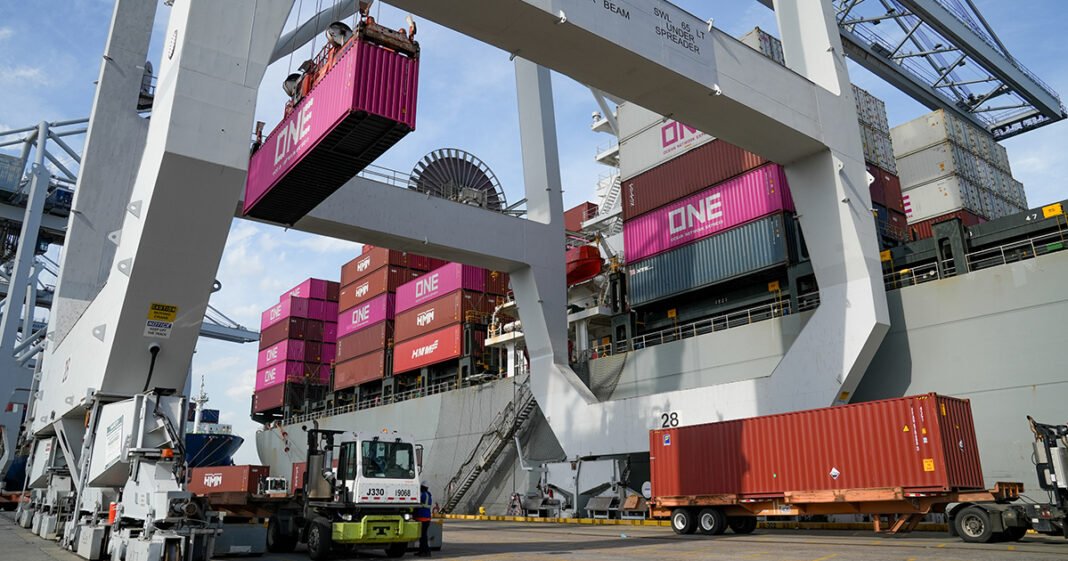

Containers offloaded from a ship at the Port of Savannah in Georgia. (Megan Varner/Bloomberg)
March 13, 2026 9:08 AM, EDT
President Donald Trump’s administration began its second tariff investigation in as many days, continuing its effort to rebuild his key trade policy that was struck down by the Supreme Court.
The office of U.S. Trade Representative Jamieson Greer on March 12 initiated the probe under Section 301 of the 1974 Trade Act into forced-labor practices in 60 economies. The European Union, China, Japan, South Korea, Canada, Mexico, India, Taiwan and the U.K. are among the targets of the inquiry.
“The investigations will determine whether acts, policies, and practices of each of these economies related to the failure to impose and effectively enforce a ban on the importation of goods produced with forced labor are unreasonable or discriminatory and burden or restrict U.S. commerce,” Greer said in a statement late March 12.
The move follows another sweeping inquiry announced March 11 focused on industrial overcapacity in more than a dozen U.S. trading partners, including major economies such as China, India, Japan and the EU.
The Trump administration has rushed to construct a new tariff regime after the high court ruled that the president violated the U.S. Constitution by imposing many of his previous duties using an emergency law.
Earlier: US Starts Trade Probe Into China, EU as Trump Revives Duties
Ambassador Greer launched Section 301 investigations into acts, policies, and practices of 60 economies to determine whether foreign governments have taken sufficient steps to prohibit the importation of goods produced with forced labor.
Learn more: https://t.co/E8HBZYZcyV pic.twitter.com/Zzf8uQ2QBy
— United States Trade Representative (@USTradeRep) March 13, 2026
Trump’s stopgap replacement levies, which fall under Section 122 of the Trade Act, expire in July. Greer has said his goal is to complete a series of trade investigations by then in order to allow the president to quickly enact new tariffs after the outgoing measures expire.
All told, Trump has said that his goal is to simply replace the tariffs that the court struck down. Section 301 tariffs are more durable and legally tested that other authorities Trump has leaned toward, but are more time-consuming.
“We had a little disappointing decision to put it mildly from the Supreme Court,” the president told House Republicans during a speech on March 9. “The good news is I have lots of other ways of doing the same thing. I just have to work a little harder.”
The industrial capacity investigation also targeted more than a dozen U.S. trading partners, including China and the EU. Singapore, Switzerland, Norway, Indonesia, Malaysia, Cambodia, Thailand, South Korea, Vietnam, Taiwan, Bangladesh, Mexico and Japan were also subject to it.

