
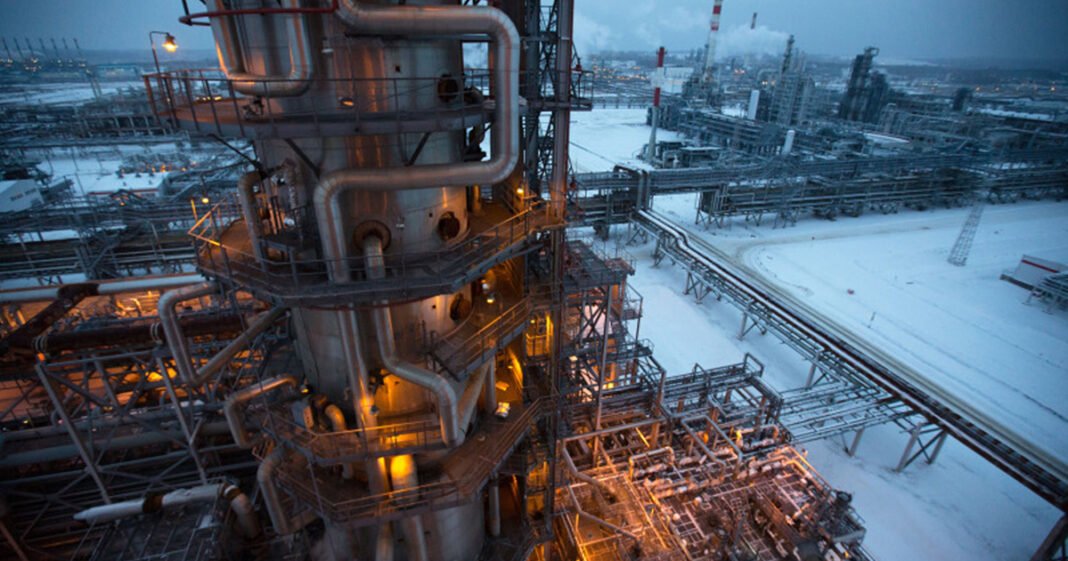

A petroleum cracking tower at a refinery in Nizhny Novgorod, Russia. (Bloomberg News)
March 13, 2026 8:37 AM, EDT
The U.S. issued a second authorization letting countries buy more Russian oil that’s stuck on tankers due to sanctions, part of the White House’s push to prevent prices from surging.
The temporary move, which widens a waiver given to India last week, only applies to oil already in transit and as such won’t provide significant financial support for the Russian government, Treasury Secretary Scott Bessent, in a social media post.
Brent oil has soared about 40% since the Iran war began, driving up fuel prices at the pump globally, including gasoline in the U.S.
The conflict has led to the effective closure of the Strait of Hormuz, the world’s most-important energy-shipping channel, choking the flow of a fifth of the world’s oil.
It’s unclear how much extra oil the step will free up in practice and it represents a fraction of what has been lost because of the Hormuz turmoil this month. India had a week from the first waiver to snap up on-water cargoes and quickly took 30 million barrels. That means there are fewer available now.
.@POTUS is taking decisive steps to promote stability in global energy markets and working to keep prices low as we address the threat and instability posed by the terrorist Iranian regime.
To increase the global reach of existing supply, @USTreasury is providing a temporary…
— Treasury Secretary Scott Bessent (@SecScottBessent) March 12, 2026
“Of course any supply helps, but this is a smaller help than it looks,” said Robert Rennie, head of commodity research at Westpac Banking Corp. “We are only really talking about replacing maybe four or five days of lost Gulf exports. Sure, it helps, but it is no panacea.”
Out of 125 million to 150 million barrels of Russian crude on the water, about a third is off China and likely to end up in storage, with 30 million to 40 million barrels near India and likely to be consumed there, Rennie said. The rest is in the Mediterranean and the Atlantic, he said.
Historic Disruption
The International Energy Agency estimated on March 12 that Middle East producers will cut their collective output by close to 250 million barrels this month, while shipments through Hormuz will decline by over 600 million barrels of crude and fuels. Up to about a third that theoretically might be diverted via pipelines that bypass the waterway.
The U.S. government has taken several other steps to tame the impact of the disruption, which the IEA said is the biggest supply disruption in the history of the oil market.
It’s releasing of 172 million barrels from its emergency oil reserve and has floated other ideas, ranging from intervention in the futures markets, to waiving a century-old law that requires U.S. ships be used to transport goods between American ports.
The latest waiver applies to oil loaded before March 12 and runs for a month. The prior one was for pre-March 5 cargoes, and also ran for a month.
Patrick Brennan of Cox Fleet talks about the common missteps that fleets make in planning for future maintenance and operational needs. Tune in above or by going to RoadSigns.ttnews.com.
About 30 vessels in Asian waters are carrying Russian crude and products that are potentially available for purchase, ship-tracking data compiled by Bloomberg show. The vessels are signaling “for orders” — meaning they have no clear destination yet — or are headed toward Singapore or Malaysia, locations where tankers tend to linger while cargoes are sold.
Bessent has previously suggested the U.S. could “unsanction” additional Russian oil to ease price pressure.
“If oil prices spike again, perhaps because Iran steps up its attacks on oil tankers in the Strait of Hormuz, pressure to lift Russia sanctions will build further,” Robin Brooks, a senior fellow at the Brookings Institution, said in a social media post.
Bessent said earlier on March 12 that any benefit for Russia from U.S. actions would be “unfortunate” and short-term.
“We hope that it will be a micro period that they will benefit,” he said on the Master Investor Podcast with Wilfred Frost.

