
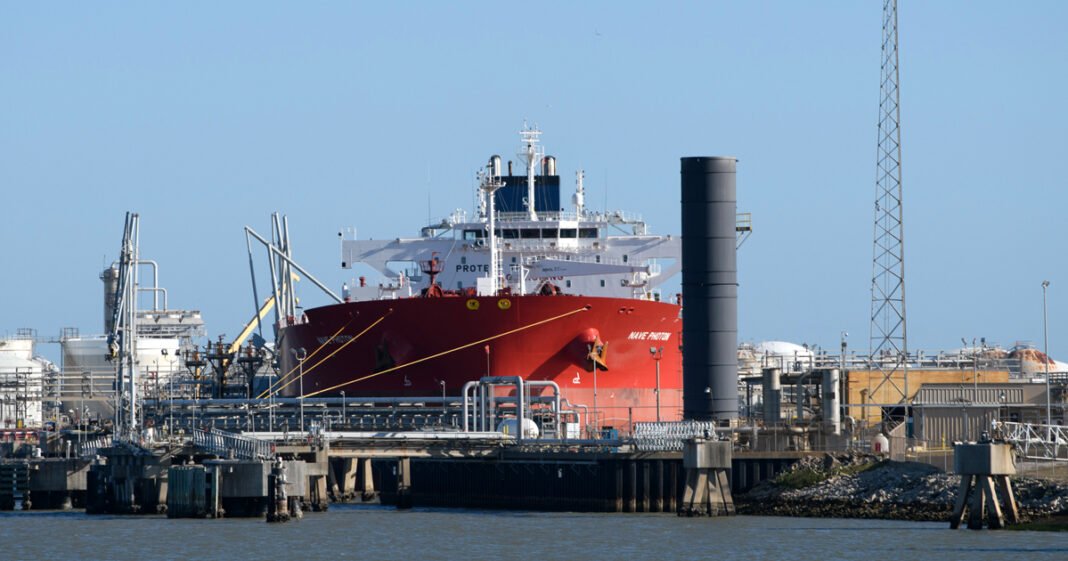

The administration will also put in place a broader mechanism that would make it easier for a wider swath of companies to enter Venezuela. (Mark Felix/Bloomberg)
March 17, 2026 5:42 PM, EDT
Key Takeaways:
- The Trump administration plans to further ease sanctions on Venezuela’s oil sector by issuing more licenses for foreign companies to operate there.
- Officials aim to boost global oil supply amid price spikes driven by the Iran war, though experts say Venezuela can add only limited near‑term production.
- Additional authorizations could be announced this week as companies await U.S. guidance and Washington seeks more market relief from various oil‑producing nations.
The Trump administration intends to take additional steps to ease sanctions on Venezuela’s oil sector in an effort to increase crude production as the Iran war sends prices surging.
The moves, which could be announced as early as this week, include issuing more individual licenses allowing foreign companies to work in Venezuela without violating U.S. sanctions, according to people familiar with the plan who asked not to be named because the plan isn’t public.
The administration will also put in place a broader mechanism that would make it easier for a wider swath of companies to enter Venezuela, the people said. It’s unclear whether that step would take the form of a general license.
“The administration has already issued many general licenses to facilitate rapid progress in the mining and energy industries,” Taylor Rogers, a White House spokeswoman said in a statement. “We will continue to take action, when necessary, to restore peace and prosperity in Venezuela.”
Among the companies poised to receive authorization from the Treasury Department to operate in Venezuela are a subsidiary of India’s state-owned ONGC Videsh Ltd, Stockholm-based Maha Capital AB and J&F Investimentos, a unit of Brazilian meatpacking giant JBS Foods Group, some of the people said.
The Treasury Department, ONGC Videsh and J&F didn’t immediately comment. Maha declined to comment.
The Trump administration has so far only issued a handful of licenses as part of its plan for private companies to spend an estimated $100 billion over the next decade to rebuild the nation’s decrepit oil sector. They include Chevron Corp., BP Plc, Shell Plc, Repsol SA, Eni SpA and Maurel et Prom SA.
The war in Iran, however, is pressuring Washington to accelerate efforts in Venezuela, home to some of the world’s largest crude reserves. Global oil futures have soared more than 40% since the U.S. and Israel launched their attacks, sending gasoline prices to the highest since 2023.
Like others interested in returning, ONGC Videsh is owed hundreds of millions of dollars by Venezuela’s state-owned energy company, Petróleos de Venezuela SA. Reviving operations in the country could allow ONGC Videsh to work out an agreement with PDVSA to recover what it’s owed.
RELATED: Iran Supply Chain Disruptions Threaten US Trucking
On a Feb. 13 earnings call, ONGC Videsh Finance Director Vivek Tongaonkar said the company is awaiting guidance from the U.S. government regarding Venezuela, saying “the movement is in the positive direction.”
It’s unclear whether easing Venezuela oil sanctions will lead to near-term production gains. The nation currently pumps around 1 million barrels a day, a third of its peak in the 1990s. The nation’s energy infrastructure has crumbled significantly since then, thanks to mismanagement, neglect, corruption and sanctions.
Francisco Monaldi, director of Latin American energy policy at Rice University’s Baker Institute for Public Policy, said Venezuela is not positioned to produce enough additional oil fast enough to offset the spike in global prices. He expects Venezuela to boost production by no more than a third or 300,000 barrels per day in 2026 — a drop in the bucket of global demand.
“It’s completely marginal in the short term,” Monaldi said in an interview.
Yet the Trump administration has been pushing to bring more oil onto the market from wherever possible. Earlier this month, it temporarily eased some sanctions on Russian crude intended to pressure President Vladimir Putin to end his war in Ukraine. It has also, for now, eased its push to get India to stop buying Russian oil.
Eric Martin, Patricia Garip, Peter Millard and Fabiola Zerpa contributed to this article.

