
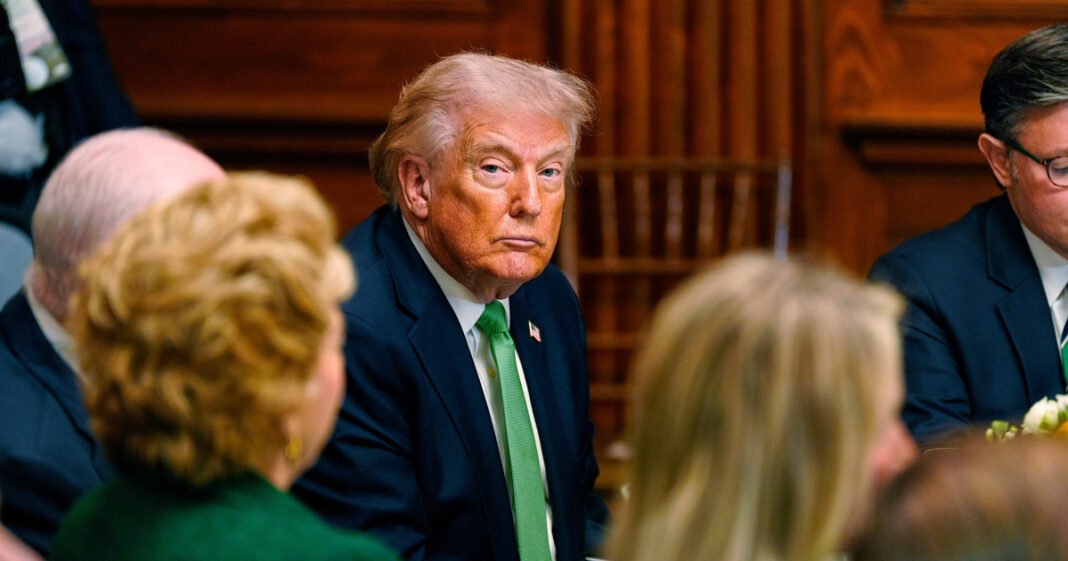

The move sheds fresh light on how Trump’s war with Iran has jumbled his foreign policy agenda. (Alex Brandon/Associated Press)
March 17, 2026 3:55 PM, EDT
Key Takeaways:
- President Donald Trump postponed his planned summit with Chinese President Xi Jinping by about five or six weeks due to the ongoing war with Iran.
- The delay highlights how the conflict has disrupted U.S. foreign policy as both countries navigate strained ties over trade, Taiwan and security in the Strait of Hormuz.
- U.S. and Chinese officials said talks will continue, with the summit expected later as both sides work on trade issues and a new mechanism to manage economic concerns.
U.S. President Donald Trump announced his highly anticipated summit with Chinese President Xi Jinping is being postponed, injecting uncertainty into the two countries’ ongoing trade negotiations.
“We’re resetting the meeting,” Trump said March 17 at the White House during a sit-down with the Irish prime minister. “We’re working with China; they were fine with it.”
Trump did not announce a new date for the summit but said it would take place in “about five or six weeks.”
Liu Pengyu, spokesperson at the Chinese Embassy in Washington, said he had no new information to provide about the timing of the summit. “China and the U.S. remain in communication on President Trump’s visit to China, including the dates,” he said in an emailed statement.
The move sheds fresh light on how Trump’s war with Iran has jumbled his foreign policy agenda. The conflict adds another point of tension to the relationship between the world’s two largest economies, which already has been strained by trade and the status of Taiwan.
Trump said he asked China to postpone the meeting, which was originally slated for March 31 to April 2, by “a month or so” to allow him to remain in Washington amid the war, now in its third week.
The U.S. president had previously suggested the summit could be put off if China did not agree to help the U.S. secure the Strait of Hormuz, a critical waterway for energy supplies that has been all but closed off since the start of the war.
RELATED: Hormuz Reopening Looks Unlikely Without a Ceasefire
Trump stressed that he has a “good relationship with China” and “looks forward” to seeing Xi.
“China actually is — has become, economically for us, very good. As you know, it’s much different than it was in the past,” the president told reporters.
Administration officials have also sought to downplay the impact of rescheduling on U.S.-China ties. Treasury Secretary Scott Bessent said March 16 that the summit “would be rescheduled because of logistics” and Trump’s desire to oversee the war, and not because of frustrations with Beijing.
“Traveling abroad at a time like this may not be optimal,” Bessent said on CNBC.
The decision to delay the summit is likely a welcome development for Beijing. China has been willing to delay the meeting given the already short preparation period and the uncertainty about the Iran war, which could create embarrassing moments during the summit, according to a person familiar with the matter.
Temporary Setback
The delay nonetheless marks a setback, albeit a temporary one, for Trump’s effort to stabilize relations with China. U.S. and Chinese officials met earlier this week in Paris to hammer out potential areas of agreement, including Chinese investment in the U.S. and exports of advanced semiconductors.
The one-year trade pact negotiated by the U.S. and China in October following months of tariff disputes will also be a critical focus of the summit. Officials indicated at the Paris talks this week that they intend to continue that economic dialogue, floating a new mechanism to manage bilateral concerns.
Trump and his team have hailed that agreement as evidence that his trade brinkmanship has benefited the U.S.
The war has overshadowed Trump’s other priorities, especially with Iran’s move to block the Strait of Hormuz sending the price of oil above $100 a barrel. In an interview with the Financial Times published March 15, Trump said it was “only appropriate” that countries benefiting from traffic through the strait should help protect it. China’s state-run Global Times dismissed the idea as Trump’s attempt to spread the risk “of a war that Washington started and can’t finish.”

