
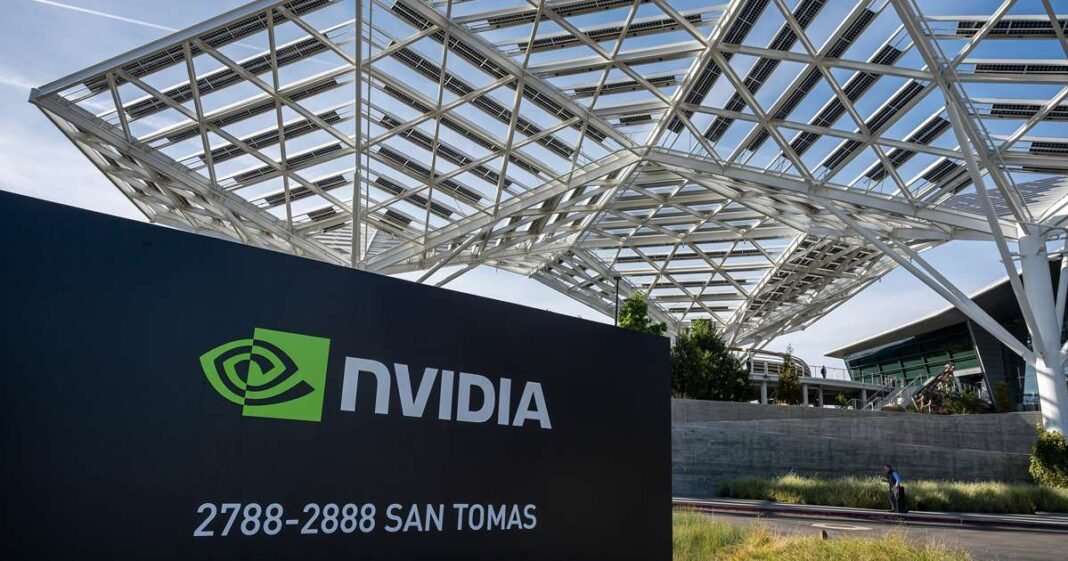

Nvidia headquarters in Santa Clara, Calif. (David Paul Morris/Bloomberg)
January 14, 2026 4:45 PM, EST
Key Takeaways:
- The U.S. imposed a 25% tariff on semiconductor imports under a Jan. 14 Trump order enabling Nvidia to ship Taiwan-made H200 chips to China.
- The levy is a condition for allowing China sales, collected on chips transshipped through the U.S., after Commerce eased H200 export licensing criteria.
- Nvidia still needs BIS export licenses that may take weeks or months, while the directive’s scope remains unclear and broader Taiwan tariff talks continue.
[Stay on top of transportation news: Get TTNews in your inbox.]
The U.S. imposed a 25% tariff on imports of certain semiconductors, a key step in an agreement blessed by President Donald Trump allowing Nvidia Corp. to ship Taiwan-made H200 artificial intelligence processors to China.
Under an order Trump signed on Jan. 14, the government would collect the duty on the chips as they’re brought to the U.S. before final shipment to Chinese customers and other foreign markets. Nvidia relies on Taiwan Semiconductor Manufacturing Co. to produce the chips it designs, including the H200 that was cleared for sale to China by Trump in December.
“It’s not the highest level, but it’s a very good level. And China wants them, and other people want them, and we’re going to be making 25% of the sale of those chips, basically,” Trump told reporters Jan. 14 during a signing ceremony.
The full text of the directive was not immediately available, and the scope could apply to chips other than the H200.
Trump signed the measure a day after the Commerce Department’s Bureau of Industry and Security eased its criteria for securing licenses to export H200 chips to China. The president didn’t refer to Nvidia by name but cited two of its platforms, the Blackwell and the Rubin, saying “those are the two top but it’s a very good chip, and people want it, and we think it’s in our best interest to do it.”
The duty would apply to chips “transshipped through the United States to other foreign countries” and not those used domestically, White House staff secretary Will Scharf said.
RELATED: Trump Establishes Process to Secure Key Mineral Supplies
That surcharge is a condition Trump required in exchange for allowing Nvidia to sell in China. The U.S. must still take additional actions before Nvidia can send the chips to China, including the approval of export licenses by BIS. That process can take weeks or months and it’s unclear when it will conclude.
Taiwanese products have generally faced a 20% tariff upon entering the U.S., though semiconductors have been spared as Commerce officials conduct a national security investigation into whether new levies should be applied across the chip sector. Trump has yet to follow on imposing tariffs, as negotiations with Taiwan and major technology companies continue.
Top Taiwanese officials were traveling to Washington on Jan. 14 for talks on finalizing a deal to lower its overall tariff rate to 15% and expand TSMC production facilities in the U.S., according to people familiar with the matter.
Trump’s decision marked a significant victory for Nvidia, which has pushed U.S. policymakers to loosen export controls that have kept the company from selling its AI chips to the world’s largest semiconductor market. Nvidia CEO Jensen Huang has forged a close relationship with Trump and has used those ties to persuade the president that restrictions only boost Chinese domestic giants, such as Huawei Technologies Co.
It’s a turnabout from years of U.S. policy that sought to limit Beijing’s access to advanced American technologies and has provoked blowback from Democrats and national-security hawks in Washington who say the move will embolden an adversary that is keen on gaining ground in the AI race.
Trump took a hard line against China at the outset of his presidency, making good on a campaign promise to crack down on its economic practices. But after triggering a trade war by imposing sky-high tariffs on Chinese goods, he eased off his pressure campaign by striking a truce with President Xi Jinping.
Trump also made it clear he’s OK with doing some business with Beijing in sensitive areas, as long as the U.S. government gets a financial cut. He teased that a similar arrangement on chip exports is in the works for other companies, including Intel Corp. and Advanced Micro Devices Inc.
“This policy will support American Jobs, strengthen U.S. Manufacturing, and benefit American Taxpayers,” Trump posted on Dec. 8.
Want more news? Listen to today’s daily briefing below or go here for more info:

