
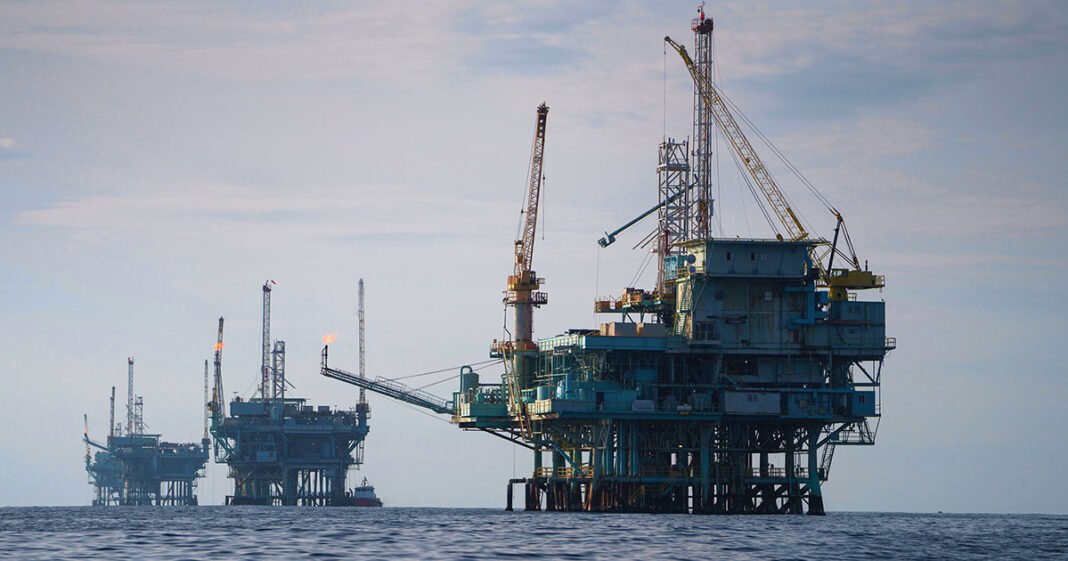

Offshore oil and gas platforms off the coast of Santa Barbara, Calif. (Eric Thayer/Bloomberg)
March 11, 2026 4:00 PM, EDT
President Donald Trump is preparing to invoke Cold War-era powers to pave the way for renewed oil production off the Southern California coast, a long-shot bid to help ease the global crude supply crunch spurred by his war with Iran.
Trump is set to soon summon authorities under the Defense Production Act to pre-empt state laws and ease permitting for Sable Offshore Corp., a Houston-based company looking to restart significant production from a cluster of offshore platforms in California. The plan was described by a person familiar with the matter who asked not to be named because it’s not yet public.
Trading in Sable’s shares was halted after prices jumped as much as 34% on the news. The company’s shares have seen sharp swings and multiple trading halts in the last year.
The planned order comes as Trump faces heavy political pressure to tackle rising fuel prices ahead of the November midterm elections, which will be decided in large part by Americans’ attitudes toward the cost of living.
A White House official said that any policy announcement would come directly from the president. Sable didn’t immediately respond to a request for comment.
California relies heavily on foreign crude — which made up about 61% of the oil used by its refineries last year. Roughly 30% of the state’s foreign oil supplies require passage through the Strait of Hormuz, a key Gulf shipping corridor that’s all but paralyzed by the war.
That disruption has caused a spike in the price of oil — as well as the gasoline and diesel made from it — obliterating an economic success story Trump had been telling to voters.
Trump has sought in recent days to assuage concerns about higher oil and gasoline prices, threatening “harder” bombing on Iran if the country disrupted crude flows and promising U.S. government-backed reinsurance as well as Naval escorts to encourage the restart of tanker traffic through the Strait of Hormuz.
Patrick Brennan of Cox Fleet talks about the common missteps that fleets make in planning for future maintenance and operational needs. Tune in above or by going to RoadSigns.ttnews.com.
Those oil relief measures have yet to materialize. Although the U.S. International Development Finance Corp. said it is deploying maritime reinsurance “on a rolling basis,” there’s no indication tankers have yet transited the strait with that support — or a U.S. Navy escort.
The International Energy Agency on March 11 agreed to its largest-ever release of emergency oil reserves as governments try to contain the price surge.
It’s unclear whether the action targeting California — which was being pursued even before the U.S. and Israel launched strikes on Iran — would offer much immediate relief.
Sable has said its offshore wells could swiftly pump 45,000 to 55,000 barrels per day of crude once restarted, with production climbing to as much as 60,000 barrels per day by the end of the decade. That’s a drop in the bucket compared to U.S. petroleum demand totaling more than 20 million barrels per day — as well as the estimated 15 million more now being kept from the world market by the Hormuz closure.
Still, the effort dovetails with Trump’s long-standing domestic oil and gas priorities, including a vision of American energy dominance and geopolitical might driven by record U.S. output.
Sable has sought to resume significant production from platforms near the Santa Barbara coast, tapping hundred of millions of barrels of crude deep below the sea floor. But its plans have been stymied by California regulators’ opposition to reopening the so-called Santa Ynez complex of pipelines needed to funnel the crude onshore and on to area refineries.
Sable CEO Jim Flores had held out the possibility of using tanker ships to haul the crude away to other markets, even as he appealed to the Trump administration for help gaining approval to use the pipelines instead. They’ve been essentially offline since a Plains All American pipeline burst in 2015, staining beaches and provoking alarm from regulators, environmentalists and local residents.
Plains ranks No. 67 on the Transport Topics Top 100 list of the largest private carriers in North America.
Trump’s order was foreshadowed by a Justice Department legal opinion last week asserting that invoking the Defense Production Act would override state-level permitting barriers and portions of a federal consent decree.
The law allows presidents to authorize a suite of actions to bolster U.S. national defense capabilities, including by directing private-sector companies to expand production of critical industrial materials.
Trump already set the stage for using the DPA to increase domestic oil and gas supplies on his first day back in the White House, when he declared a national emergency tied to U.S. energy supply and infrastructure. The directive said the country faced an “extraordinary threat” from insufficient energy production, transportation and refining capacity.
Resumed Sable production could help supply California, where motorists shoulder some of the highest pump prices in the nation because of stiff environmental rules, bespoke fuel formulations and high taxes. That dynamic has been compounded by the closure of two refineries in the past six months.
‘Lower Prices’
California has the “largest consumption of transportation fuels” of any U.S. state and is “most vulnerable to international price shocks, and that’s all because of policies that state has put in place,” Interior Secretary Doug Burgum told Bloomberg News last week. “If we invoke the Defense Production Act, that is for the benefit of the people in California — it’s for them to pay lower prices for gas at the pump.”
New production at Sable’s facilities would mark a significant boost to California’s oil production. The state’s onshore oil fields have been in a 40-year decline, producing just 246,000 barrels a day in late 2025 compared with over a million barrels daily in the early 1980s.
Trump’s maneuver could roil the already fraught energy politics in California, where Gov. Gavin Newsom has sought some rapprochement with the oil industry, after years of state policies that refiners said increased operating costs and led to closures.
Newsom last year enacted legislation aimed at bolstering oil production in California, a move seen helping to moderate his approach to energy production before a possible presidential bid.
Further complicating matters for Sable, federal investigators have scrutinized the company’s handling of sensitive information.
In a filing earlier this year, the company said it had received subpoenas from the U.S. Attorney’s Office for the Southern District of New York and the Securities and Exchange Commission, following a report from Hunterbrook Media that it had selectively disclosed information to investors.

