

Trucking operators tend to be a cautious but generally optimistic and reasonably confident bunch. That’s been a tough line to hold considering the industry, by many accounts, saw 2026 kick off the fourth year of a persistent and debilitating freight recession.
Yet while the market has been bouncing along the bottom for several years, as the intense winter of 2026 gives way to a hopeful spring, there are signs of a recovery on the horizon, if first-quarter trucker earnings reports are any indication.
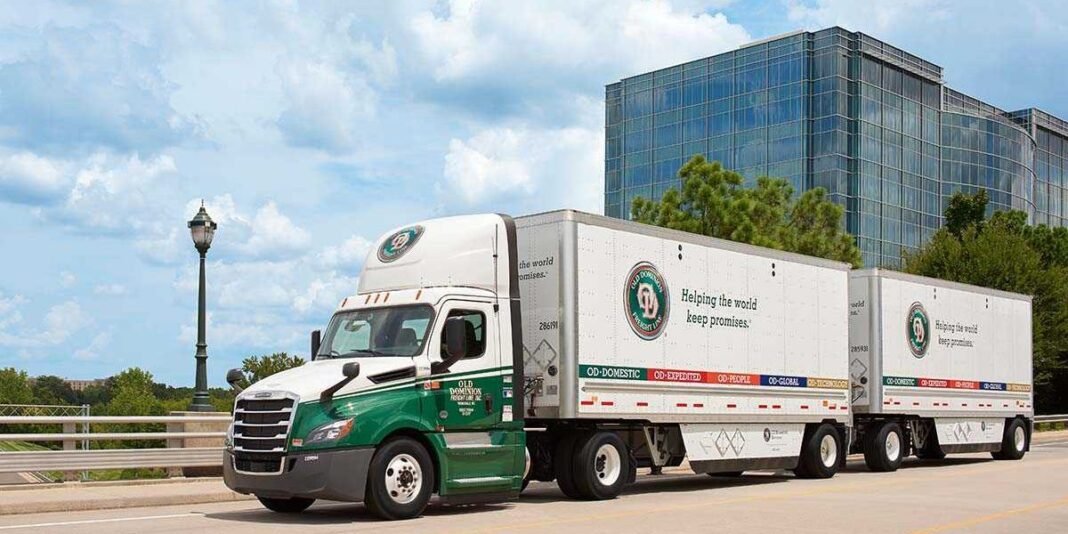
“I think we’ve seen some positive signs that we’ve been really pleased with,” says Adam Satterfield, chief financial officer at less-than-truckload (LTL) carrier Old Dominion Freight Line (ODFL), during the company’s recent earnings call recapping fourth-quarter and full-year 2025 results.
Among those signs: the January 2026 PMI (purchasing managers index) report from the Institute for Supply Management, a bellwether report that tracks manufacturing trends. The group’s overall January Manufacturing PMI came in at 52.6, up from 47.9 in December 2025, with manufacturing orders specifically rising strongly to 57.1. That was the first time in 12 months the manufacturing sector posted an expansion.
“It’s a leading indicator—and, typically, a couple of months after that [it] inflects positive—[and] we see [freight] volumes somewhat do the same,” Satterfield notes, adding the metric ODFL has been the most pleased with is the increase in weight per shipment, which went from roughly 1,450 pounds in September 2025 to 1,520 pounds in December. “Hopefully, [we’re] finally seeing the turn that we’ve been predicting for the last couple of years,” he says.
GREEN SHOOTS
During a separate interview, Marty Freeman, president and chief operating officer of ODFL, notes that he’s seeing “a few green shoots” in the market. One indicator he cites is a firming of the truckload market, where carriers are securing rate increases in the 1% to 3% range. At the same time, truckload overall continues to shed capacity, albeit at a slower pace than in the past.
“The smaller mom-and-pops are exiting the market; they can’t afford to keep their fleet in service because they can’t make enough money per load,” he observes. Where that helps ODFL and other LTL carriers is that “some of that freight falls back into the LTL environment. It might have gone to truckload previously, maybe for cheaper linehaul rates or as a distribution service, where the truckload carrier was handling five to six shipments with drop-offs.” Fourth-quarter increases in seasonality also were a harbinger of improvement, he says.
Yet overall, it is still a fragile market, influenced by a somewhat tepid overall economy, cautious consumers, regulatory mandates, and businesses that can’t forecast accurately because of tariff uncertainty and its ripple effects.
“Everyone is on edge trying to figure out where these tariffs are going and how they will affect their businesses,” Freeman says. “We are not at code red or anything like that,” he adds. “But you still have to be cautious when customers are not talking about double-digit increases in supply chain volumes and their shipping needs. We are keeping our belt very tight and [our plans] close to the vest.”
NOT OUT OF THE WOODS
Improving industrial output along with tightening capacity in the truckload market—and rising spot market rates—are a few of the factors behind the budding turnaround for both LTL and truckload. In slower periods, heavier LTL shipments typically migrate to the truckload market as truckload operators look to pick up almost any shipment—even if it won’t fill the entire trailer—that will generate revenue and help offset expenses. As the truckload market tightens, those shipments tend to migrate back to the LTL market, fueling its growth.
Nevertheless, the industry isn’t out of the woods yet, say some industry executives. Andy Dyer, chief executive officer of AFS Logistics, which manages several billion dollars’ worth of freight spend for its clients annually, isn’t ready to jump on the market-turnaround bandwagon.
“There is no basis for optimism on the demand side,” he observes. “And there is further pessimism on the supply side” as more one- and two-truck operators and small brokerages are forced out of business.
“Small brokers are the first ones to get hit because they don’t have the cash reserves,” he notes. “And we are also seeing more small and mid-sized fleets go out … they just don’t have the financial resources to weather the trough,” he says, adding “fleets are hunkered down—they’re just waiting for attrition of financially weaker players, then scooping up that freight.”
“No one in their right mind would start a truckload company today,” he concludes.
GLASS HALF FULL … OR HALF EMPTY
Some observers are optimistic that the market is about to turn, while others see little light at the end of the proverbial tunnel.
“The problem with being reasonably confident depends on whose side you are taking,” says Avery Vise, vice president of trucking at the research and analytics firm FTR Transportation Intelligence. The downside argument takes the position that as the market turns, “shippers are going to have start worrying about costs,” he says.
The upside argument points to truckload spot market rates beginning to firm. “I would not call it a surge, but our forecasts have been tightening a bit for a while” based on trend lines signaling improving freight volumes and rates. “Not anything off the charts,” but an expectation, Vise says, that overall truckload rates in 2026 “will rise some 4% as a blended rate, with spot rates up 6.5%, and contract rate increases coming in at more than 2%.” Vise notes, though, that as of now, FTR’s forecast for truckload rates “is more likely to strengthen than to weaken.”
Yet the economics of running a truckload operation still remain problematic. “Some fleets are not able to achieve the ROI [return on investment] necessary to cover their costs, let alone have a decent margin,” notes Vise. More-expensive trucks, costly financing, escalating insurance premiums, and an upswing in overall operating expenses is weeding out capacity and keeping new entrants to a minimum, he believes.
“I would argue that the overhang of small carriers has come down from the fall 2022 peak but is still quite elevated,” he says. The number of those carriers still in the market “is still above the trend line, roughly 33% higher now than before the pandemic.”
One positive indicator for carriers, Vise notes, is driver utilization—a measure of how often a driver has a load. “At the peaks of 2018 and 2021, we were at 100% utilization. If you had a driver and a truck, you had a load,” Vise explains. By late 2022, utilization had briefly fallen to as low as below 88% before climbing to around 95% today. “Capacity has essentially bottomed out, I don’t know that we will see much more capacity loss,” he adds.
HANDICAPPING REGULATORY IMPACT
Besides what has been up to this point a soft manufacturing economy, and one riven with uncertainty from fluctuating interest rate policy and on-again/off-again tariffs, the impact of several federal regulatory actions in the past year could reduce capacity as well. The larger question is timing and how deep these actions will go.
Jason Seidl, managing director, industrials, airfreight, and surface transportation at investment firm TD Cowen, cites several initiatives that, as they gain traction, could impact truckload capacity. “One is the English language proficiency [ELP] rule and the other is the government’s focus on revoking commercial driver’s licenses from nondomiciled drivers,” he notes.
States that the Federal Motor Carrier Safety Administration (FMCSA) have called out for noncompliance on license issuances so far have been Minnesota, New York, California, Colorado, Pennsylvania, South Dakota, Texas, and Washington. The FMCSA is demanding these states revoke licenses the agency claims were improperly issued. Final determination is currently the subject of litigation.
The next step, Seidl believes, could be the FMCSA going after so-called “CDL mills,” or truck driver training schools that have been quietly backfilling capacity—in some cases, issuing licenses in as little as 48 hours. “Some of these trucking schools are pumping out drivers that are unsafe,” he notes. And as the FMCSA accelerates and expands its focus on fraudulently issued CDLs, “that backfill will be taken away with more FMCSA enforcement,” Seidl believes.
There is also the issue of “what insurance companies will do about insuring fleets that have nondomiciled drivers,” Seidl adds. “Do rates go up? Do they cancel policies?”
Lastly, a government crackdown on cabotage violations could reduce available trucks and drivers as well. Cabotage involves drivers and trucks from Mexico operating in the U.S., who have permission to deliver cross-border freight to a U.S. location but then must return to Mexico within a certain time period. Cabotage violations occur when these drivers overstay their time and compete for freight loads in the U.S.
If all these factors converge in 2026 and a substantial amount of illegal trucking capacity is removed from the market, “when the market tightens up—and it will—that capacity won’t be there to rush back into the market like it has in the past,” Seidl says.
BETTING ON THE UPTURN
Like a savvy poker player sensing they have a strong hand, some carriers are doubling down on the market, expanding terminal networks and fleets, or acquiring other carriers. One example is LTL carrier A. Duie Pyle.
John Luciani, chief operating officer for LTL at the family-owned trucker, believes LTL carriers “will see a bump in the second half of 2026. With what I’m reading about the manufacturing sector, firming in the truckload space, higher diesel costs, and the impact of the ELP ruling, that’s creating a tighter environment.”
Entering its 102nd year, Pyle is making a bet on the turnaround with significant investments in its network. The primarily Northeast U.S. carrier is looking for space in Cincinnati and plans in 2026 to complete expansions of door capacity or add new service centers in northeast Maryland; Altoona, Pennsylvania; Milton, Vermont; Columbus, Ohio; and Southington, Connecticut.
“We’re not throwing caution to the wind, but we want to continue to build up the network.” Luciani explains. “The family takes a long view of the business. And they want to keep it moving.”
From a pricing perspective, based on his conversations with shippers, “customers still know there is excess LTL capacity” Luciani says, as Pyle and other fleets over the past two years have absorbed and repurposed the real estate acquired from the auction of Yellow Freight’s former freight terminal network.
“So some customers are leveraging that to drive down their transportation costs,” he says. “They want to reduce their spend but also improve the quality and reliability of the service they receive.” That, Luciani believes, presents an opportunity for Pyle with its expanding network, efficient operations, and strong employee culture.
Another example is Estes Express Lines. On top of acquiring and investing in 52 former Yellow Freight sites, the LTL carrier recently purchased six additional terminals. It added facilities in Charleston, West Virginia; Greenville, South Carolina; Kansas City, Kansas; Lexington, Kentucky; Scranton, Pennsylvania; and Sioux Falls, South Dakota. Those put Estes on track to grow its door count to over 14,000 in 2026.
“We have continued to find ways to improve our network and add capacity,” says Webb Estes, the company’s president and chief operating officer, adding “I’ll argue that we are betting on [and preparing for] what trucking looks like in 10 years.”
Customers, he says, keep telling his sales team that they expect reliable capacity and service—from partners they can rely on long term in any market. “What we have focused on is dialing in really strong service,” he explains.
One metric he has been tracking as a bellwether has been inventory levels, particularly as shippers have been working down inventory buffers from large stocks put in place ahead of tariffs.
“There was such a pre-buy ahead of tariffs—a lot of that has been sold off and businesses need to restock,” he notes.
That presents a conundrum for shippers. “An item bought for $100 pretariff is now $130 with tariffs,” he says. “Do I restock at that price? Will it sell? What happens if tariffs go down? Did I overbuy at a high price, and will I have to absorb some of the increase?”
That’s driving renewed interest in just-in-time (JIT) inventory and procurement practices, such as ordering smaller lots more frequently, Estes says. That contrasts with pretariff “just in case” practices, where businesses bought and held heavy inventory levels and then took months to work those off.
AN END TO THE SKID
With several positive factors converging, the trucking markets are sensing a long-anticipated end to what has been a deep slog through the freight darkness. Whether that holds true or not, time will tell.
“The common sentiment around the industry is that carriers who have weathered the rock-bottom rates of the past three years will be rewarded with recovery,” predicts Aaron LaGanke, AFS Logistics’ vice president of freight services. “But when exactly that shift will occur is anyone’s guess.”

