
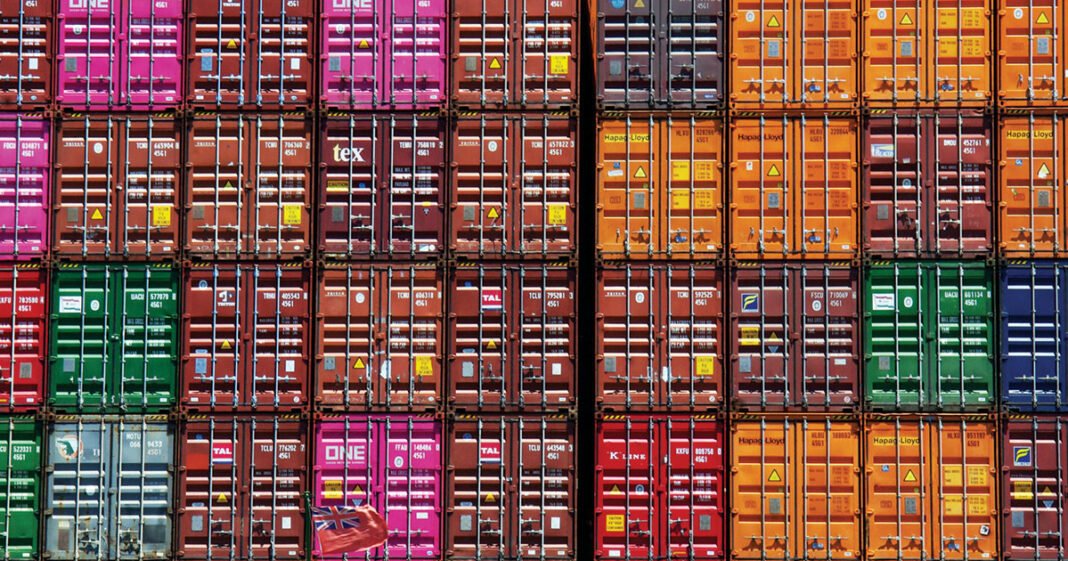

A wall of shipping containers at the Port of Oakland. While avenues exist for companies looking to secure refunds, the process can take time. (Port of Oakland via X)
February 26, 2026 12:00 PM, EST
Key Takeaways:
- The Supreme Court struck down President Donald Trump’s IEEPA-based tariffs, leaving billions in collected duties in question as the case returns to a lower court.
- Customs experts say the ruling raises significant uncertainty for shippers and importers, with companies evaluating potential refunds and how to navigate liquidation and protest deadlines.
- Industry leaders expect further legal and policy shifts as courts determine refund procedures and companies pursue challenges, creating continued uncertainty for transportation and trade markets.
In the wake of the Supreme Court striking down a spate of international trade tariffs enacted by President Donald Trump, the question whether and how the federal government would refund the billions of dollars collected while the tariffs were in effect has loomed large over the transportation sector.
“With the Supreme Court not addressing refunds in its decision and sending the case to a lower court without instructions, no one should make any assumptions,” said Ben Bidwell, senior director for customs at C.H. Robinson. “This is the first time a tariff has been declared unconstitutional with this amount of money at stake.”
The high court ruled 6-3 that Trump’s use of the International Emergency Economic Powers Act as a justification to pursue a wave of global tariffs violated the law. Trump has leaned heavily on tariffs to rework international trade policies he views as unfair to the U.S.
“The Supreme Court’s decision introduces new considerations for shippers and importers, particularly around potential duty refunds and how those may be processed,” said Jose Guerrero, director of U.S. customs operations at Uber Freight. “Many companies are evaluating what the ruling means for their past entries, and what steps may be required to pursue refunds.”
Uber Freight has already seen some near-term adjustments as companies respond to related policy changes — including updated duty rates — which has influenced how importers are timing customs entries and shipments in the short term.
“We’re staying closely engaged with the evolving situation, proactively informing our customers and preparing to support them with the documentation and filings needed as the process becomes clearer,” Guerrero said.
Uber Freight’s Guerrero said the company is “proactively informing our customers and preparing to support them with the documentation and filings needed as the process becomes clearer.” (Uber Freight)
Uber Freight ranks No. 14 on the Transport Topics Top 100 list of the largest logistics companies in North America.
FedEx Corp. took a more aggressive approach, filing a lawsuit against the government seeking a full refund. The company in the suit argued that it had “suffered injury” as a U.S. importer of goods from countries subject to the IEEPA duties.
FedEx ranks No. 2 on the Transport Topics Top 100 list of the largest for-hire carriers in North America, No. 3 on the TT Top 50 list of the largest global freight firms and No. 43 on the logistics TT100.
FedEx has argued in a lawsuit that it had “suffered injury” as a U.S. importer of goods from countries subject to the IEEPA duties. (FedEx Corp.)
Getting Money Back
While avenues exist for securing refunds, the process can take time.
“Once U.S. Customs closes the books on a customs entry — what’s known as liquidation — you typically have 180 days to protest the tariffs,” Bidwell said. “For entries that are still open, you may want to pursue a refund through the standard process of filing a correction. For entries that are closed, make sure to file your protest within the 180-day window.”
C.H. Robinson ranks No. 2 on the logistics TT100 and No. 21 on the global freight TT50.
RELATED: Confusion Mounts as US 10% Tariffs Begin
Bidwell acknowledged that the administration has already stated it will pursue other tariff avenues. To that end, he said C.H. Robinson is focused on helping customers establish structured plans for sourcing materials that take into account tariffs and other risks.
RELATED: Democrats Craft Bill to Refund Billions From Trump Tariffs
“While the Supreme Court’s decision addressed the underlying legal questions related to the IEEPA tariffs, it did not establish a refund framework or prescribe specific administrative steps,” DHL Group said in a statement. “Such guidance will be necessary to determine eligibility criteria for affected entries and to outline the applicable procedural and administrative requirements.” The company said it’s too early to assess how potential refunds may be processed and stressed that it will monitor evolving legal developments to ensure customers receive clarity and can exercise appropriate legal avenues.
“We expect continued changes in customs and trade policies and are prepared to adjust through our global network,” the statement continued. “With decades of experience supporting trade across approximately 220 countries and territories, DHL is well positioned to help customers navigate short-term developments.”
DHL says it is “well positioned to help customers navigate short-term developments.” (Nick Souza)
DHL Group ranks No. 5 on the global freight TT50, and DHL Supply Chain (North America) ranks No. 13 on the logistics TT100.
RELATED: Bessent Warns Tariff Refunds Would Favor Corporations
“If the [Supreme Court] decision is correct, and the tariffs were unlawful, then there was a whole bunch of money collected unlawfully, and it should be refunded,” said Karl Fillhouer, vice president of sales and operations at Circle Logistics. “Unfortunately, at the end of the day, my belief is also that it’s going to be … the American consumer that’s going to pay the price for the lawsuits.”
Fillhouer suspects a successful lawsuit seeking refunds could create havoc and chaos in the long term but stressed that he understands the motivation for seeking them. Circle Logistics ranks No. 91 on the logistics TT100.
“The problem we have in the transportation world is we are highly relying on certainty in the marketplace, as do investors and as do large importers and retailers,” Fillhouer said. “It is the uncertainty that really makes it tough for our economy to get some traction.”

