
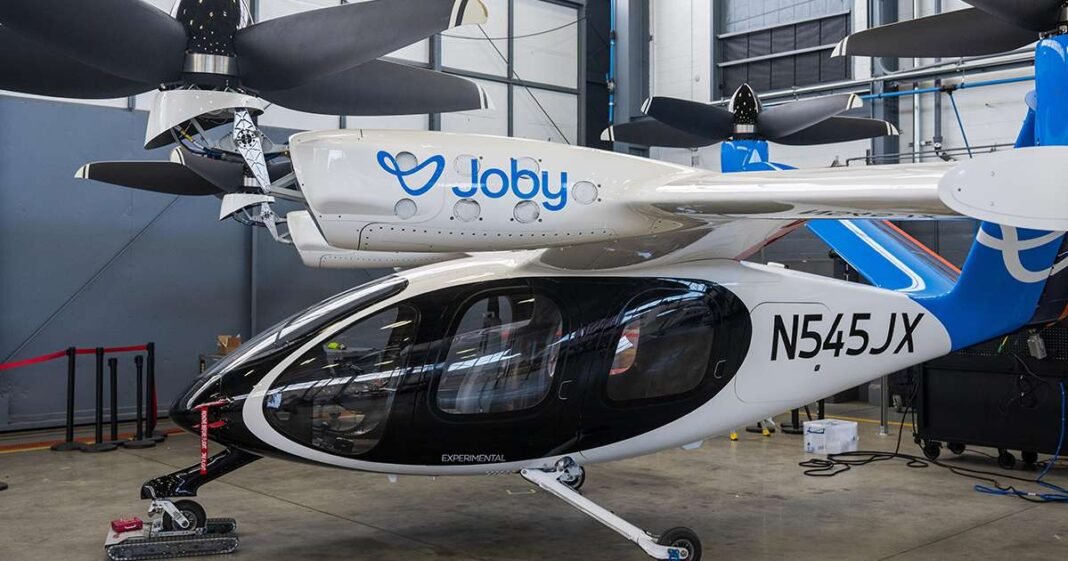

A pre-production prototype eVTOL aircraft at Joby’s facility in Marina. (Nic Coury/Bloomberg)
February 13, 2026 11:29 AM, EST
Toyota Motor Corp. is safeguarding its nearly $1 billion investment pledge to air taxi maker Joby Aviation Inc. by troubleshooting production processes and mulling a deeper manufacturing role.
The Japanese automaker, which last year became Joby’s largest shareholder, has a team of almost 200 employees working to supply critical parts, training tips and assembly line know-how. That involves deploying a set of lean manufacturing precepts known as the Toyota Production System, or TPS, said Sandy Lobenstein, Toyota’s group vice president of flying mobility.
“We’re really trying to bring TPS and the philosophy of TPS into the operations here,” Lobenstein told reporters on a tour of Joby’s factory. “Those types of innovations are helping to improve the lead time to production and scaling.”
Joby is among a handful of startups developing eVTOL aircraft — electric vertical takeoff and landing vehicles — to fly customers on short commuter journeys via battery-powered air taxis. The Santa Cruz, Calif.-based firm is currently set up to make one aircraft a month, but plans to boost that to as many as four per month by 2027.
Shares of Joby, which will report fourth-quarter earnings on Feb. 25, are down about 23% this year. They fell sharply last month after the company announced a $1 billion equity and convertible bond offering to raise cash. The stock rose 2.9% to $10.16 as of 10:35 a.m. in New York on Feb. 13.
Save the date: Joby’s Q4 and FY 2025 earnings call is set for Wednesday, February 25, 2026, at 5:00 pm ET.
Tune-in for our latest financials and operational progress.
Read the full announcement ⬇️ pic.twitter.com/uTqusMsxSo
— Joby Aviation (@jobyaviation) February 11, 2026
Full certification for commercial flight operations by the Federal Aviation Administration and regulators in other countries is still pending. Joby previously said it aimed to start commercial passenger services in Dubai by early this year, but the exact timeline is unclear. It has pushed back earlier goals to begin service from 2024 and then 2025.
“We are targeting to be able to start carrying passengers this year,” Eric Allison, Joby’s chief product officer, told reporters.
Stress-Testing
As it awaits certification — and the final $250 million tranche in Toyota’s promised $894 million in funding — the company is assembling prototype aircraft and stress-testing parts and manufacturing processes. Joby wouldn’t specify the defect rate for parts undergoing testing, but Allison said the number of nonconforming components is “trending in the right direction.”
The car giant is now considering a proposed strategic manufacturing alliance to strengthen its relationship further ahead of Joby’s planned production ramp-up. Joby has said it aims to make as many as 500 aircraft a year once it builds out facilities in California and Ohio.
Toyota began financing Joby in 2020, two years after its venture capital arm participated in a funding round. It has taken on a larger role as its investment has grown. Toyota’s Lobenstein was tasked with overseeing the partnership a year ago.
Transport Topics reporters Eugene Mulero and Keiron Greenhalgh examine the critical trends that will define freight transportation in the year ahead. Tune in above or by going to RoadSigns.ttnews.com.
For now, Toyota’s main role is advisory, in addition to supplying key subcomponents for Joby’s aircraft motors. The automaker’s North American manufacturing chief, Kevin Voelkel, has visited Joby’s operations twice, most recently this month, to share tips on things like improving efficiency and safety.
Visible signs of Toyota are scant at Joby’s main production hub near Monterey, Calif. Unlike the carmaker’s own plants or even Honda Motor Co.’s jet factory in North Carolina, there’s no central assembly line. Parts are assembled at various separate workstations in a hangar and then transported by truck to a nearby Quonset hut for final assembly.
Also absent are Toyota’s trademark andon cords to flag problems, robots pushing parts bins and wall-hung banners exhorting workers that “Safety is No. 1!” Toyota currently has about 30 employees on site.

