
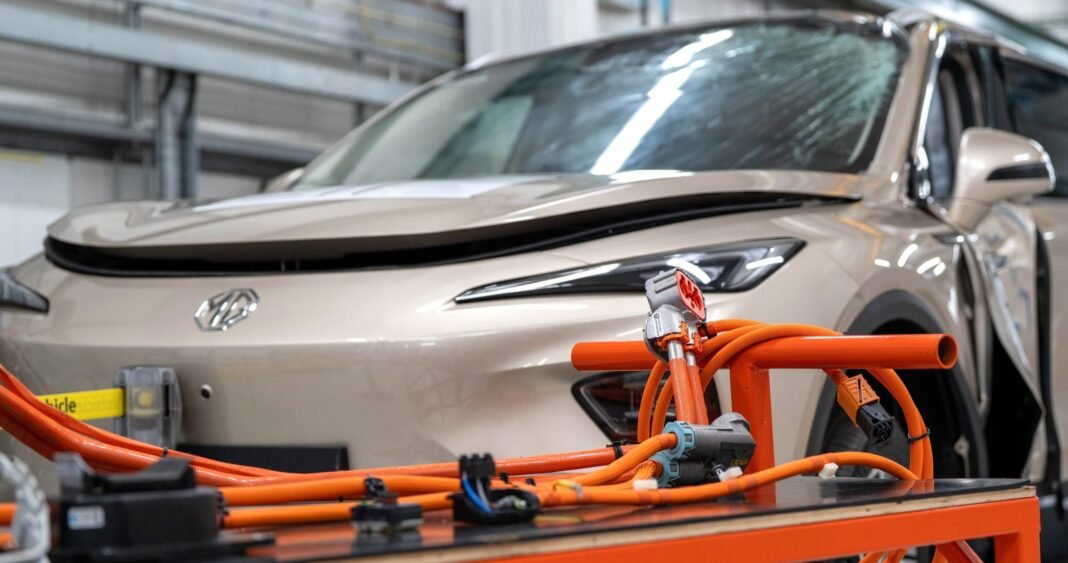

Thatcham Research has unveiled a comprehensive new EV Blueprint aimed at addressing the growing challenge of insurability and repair costs for battery electric vehicles. The initiative seeks to prevent repairable EVs from being unnecessarily written off, ensuring both consumer confidence and economic sustainability as the adoption of electric vehicles accelerates.
Image: Thatcham Research
Over the past five years, the automotive industry has made significant progress in understanding EV safety. First responders now have clear protocols to safely manage high-voltage systems after collisions, and UK repair centres can identify EVs and apply safety measures to protect technicians. With this foundation in place, the focus is shifting from basic safety awareness to improving recovery, assessment, and repair efficiency in a way that is commercially viable.
Despite these advances, operational challenges remain. A recent survey by Thatcham Research in partnership with the Centre for Economics and Business Research (CEBR) found that battery-related issues are the primary concern for 44.6% of insurers and 41.7% of repair professionals. With EV batteries accounting for up to 40% of a vehicle’s total value, even minor collision damage often triggers total loss decisions, especially as vehicles age.
Dan Harrowell, Principal Engineer for Advanced Technologies at Thatcham Research, said: “How affordable it is to insure these cars largely relies on how well the industry can handle repairs after accidents. As repair shops have become more experienced with EV technology, repair costs have already decreased by 10.7%. To continue making insurance more affordable, manufacturers, insurers and repairers must collaborate to overcome remaining challenges. This blueprint provides the roadmap to ensure both environmental benefits and economic sustainability for consumers.”
Eight recommendations for industry adoption
The EV Blueprint establishes eight key recommendations designed to improve safety, repair efficiency, and economic viability:
- Resettable Emergency Safety Loop – Safety systems should be resettable without permanent damage or extensive component replacement.
- Safe and Simplified Battery Handling – Battery removal and reinstatement must be straightforward, avoiding complex or subscription-based tools.
- Vehicle Damage Assessment Guidelines – Clear methodologies for assessing battery damage should be accessible to insurers and independent repairers.
- Accessible Diagnostics – High-voltage diagnostics should use standard, widely available equipment, similar to conventional On-Board Diagnostics.
- Battery Damage Protection – Batteries should be shielded against impacts with replaceable protective components at reasonable costs.
- HV Battery Repair Strategies – Repairs should be achievable without removing entire battery packs, and pyrotechnic fuses should be easily reset or replaced.
- Serviceability of HV Batteries – Batteries should allow safe disassembly with modular construction and removable fasteners for refurbishment or remanufacturing.
- HV System Component Design – Key components like charge ports should be positioned in less vulnerable areas and designed for standalone replacement.
These recommendations are underpinned by three principles: Safety, Sustainability, and Affordability, ensuring EVs are safe for all users, support a circular economy for high-voltage batteries, and remain cost-effective to repair.
Image: Thatcham Research
Thatcham Research highlights that current repair protocols often result in total loss for minor battery casing damage. Under the EV Blueprint, damaged components could be repaired or replaced with cost-effective refurbished units, keeping vehicles on the road while preserving battery life. Real-world testing of over 8,000 electric cars and LCVs shows that 8-9-year-old vehicles retain around 85% of battery capacity, while 4-5-year-old EVs maintain a median state of health of 93.5%.
Dan Harrowell added: “This represents an achievable future. Vehicles return to service quickly, salvage values improve, and environmental impact is reduced compared to manufacturing a new battery. Batteries have long operational lives, and we should maximise that through sustainable repair practices.”
The EV Blueprint addresses post-collision diagnosis, assessment, and repair execution, aiming to reduce unnecessary write-offs, improve residual values, and influence insurance premiums. Thatcham Research calls on vehicle manufacturers, battery producers, insurers, repairers, and training providers to adopt these recommendations to ensure EVs remain economically viable.
Jonathan Hewett, CEO of Thatcham Research, said: “The transition to electric vehicles is one of the most significant transformations our industry has faced. It cannot succeed if EVs become uneconomical to insure and repair. Too many repairable vehicles are written off because current designs do not allow efficient assessment and repair. Our EV Blueprint is evidence-based and practical, showing that vehicles can be safely assessed, repaired efficiently, and economically maintained throughout their lifecycle. We want to work with the industry to create an EV ecosystem that is sustainable not just environmentally, but financially and practically for millions of consumers.”

