
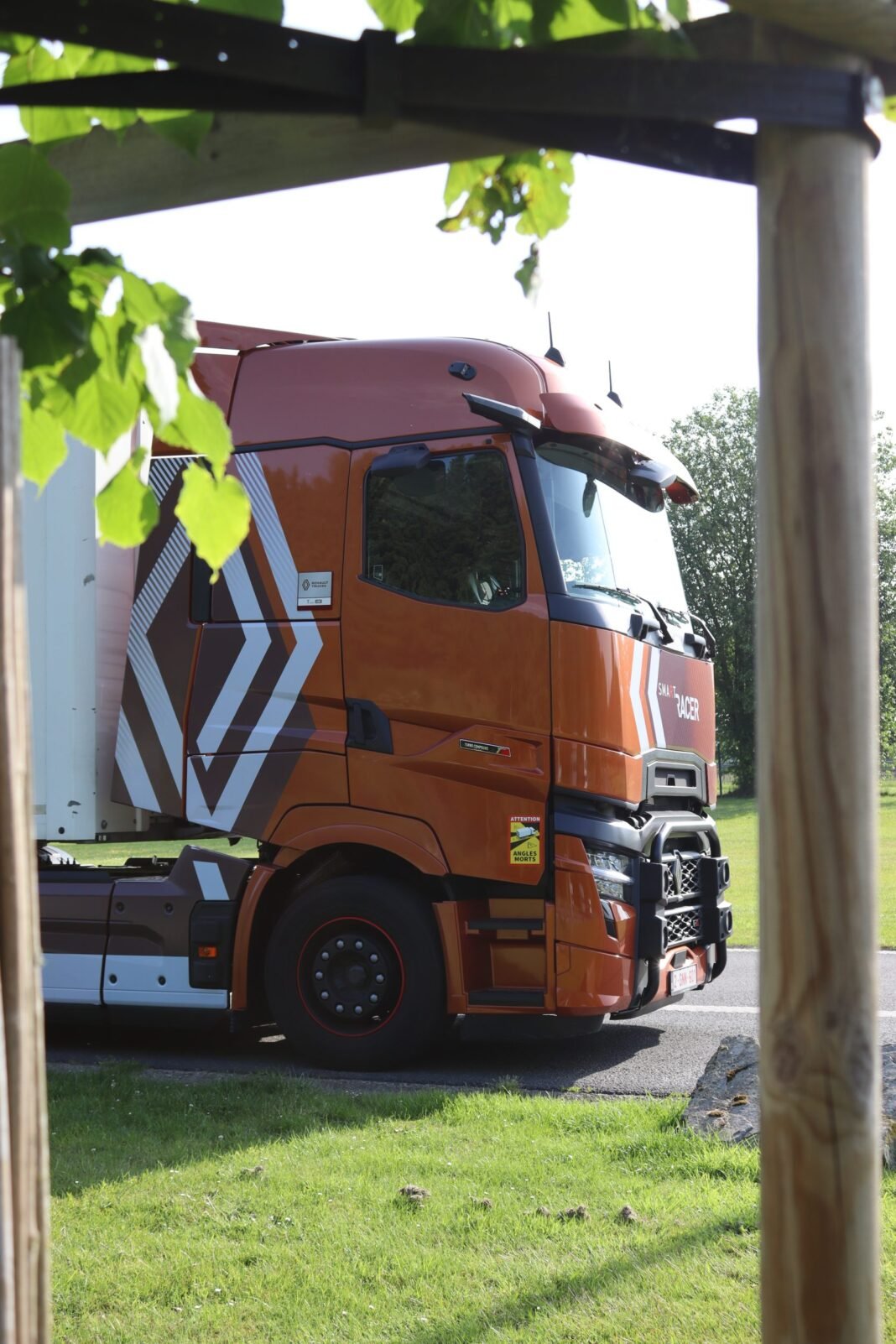

At Renault Trucks we have to go back to 2013 for the renewal of the entire range. In 2021, the manufacturer proposed new evolutions in the field of comfort, aerodynamics and technology. It had been a very long time since we had been able to test a T, and the curiosity was great.
Step by step, the Renault Trucks T has been given an aesthetic update. The latest example of this: the arrival of cameras to replace the classic mirrors, which means that Scania is now the only one still sticking to traditional technology.
More pronounced exterior design
In addition to the cameras, we also appreciate the more compact headlights, which leave more painted surface area on the body. And since the grille often radiates the identity of the truck, the T is not inferior to anyone. The ‘identity card’ on the side of the cabin – a Renault exclusive – also received a more modern design.
Ergonomics and comfort. Since 2021, you can ideally adjust the steering column via a pedal on the left on the floor, with a triple adjustment option. You can also fold them up completely. To the right of the steering wheel, the driver has a screen that, in a touchscreen version, displays a lot of information per category. As befits a modern truck, there are several USB-C connections.
Storage space. In addition to the storage space in the door, there is the central storage drawer at the bottom of the dashboard, which can accommodate A4 documents even when closed. On the right, on the passenger side, two compartments together offer 7 liters of extra space (2 liters of which are cooled). If you add the four outside compartments, the driver has more than enough space. There is also space on top of the dashboard to put things down, with – as is known – the fuse box below.
For a night’s sleep there is a 17 cm thick mattress, finished with a memory foam topper. The swiveling passenger seat comes in handy during rest breaks. A new feature is a folding table; her arm is attached to the dashboard and you can use it not only from the driver’s seat, but also from the passenger seat and from the bed. For extra peace of mind during rest breaks, there is also a mechanical anti-burglary system (Safety Door-Lock).
Impression in the cabin. At T-High you climb four steps before you get in. The flat floor is now at a height of more than 160 cm! The key must of course be present in the cabin, but you no longer have to turn it to start. The Start button is sufficient, although you must carefully follow the three steps provided.
The driver also has to get used to the camera screens. There are only two, because the front and sidewalk mirrors are retained. The French manufacturer believes that omitting it hardly yields anything in terms of fuel savings. However, when activating the right turn signal, an additional camera image appears on the central screen thanks to a lens under the arm of the camera.
The new steering wheel offers more comfort due to its shape, diameter and control buttons. Everything is now ideally located on either side of the handlebars. For example, it has become much easier to activate the Cruise Control. The main combination lever to the right of the steering wheel groups the functions of the automated gearbox: driving modes, manual shifting or up/down gears. The controls remain free, so that the driver can always intervene.
Guided driving experience
The auxiliary braking systems are operated via a second, finer lever behind that of the gearbox. For those who are not used to it, it can be a bit confusing, but it is not really a nuisance, as the Cruise Control takes over most of the work. It is also striking that the power steering works together with an electric motor that continuously adjusts driving behavior via sensors to the movements of the truck and the driver’s intentions. This ensures more stability at high speed and more flexibility at low speed – resulting in higher driving comfort.
Performance & consumption. As a reminder, the TurboCompound system recovers heat energy that is normally lost. This heat is converted by the system into mechanical energy delivered directly to the crankshaft, which increases engine torque. This provides better performance at low speeds. Our test went well, although the semi-trailer was classically equipped (without the usual side skirts) and the total weight was 32 tons instead of 40.
Thanks to the confidence in the predictive cruise control Optivision, we recorded an average of 23.5 l/100 km. In the previous test, with Sleeper Cab and 40 tonnes total weight, this was 26.1 l/100 km. The effect of weight therefore remains a decisive factor in consumption.

