
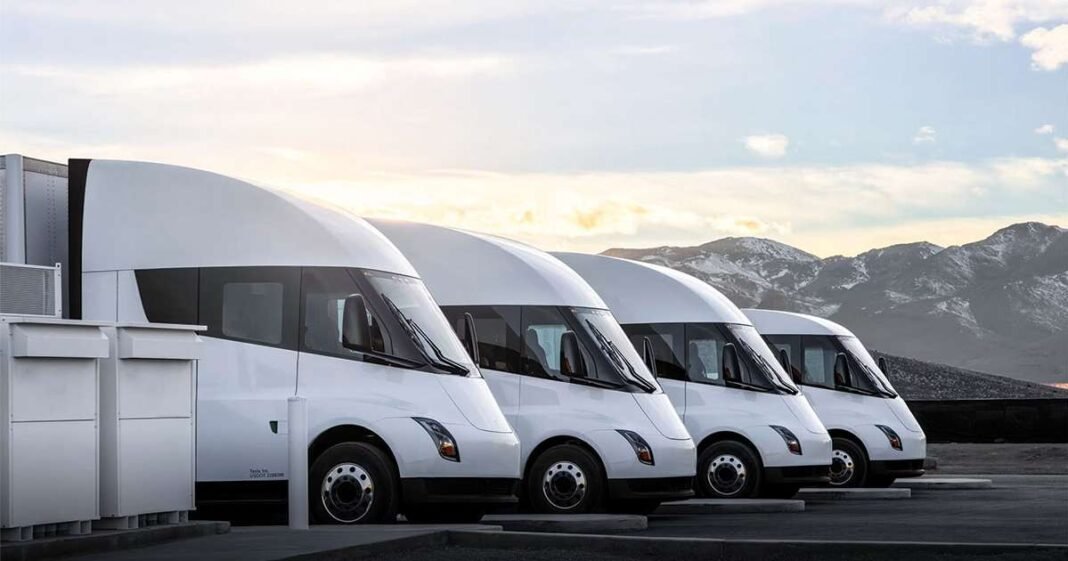

Both the 325- and 500-mile variants of the Semi will be capable of charging up to 60% of their range in 30 minutes and achieving energy consumption of 1.7 kilowatt-hours per mile. (Tesla Inc.)
February 10, 2026 3:00 PM, EST
Key Takeaways:
- Tesla confirmed it will offer standard and long-range versions of the Semi with ranges of about 325 miles and 500 miles.
- The disclosure matters because it clarifies long-speculated specifications as Tesla prepares to scale production and carriers test the trucks in freight operations.
- Tesla says high-volume production will start this year as it completes Reno factory buildout and partners expand charging sites.
Tesla will offer two versions of its long-awaited Class 8 battery-electric tractor, the Semi, the electric vehicle manufacturer confirmed.
Details on standard offerings and options available to customers interested in the much-ballyhooed truck were closely held information until Tesla publicly released specifications for the tractor Feb. 8. In particular, the company confirmed there will be standard and long-range options available.
Fleets including ArcBest, DHL Supply Chain and PepsiCo have been testing the Semi in their operations.
ArcBest ranks No. 13 on the Transport Topics Top 100 list of the largest for-hire carriers in North America. DHL Supply Chain (North America) ranks No. 13 on the TT Top 100 list of the largest logistics companies in North America. PepsiCo was Tesla’s first test partner and ranks No. 2 on the TT Top 100 list of the largest private carriers in North America.
The standard truck will have a range of about 325 miles, while the long-range version’s range will be about 500 miles.
When the Semi was unveiled back in 2017, Tesla CEO Elon Musk’s boast was that it would have a 500-mile range, but he also said there would be a less powerful version.
The standard version has a curb weight of less than 20,000 pounds, while the long-range option tips the scales at 23,000 pounds, according to the company, indicating the latter will come with more batteries. Each one has a powertrain comprising three independent motors on rear axles and drive power of up to 800 kilowatts. Both will be capable of charging up to 60% of their range in 30 minutes and achieving energy consumption of 1.7 kilowatt-hours per mile.
The lower an energy consumption rating, the greater the potential returns a carrier could wring out of a battery-electric truck, proponents say.
Tesla said in a presentation Jan. 28 accompanying the release of its fourth-quarter 2025 earnings that its Reno, Nev., plant was tooling up and remained on schedule to ramp up production in the first half of 2026.
On Feb. 8, Musk wrote on social media platform X that “Tesla Semi starts high volume production this year.”
Tesla Semi starts high volume production this year https://t.co/yZLDmkA9EP
— Elon Musk (@elonmusk) February 8, 2026
The Semi factory in Reno is capable of producing up to 50,000 vehicles per year, according to Tesla.
Construction of the factory building in Reno was completed in October, and installation of the production line was ongoing, Tesla Vice President of Vehicle Engineering Lars Moravy told investors and analysts during Tesla’s third-quarter 2025 earnings call. Site work at the facility started in 2023 next to Tesla’s existing Gigafactory Nevada. At the time of the truck’s 2017 unveiling, Tesla slated it for a production launch of 2019.
Meanwhile, Tesla is building out the infrastructure required to charge and sell the Semi.
Transport Topics reporters Eugene Mulero and Keiron Greenhalgh examine the critical trends that will define freight transportation in the year ahead. Tune in above or by going to RoadSigns.ttnews.com.
Pilot Travel Centers said in late January that it was teaming up with the manufacturer to build a series of charging stations for the Semi, mostly in Western states. Charging stations will be built at about 20 Pilot truck stops along interstates 5 and 10 plus several other major freight corridors, with the first opening in the summer, the partners said Jan. 27.
Construction of the facilities will start in the first half of 2026 at truck stops in California, Georgia, Nevada, New Mexico and Texas, they added.
In addition to the Pilot partnership, Tesla laid additional groundwork for the launch of the Semi by revealing a specialist sales program in September.
The company teamed up with Uber Freight on an all-inclusive program for carriers that will package trucks, charging infrastructure and guaranteed freight as a means of jump-starting appetite for the Semi.
Uber Freight ranks No. 14 on the logistics TT100.

