
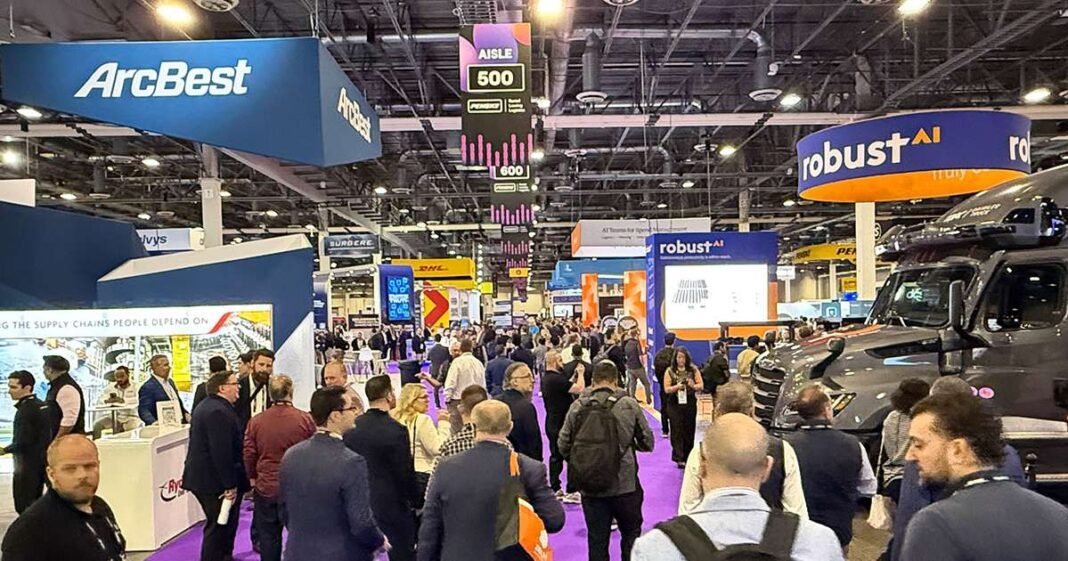

Attendees explore the show floor at Manifest 2026 in Las Vegas. (Seth Clevenger/Transport Topics)
February 12, 2026 1:30 PM, EST
Key Takeaways:
- Speakers outlined how shippers and logistics providers are adopting AI, automation and robotics to build more resilient supply chains amid constant disruption.
- Executives from companies including American Eagle Outfitters, Scotts Miracle-Gro and DHL Supply Chain said AI-driven forecasting, inventory optimization and robotics are becoming essential.
- Industry leaders expect greater investment in automation, nearshoring and AI-enabled decision-making, while companies continue testing autonomous trucks, cargo security tech and warehouse robots.
LAS VEGAS — Shippers, logistics providers and technology developers are increasingly harnessing artificial intelligence and automation to improve supply chain efficiency and become more resilient in an increasingly unpredictable world.
This embrace of technology was clear at the Manifest 2026 supply chain conference, where speakers on stage and exhibitors on the show floor presented many different ways for the transportation sector to become smarter and faster by implementing AI and robotics.
Those gains in efficiency and business intelligence will be crucial as supply chain leaders navigate a period that Jake Barr, CEO and principal of BlueWorld Supply Chain Consulting, described as “the new never normal.”
“You’re in this constant state of needing your supply chain and your operation to deal with continued disruption, not just infrequent disruption,” Barr said during a main-stage session at the event, which ran Feb. 9-11.
Brandon Friez, senior vice president of global logistics and supply chain intelligence at apparel retailer American Eagle Outfitters, outlined how his company has positioned itself to adapt to ever-changing business conditions.
AEO, which operates the American Eagle, Aerie, Todd Snyder and Unsubscribed clothing brands, has implemented AI to forecast demand down to the ZIP code level, reposition inventory as needed and optimize logistics and mode selection based on capacity and cost.
“We believe that volatility can actually create opportunity,” Friez said.
Brandon Friez (right) of AEO Inc. and Jake Barr of BlueWorld Supply Chain Consulting discuss supply chain innovation. (Seth Clevenger/Transport Topics)
A year ago, when AEO was contending with the effects of new tariffs, the company ran simulations across its network to support decision-making on the best ways to respond.
Friez emphasized the importance of collecting high-quality data that leads to business insights.
“When you think of good data, it’s got to be accurate, it has to be timely, and it’s got to be actionable,” he said.
In this time of change and disruption, shippers will need to constantly re-evaluate their operations and processes and explore ways to make them better.
“A static supply chain is a dead supply chain, because it’s always evolving,” Friez said.
David Huskisson, head of enterprise transformation at Scotts Miracle-Gro Co., discussed how his company has improved efficiency by applying AI.
“The opportunities are endless, and I think you have to be focused on where you start,” he said.
Scotts Miracle-Gro identified an opportunity to harness its unique data on consumer behavior in the lawn and garden space to better manage its inventory levels.
“Frankly, the math equation was not something a human could solve, and we really leaned in on AI there,” Huskisson said. “We were able to reduce our year-ending average inventory by $600 million by being more predictive through the data that we had.”
From left: DHL’s Gretchen Torres, Jonathan Tam of Figs, David Huskisson of Scotts Miracle-Gro and DHL’s Will Heywood talk about supply chain trends. (Seth Clevenger/Transport Topics)
Dave Yoder, group director for product development and innovation at Ryder Supply Chain Solutions, noted that industry conversations about AI have matured during the past couple years.
As managers have incorporated AI into their own work lives, they’ve gained a better understanding of what it can and cannot do and how it can apply to their businesses, he said.
Yoder also emphasized the importance of laying a good foundation for AI deployment by collecting the right data and mapping out business processes.
“If you don’t already have a decision-making framework in place, AI automation or agentic AI is not going to provide you value,” he said.
Ryder System ranks No. 7 on the Transport Topics Top 100 list of the largest logistics providers in North America and No. 6 on the TT Top 100 for-hire carriers list. It also ranks No. 40 on the TT Top 50 list of the largest global freight companies.
Supply Chain Outlook
During Manifest, contract logistics provider DHL Supply Chain presented the results of a research project dubbed “Insight 2030,” which reflects the collective views of 350 North American supply chain leaders.
“What stood out in this research is just how strongly leaders now view supply chain’s strategic role in their overall business success,” said Will Heywood, chief customer officer at DHL Supply Chain.
Looking ahead to 2030, participants generally predicted greater dependence on AI, continued investment in the supply chain and increased reliance on robotics to automate routine tasks, said Gretchen Torres, DHL Supply Chain’s vice president of marketing and engagement.
Beyond technology, supply chain leaders anticipate bigger and more complex networks, higher transportation costs, higher labor costs and a risk environment “that’s not easing up,” Heywood said, adding that 65% expected investments in supply chain nearshoring to better manage trade uncertainty and build resilience.
Transport Topics reporters Eugene Mulero and Keiron Greenhalgh examine the critical trends that will define freight transportation in the year ahead. Tune in above or by going to RoadSigns.ttnews.com.
“The mandate is clear,” Torres said. “We need more speed; we need more visibility; we need smarter orchestration without all of the exacerbated costs to get there.”
In addition, 73% of decision makers expect robotics to shape their operations, yet only 44% have deployed them today.
Meanwhile, 62% expect international tensions to impact their operations by 2030.
DHL Supply Chain ranks No. 13 on the logistics TT100 and DHL Group is No. 5 on the global freight TT50.
Automation, Robotics and Cargo Security
The Manifest exhibit hall featured a broad range of innovations, logistics software and supply chain services from technology startups, third-party logistics providers and equipment manufacturers.
Many exhibitors showcased various forms of warehouse automation and robotics designed to improve throughput and assist workers.
Others highlighted AI agents developed to automate various aspects of freight operations.
Torc Robotics exhibits a truck equipped with its autonomous driving system. (Seth Clevenger/Transport Topics)
The show floor also featured Class 8 trucks equipped with autonomous driving systems developed by Aurora Innovation and Torc Robotics.
RELATED: Aurora Expands Driverless Network for Runs to Phoenix
Meanwhile, trailer manufacturer Wabash unveiled a cargo security system that combines a digitally connected trailer door and intelligent locking system with the TrailerHawk.AI technology platform.
The patent-pending system incorporates driver and carrier identity verification, chain-of-custody data and real-time alerts to help prevent cargo theft and trailer damage.
Wabash unveils a cargo security system combining a digitally connected trailer door with TrailerHawk.AI technology platform. (Seth Clevenger/Transport Topics)
“This industry can no longer afford to rely on disconnected cargo security tools that lack true access control and don’t verify who is touching the freight,” said Brett Suma, managing director at Wabash.
The system will be available as a retrofit or as an option on new 2027 Wabash trailers.
Elsewhere in the exhibit hall, Pickle Robot showcased a video demonstration of its automated trailer unloading system, which essentially acts as a robotic lumper for certain cargo types.
RELATED: UPS Purchases 400 Robots to Unload Trucks in Automation Push
A worker uses a gamelike controller to guide the system onto a trailer or shipping container, where it then uses computer vision and a robotic suction arm to pick up small boxes and place them on a conveyor belt.
Mike Fair, senior director of product at Pickle Robot, said the system helps address labor challenges associated with a tough job that can involve heavy lifting for long hours, often in hot or cold environments.
“Robots have always been about solving the dull, dirty and dangerous jobs,” he said.
Manifest’s organizers said the event drew more than 7,000 attendees and over 400 exhibitors.

