
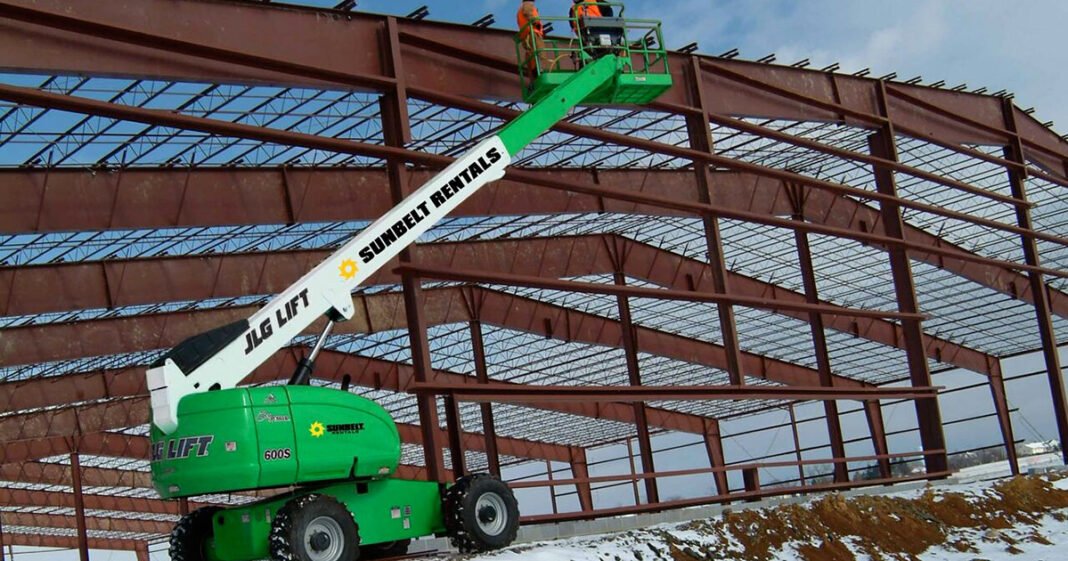

Sunbelt ranks No. 20 on the Transport Topics Top 100 list of the largest private carriers in North America and No. 2 on the equipment rental sector list. (Sunbelt Rentals via LinkedIn)
March 2, 2026 5:30 PM, EST
Equipment rental company Sunbelt Rentals Holdings made its U.S. stock-market debut March 2, amid a recent rush by investors into asset-heavy, capital intensive businesses that can’t be replaced by artificial intelligence.
The company, which previously had its primary listing in London as Ashtead Group, is now one of the largest U.S.-listed players in the sector. Ashtead’s shares ended Feb. 27 with a market value of about 22 billion pounds ($30 billion).
Sunbelt shares closed March 2 trading on the New York Stock Exchange at $73.79, a 3% gain. They closed Feb. 27 in London at 53.26 pounds, roughly equal to $71.66, according to the company.
Sunbelt ranks No. 20 on the Transport Topics Top 100 list of the largest private carriers in North America and No. 2 on the equipment rental sector list.
Before the conflict in Iran grabbed their attention, investors were dumping anything they feared new AI tools could disrupt, from real-estate services companies to payment firms. They piled into companies that make or move physical goods, sending the S&P 500 Industrials Index to record highs.
A stock like Sunbelt “should act well under the scenario where people are looking for heavy assets,” said Matt Maley, chief market strategist at Miller Tabak + Co.
Shares of Ashtead traded in London climbed 14% in February, about double the benchmark FTSE 100 index’s near 7% advance, as what is now called the “HALO” trade — “heavy assets, low obsolescence,” gathered pace.
But HALO isn’t a guarantee of success. Though shares of U.S. peers United Rentals (No. 13 on the private TT100 and No. 1 on the sector list) and Herc Holdings (No. 36 on the private TT100 and No. 3 on the sector list) jumped double digits in the first week of February, both ended the month lagging the S&P 500 industrials index, which rose 10%.
US Move
Sunbelt generates more than 90% of its revenue in North America and sees the move to the U.S. as a way to align its investor base and its business.
Sunbelt CEO Brendan Horgan said the company’s specialty offerings — such as heavy-duty power generation equipment and complex scaffolding — help it win business related to massive construction plans like data centers and infrastructure projects.
“This is a generational period. This is not a flash in the pan,” he said. “Megaprojects will be a rich part of the end markets we serve for the rest of our career.”

